Tujunga, Los Angeles
Updated · 27,884 residents
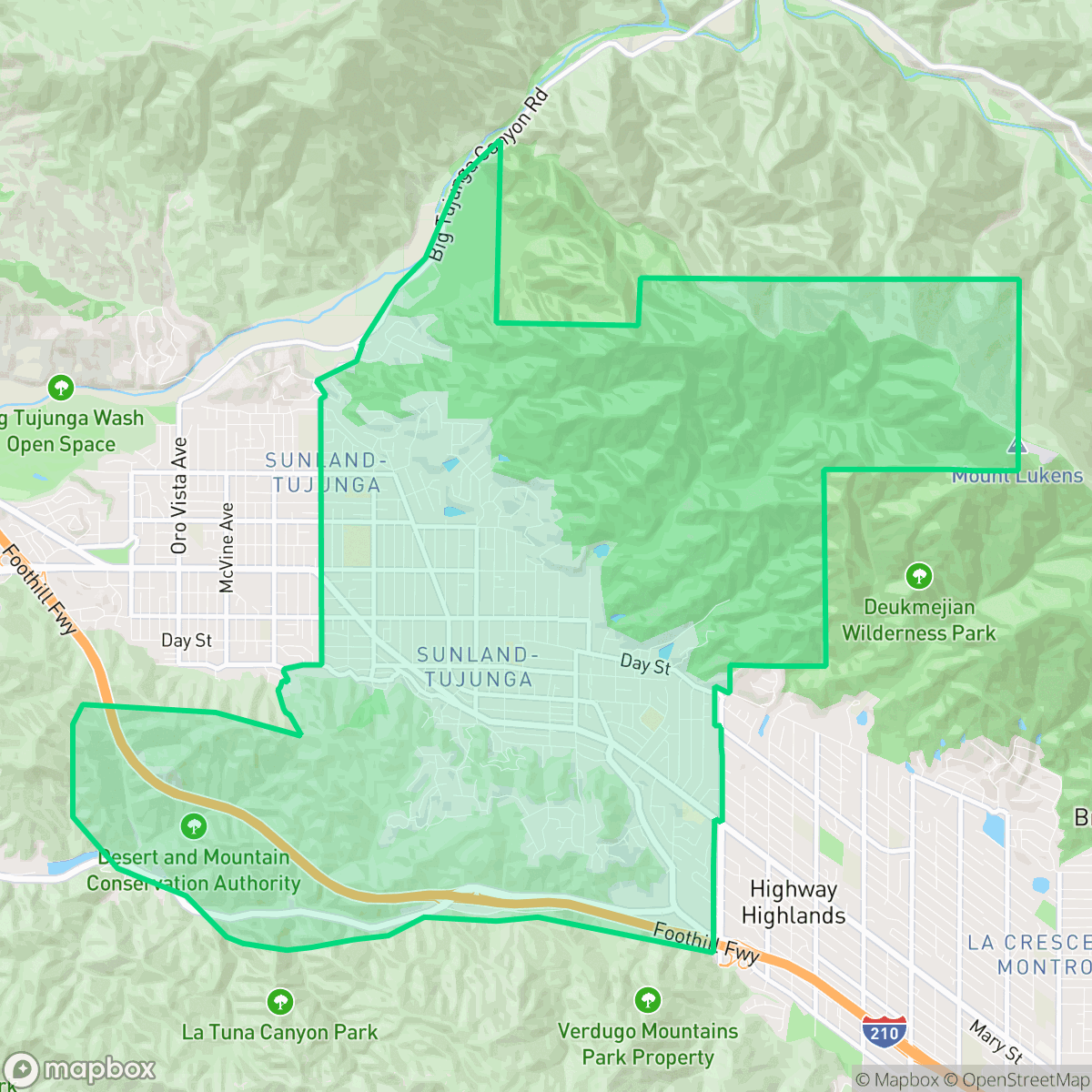
Tujunga is a quiet, hilly community located between the San Gabriel Mountains and the Verdugo Hills, known for its scenic landscape and suburban character. While the area offers a peaceful environment with good air quality and access to nature trails, it remains a largely car-dependent neighborhood with limited local commercial density.
Key Highlights
About Tujunga
Nestled between the San Gabriel Mountains and the Verdugo Hills, Tujunga’s name derives from a Tongva word meaning 'old woman’s place'. In 1911, developer M.V. Hartranft and social philosopher William Ellsworth Smythe established the 'Little Lands' utopian agricultural colony here under the motto, 'A Little Land and a Lot of Living'. This movement inspired early settlers to build unique homes using local river rocks and boulders. The neighborhood’s architectural heritage is anchored by Bolton Hall, a 1913 stone community center that later served as Tujunga’s city hall before its 1932 annexation to Los Angeles. Another key landmark is Rancho Chupa Rosa, the 1923 home of California Poet Laureate John Steven McGroarty, which now operates as the McGroarty Arts Center.
The neighborhood functions as a suburban-urban transition zone where dense residential grids meet the rugged terrain of the Verdugo Hills. Residents benefit from a quiet, low-density atmosphere that feels removed from the typical bustle of Los Angeles, characterized by a mix of single-family homes and modest multi-unit blocks. The area maintains a strong connection to its natural surroundings, offering residents immediate access to hillside trails and green spaces that are ideal for outdoor recreation. While it lacks a high concentration of commercial hubs, the neighborhood provides a consistent, pedestrian-friendly layout in its residential cores, supported by a network of sidewalks and well-defined streets.
Prospective residents should consider the trade-offs of living in a mountain-adjacent area, particularly regarding environmental safety, as the neighborhood faces a notably high fire risk. Educational needs are met by a combination of schools within the Glendale Unified and Los Angeles Unified school districts, providing a range of options for families. Because local services and businesses are sparse, the lifestyle here is largely car-oriented, making it best suited for those who prioritize a serene, nature-adjacent residential environment over proximity to urban nightlife or dense retail corridors.
Neighborhood Scores Across 15 Qualities
Housing density varies between multi-unit blocks and detached single-family homes, offering more personal space than the Los Angeles average. While some neighbors live in close proximity, many properties maintain a buffer of yards and side spacing.
Pedestrian movement is supported by established sidewalk networks and clear crossings throughout most residential blocks, though overall walkability is lower than the Los Angeles average.
Large, well-maintained homes and frequent private backyard pools characterize many parts of this area. According to iHuus data, the neighborhood offers a higher level of visual amenity and property scale than the Los Angeles average.
Proximity to large hillside nature preserves and dirt trails offers superior opportunities for dog walking compared to the Los Angeles average. While many residential sidewalks have narrow verges, the neighborhood provides excellent access to expansive green spaces for exercise.
Vast green open spaces and hillside topography dominate the built environment, offering a more rural atmosphere than the typical Los Angeles urban landscape. According to iHuus data, the area features a mix of scattered homes and undeveloped natural terrain.
A blend of serene, rural landscapes and lively suburban pockets provides a steady rhythm of life, though most areas remain car-dependent with limited commercial density. While some blocks feature diverse dining and local social hubs, much of the neighborhood is characterized by vast open spaces and minimal business activity, making it comparable to the city average for liveliness.
Steady sounds from local traffic on nearby busy streets are common, though levels remain more tranquil than the city average. According to iHuus data, the area experiences a consistent hum of activity without the extreme noise levels found in denser parts of Los Angeles.
Air quality in this area remains high with rare instances of elevated readings. This level of air cleanliness is roughly in line with the average found across Los Angeles.
Residential and light commercial zones define this area, with no heavy industrial facilities or warehouses detected. According to iHuus data, this neighborhood is notably freer from industrial hazards than the Los Angeles average.
Health insurance access is notably higher than the Los Angeles average, providing residents with better stability for managing medical costs. According to iHuus data, the majority of the population maintains coverage.
Political leanings here are more moderate than the broader Los Angeles area, featuring a liberal majority with a notable presence of opposing viewpoints. According to iHuus data, the area lacks the intense progressive concentration found elsewhere in the city.
Residents live alongside a balanced demographic of young professionals, families, and seniors. This age distribution is slightly more varied than the typical Los Angeles profile, according to iHuus data.
Flood risk in this area is higher than the Los Angeles average, though official FEMA studies for this specific location remain incomplete. Residents should remain aware of potential drainage concerns during heavy rain events according to iHuus data.
Wildfire risk is exceptionally high in this area, significantly exceeding the Los Angeles average. Residents should prioritize extreme fire protection measures due to the severe landscape vulnerability identified in iHuus data.
Address-Level Insights for Tujunga


iHuus Neighborhood Intelligence Insights
Get address-level neighborhood insights for Tujunga
- Street-level scores — see how individual blocks compare, not just neighborhood averages
- Micro-zone boundaries — identify quiet pockets, flood boundaries, and walkable clusters before you visit
- 15 dimensions in full — walkability, noise, air quality, school quality, insurance coverage, population age profile, urban/rural index, and more
- Boundary risk alerts — know if your address sits near a block boundary where scores drop, the kind of detail no listing will ever mention
- School insights — individual school ratings and insights, not just district-level data
- Compare before you commit — side-by-side data across neighborhoods, down to block precision
No credit card required
Compare with Any Neighborhood
| Dimension | Tujunga | Adams-Normandie |
|---|---|---|
| 🚶 Walkabilityavg 8.9 | ||
| 🔊 Acoustic Comfortavg 2.91 | ||
| 🤫 Privacy Indexavg 4.14 | ||
| 🎨 Visual Appealavg 6.58 | ||
| 🐕 Dog Friendlinessavg 5.04 | ||
| 🗺️ Urban-Rural Indexavg 5.96 | ||
| ✨ Neighborhood Vibeavg 5.07 | ||
| 🏥 Health Insurance Coverageavg 6.2 | ||
| 🌿 Air Qualityavg 8.12 | ||
| 🏭 Industrial Proximityavg 8.46 | ||
| 🌊 Flood Safetyavg 2.66 | ||
| 🗳️ Ideological Leanavg 9.56 | ||
| 👥 Population Age Profileavg 4.85 | ||
| 🔥 Fire Safetyavg 0.18 | ||
| 🏫 School Quality |
Tujunga Rankings
School Districts Serving Tujunga
School Insights for Tujunga
Below average outcomes; significant attendance and academic challenges.
School Insights
See what's really behind every school rating near Tujunga
- Individual school ratings — each school's own score with outcome context, not just a district average
- Enrollment & class size data — student-to-teacher ratio and how it compares to the state average
- Full demographics breakdown — ethnicity and gender composition for every school in the enrollment zone
- Every school in the district — all schools within the enrollment boundary ranked by rating, not just the closest one
- Grade levels & benchmarks — elementary through high school, with below/above state-average flags
No credit card required