Tarzana, Los Angeles
Updated · 37,194 residents
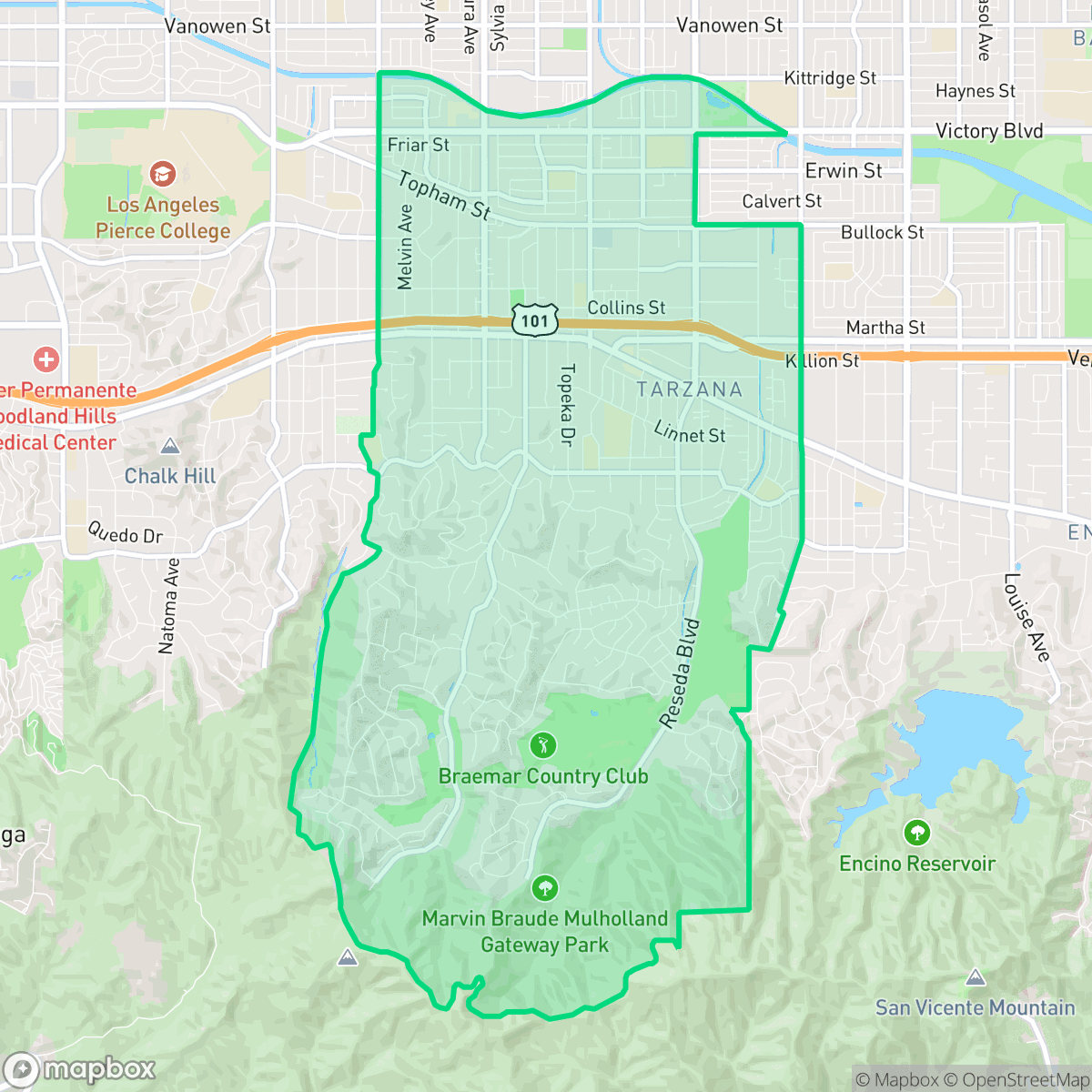
Tarzana is a suburban neighborhood in the San Fernando Valley characterized by its mix of detached homes and multi-unit complexes. While it offers a visually appealing environment with well-maintained landscaping, the area remains primarily car-dependent due to its layout and proximity to major highways.
Key Highlights
About Tarzana
Originally part of the 1797 San Fernando Mission lands, the area that became Tarzana evolved into vast wheat fields in the late 19th century. In 1911, Los Angeles Times publisher General Harrison Gray Otis purchased 550 acres in the area. Author Edgar Rice Burroughs, creator of Tarzan of the Apes, bought Otis’s tract in 1919 to establish 'Tarzana Ranch,' where he raised livestock and grew citrus. A neighboring poultry-farming community named Runnymede was founded nearby in 1922. When establishing a local post office in the late 1920s, residents voted to rename the combined community 'Tarzana' in honor of Burroughs' famous literary hero. Today, the neighborhood's unique heritage is preserved by the Tarzana Community Cultural Center and Edgar Rice Burroughs, Inc., which remains headquartered in the area.
Located in the heart of the San Fernando Valley, the area maintains a distinct suburban character defined by its blend of single-family residences and apartment developments. Residents benefit from high levels of health insurance coverage and generally good air quality, contributing to a stable residential environment. The neighborhood features a variety of architectural styles and private backyard pools, which, according to iHuus data, contribute to a high visual appeal score compared to other parts of Los Angeles. While the community offers a calm atmosphere, it is situated near major transit corridors, which results in consistent road traffic noise for many residents. For prospective residents, the area presents a balance of suburban comfort and practical trade-offs. The school system is notably polarized, featuring high-performing charter schools alongside under-resourced campuses. While the sidewalk network is comprehensive, the presence of major highways creates natural barriers for pedestrians, making the area more suitable for those who rely on personal vehicles for daily errands. According to iHuus data, those considering a move should also be aware of the low fire safety rating, which is a characteristic shared by many Southern California residential zones.
Neighborhood Scores Across 15 Qualities
Residential spacing varies from dense apartment blocks with shared walls to detached homes with private yards. This level of separation is notably higher than the Los Angeles average, providing more buffer between neighbors than most parts of the city.
Pedestrian connectivity is reliable across residential zones due to consistent sidewalks and marked crosswalks, though heavy traffic on major arterials and the nearby freeway can create barriers for walkers. This level of walkability is slightly below the Los Angeles average.
Manicured lawns, large floorplans, and frequent private backyard pools contribute to a visual environment that is more polished than the Los Angeles average. According to iHuus data, the presence of luxury apartment complexes and well-maintained estates defines the area's aesthetic.
Access to public walking areas is slightly above the city average due to the presence of river canal trails and local sports parks. While some residential blocks offer wide green verges, other areas rely primarily on private backyards for greenery.
Open land and wooded areas are more frequent here than in most parts of Los Angeles. Residential layouts often feature scattered homes amidst natural greenery, providing a slightly more open atmosphere than the typical urban density found across the city.
A mix of serene residential pockets and car-dependent commercial strips defines the area, offering a steady but low-density pace of life. While various dining and social hubs are scattered throughout, the neighborhood's character is largely similar to the city average in terms of active urban energy.
Steady sounds from nearby busy streets are present, though levels are noticeably quieter than the city average. According to iHuus data, residents can expect a consistent but manageable level of local traffic hum.
Air quality remains consistently high with rare instances of elevated readings; this level is roughly comparable to the Los Angeles average according to iHuus data.
Primarily residential and light commercial, this area is largely free from heavy industrial hazards or large-scale warehouses. According to iHuus data, the neighborhood maintains a low level of industrial proximity that is consistent with the Los Angeles average.
Health insurance accessibility is notably higher than the Los Angeles average, according to iHuus data. Residents in this area benefit from a greater proportion of covered individuals compared to most parts of the city.
Political leanings in this area lean liberal, though the community is slightly less progressive than the broader Los Angeles average according to iHuus data.
Residents live alongside a balanced mix of young professionals, families, and seniors. This age distribution is slightly more varied than the average found across Los Angeles, according to iHuus data.
Flood risk levels in Tarzana are higher than the Los Angeles average, though the area lacks a detailed FEMA study to confirm specific vulnerabilities. According to iHuus data, the region presents an undetermined level of safety regarding flood events.
Wildfire risk is exceptionally high in this area, presenting a severe danger that remains slightly higher than the Los Angeles average. According to iHuus data, residents must prioritize maximum protection measures due to the extreme presence of flammable vegetation and terrain.
Address-Level Insights for Tarzana


iHuus Neighborhood Intelligence Insights
Get address-level neighborhood insights for Tarzana
- Street-level scores — see how individual blocks compare, not just neighborhood averages
- Micro-zone boundaries — identify quiet pockets, flood boundaries, and walkable clusters before you visit
- 15 dimensions in full — walkability, noise, air quality, school quality, insurance coverage, population age profile, urban/rural index, and more
- Boundary risk alerts — know if your address sits near a block boundary where scores drop, the kind of detail no listing will ever mention
- School insights — individual school ratings and insights, not just district-level data
- Compare before you commit — side-by-side data across neighborhoods, down to block precision
No credit card required
Compare with Any Neighborhood
| Dimension | Tarzana | Adams-Normandie |
|---|---|---|
| 🚶 Walkabilityavg 8.9 | ||
| 🔊 Acoustic Comfortavg 2.91 | ||
| 🤫 Privacy Indexavg 4.14 | ||
| 🎨 Visual Appealavg 6.58 | ||
| 🐕 Dog Friendlinessavg 5.04 | ||
| 🗺️ Urban-Rural Indexavg 5.96 | ||
| ✨ Neighborhood Vibeavg 5.07 | ||
| 🏥 Health Insurance Coverageavg 6.2 | ||
| 🌿 Air Qualityavg 8.12 | ||
| 🏭 Industrial Proximityavg 8.46 | ||
| 🌊 Flood Safetyavg 2.66 | ||
| 🗳️ Ideological Leanavg 9.56 | ||
| 👥 Population Age Profileavg 4.85 | ||
| 🔥 Fire Safetyavg 0.18 | ||
| 🏫 School Quality |
Tarzana Rankings
School Districts Serving Tarzana
School Insights for Tarzana
Below average outcomes; significant attendance and academic challenges.
School Insights
See what's really behind every school rating near Tarzana
- Individual school ratings — each school's own score with outcome context, not just a district average
- Enrollment & class size data — student-to-teacher ratio and how it compares to the state average
- Full demographics breakdown — ethnicity and gender composition for every school in the enrollment zone
- Every school in the district — all schools within the enrollment boundary ranked by rating, not just the closest one
- Grade levels & benchmarks — elementary through high school, with below/above state-average flags
No credit card required