Sun Valley, Los Angeles
Updated · 88,781 residents
Sun Valley is a dense, industrial-suburban neighborhood defined by its mix of residential streets and large-scale logistics warehouses. While residents have access to local schools and community landmarks, the area experiences high levels of road noise and limited pedestrian infrastructure due to heavy industrial activity.
Key Highlights
About Sun Valley
Originally the site of the Tongva village Wixánga, the Los Angeles neighborhood of Sun Valley was settled by European Americans after the Southern Pacific Railroad arrived in 1876. Initially known as Roberts and later Roscoe, the area began transforming in the 1920s with the development of the Fernangeles tract, which involved filmmaker Cecil B. DeMille. During this era, the Stonehurst neighborhood emerged, now protected as a Historic Preservation Overlay Zone featuring 92 unique homes built from local river rock, alongside the historic Stonehurst Recreation Center. In 1950, residents officially renamed the community Sun Valley. Post-World War II industrialization brought manufacturing, landfills, and a famous cluster of auto-wrecking yards like Aadlen Bros. Today, the neighborhood also hosts the Theodore Payne Foundation, dedicated to California's native flora.
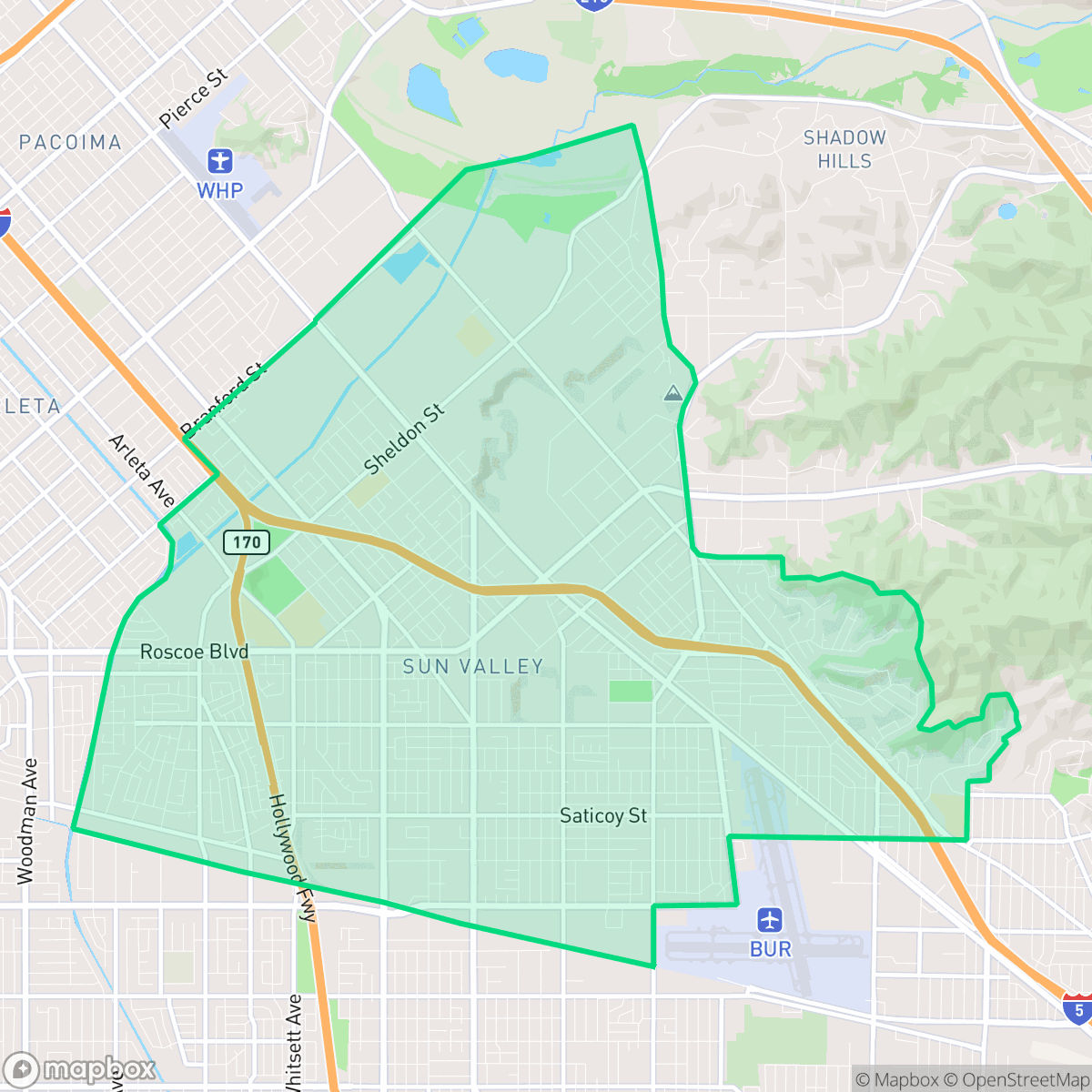
The neighborhood is a dense, industrial-suburban area located in the San Fernando Valley. It features a grid of single-family homes interspersed with major logistics centers and manufacturing facilities. The area is notable for its proximity to regional transit corridors, which facilitate access to the broader Los Angeles basin but contribute to significant acoustic challenges. According to iHuus data, the neighborhood presents a distinct industrial-residential blend that shapes its daily rhythm and overall character.
This area is best suited for those seeking a central location with access to essential services and educational facilities like Glenwood Elementary. Residents should be aware that the community is largely car-dependent, with industrial zones creating physical barriers to walkability. Privacy is generally limited due to high-density residential packing, and the prevalence of heavy truck traffic contributes to a noisy environment that differs from quieter suburban settings.
Neighborhood Scores Across 15 Qualities
Residential structures are generally closely spaced with minimal setbacks, though some areas provide more separation than the Los Angeles average. Depending on the specific block, neighbors may share property lines or live in high-density units with limited distance between homes.
Residential streets feature consistent sidewalks and marked crosswalks, although large arterial roads and nearby freeway corridors create notable barriers for pedestrians. While the neighborhood is less walkable than the Los Angeles average, many residential blocks remain easy to navigate on foot.
Uniform tract housing and boxy rooflines characterize much of the area, though some pockets feature well-maintained lawns and private pools. The visual landscape is slightly less varied than the Los Angeles average due to the prevalence of consistent, mid-century suburban density and nearby industrial zones.
Walking opportunities for dogs are primarily restricted to private backyards and narrow street verges. According to iHuus data, the availability of large public parks and wide green sidewalks is slightly below the Los Angeles average.
A blend of suburban residential grids and open land provides a slightly more open feel than the typical Los Angeles urban landscape. According to iHuus data, the area features a notable presence of large-scale industrial warehouses and nearby recreational spaces alongside single-family homes.
Industrial landscapes and warehouse corridors define the area, offering a serene but low-activity environment. Most daily errands and dining options require a vehicle, as the neighborhood lacks the commercial density found in the city average.
Frequent noise from nearby freeways and railroad tracks is common here. According to iHuus data, acoustic comfort in this area is lower than the Los Angeles average.
Air quality remains mostly clean with rare instances of elevated readings. According to iHuus data, the air quality in this area is slightly below the Los Angeles city average.
Logistics warehouses, truck depots, and rail lines are interspersed with residential areas, resulting in a higher industrial presence than the Los Angeles average. Residents may encounter increased heavy vehicle traffic and noise from nearby warehouse loading docks and airport-related infrastructure.
Health insurance access among residents is slightly higher than the Los Angeles average, according to iHuus data.
Voting patterns and census indicators show a strong liberal leaning, though this is slightly less pronounced than the average seen across Los Angeles.
Residents live alongside a balanced mix of young adults, families, and seniors. This demographic distribution is consistent with the average seen across Los Angeles.
Significant flood risk exists due to the neighborhood's location within a designated floodplain, which is notably higher than the Los Angeles average. According to iHuus data, residents should anticipate the potential necessity for flood insurance.
Wildfire risk in Sun Valley is severe, matching the high level of fire danger found across the rest of Los Angeles. Residents should be prepared for extreme fire hazards and ensure all necessary safety precautions are in place according to iHuus data.
Address-Level Insights for Sun Valley


iHuus Neighborhood Intelligence Insights
Get address-level neighborhood insights for Sun Valley
- Street-level scores — see how individual blocks compare, not just neighborhood averages
- Micro-zone boundaries — identify quiet pockets, flood boundaries, and walkable clusters before you visit
- 15 dimensions in full — walkability, noise, air quality, school quality, insurance coverage, population age profile, urban/rural index, and more
- Boundary risk alerts — know if your address sits near a block boundary where scores drop, the kind of detail no listing will ever mention
- School insights — individual school ratings and insights, not just district-level data
- Compare before you commit — side-by-side data across neighborhoods, down to block precision
No credit card required
Compare with Any Neighborhood
| Dimension | Sun Valley | Adams-Normandie |
|---|---|---|
| 🚶 Walkabilityavg 8.9 | ||
| 🔊 Acoustic Comfortavg 2.91 | ||
| 🤫 Privacy Indexavg 4.14 | ||
| 🎨 Visual Appealavg 6.58 | ||
| 🐕 Dog Friendlinessavg 5.04 | ||
| 🗺️ Urban-Rural Indexavg 5.96 | ||
| ✨ Neighborhood Vibeavg 5.07 | ||
| 🏥 Health Insurance Coverageavg 6.2 | ||
| 🌿 Air Qualityavg 8.12 | ||
| 🏭 Industrial Proximityavg 8.46 | ||
| 🌊 Flood Safetyavg 2.66 | ||
| 🗳️ Ideological Leanavg 9.56 | ||
| 👥 Population Age Profileavg 4.85 | ||
| 🔥 Fire Safetyavg 0.18 | ||
| 🏫 School Quality |
Sun Valley Rankings
School Districts Serving Sun Valley
School Insights for Sun Valley
Below average outcomes; significant attendance and academic challenges.
School Insights
See what's really behind every school rating near Sun Valley
- Individual school ratings — each school's own score with outcome context, not just a district average
- Enrollment & class size data — student-to-teacher ratio and how it compares to the state average
- Full demographics breakdown — ethnicity and gender composition for every school in the enrollment zone
- Every school in the district — all schools within the enrollment boundary ranked by rating, not just the closest one
- Grade levels & benchmarks — elementary through high school, with below/above state-average flags
No credit card required