Studio City, Los Angeles
Updated · 35,790 residents
Studio City is a prominent San Fernando Valley neighborhood defined by its deep ties to the entertainment industry and the vibrant commercial corridor of Ventura Boulevard. The area offers high walkability and an affluent residential atmosphere, though residents should expect significant noise levels from local road traffic.
Key Highlights
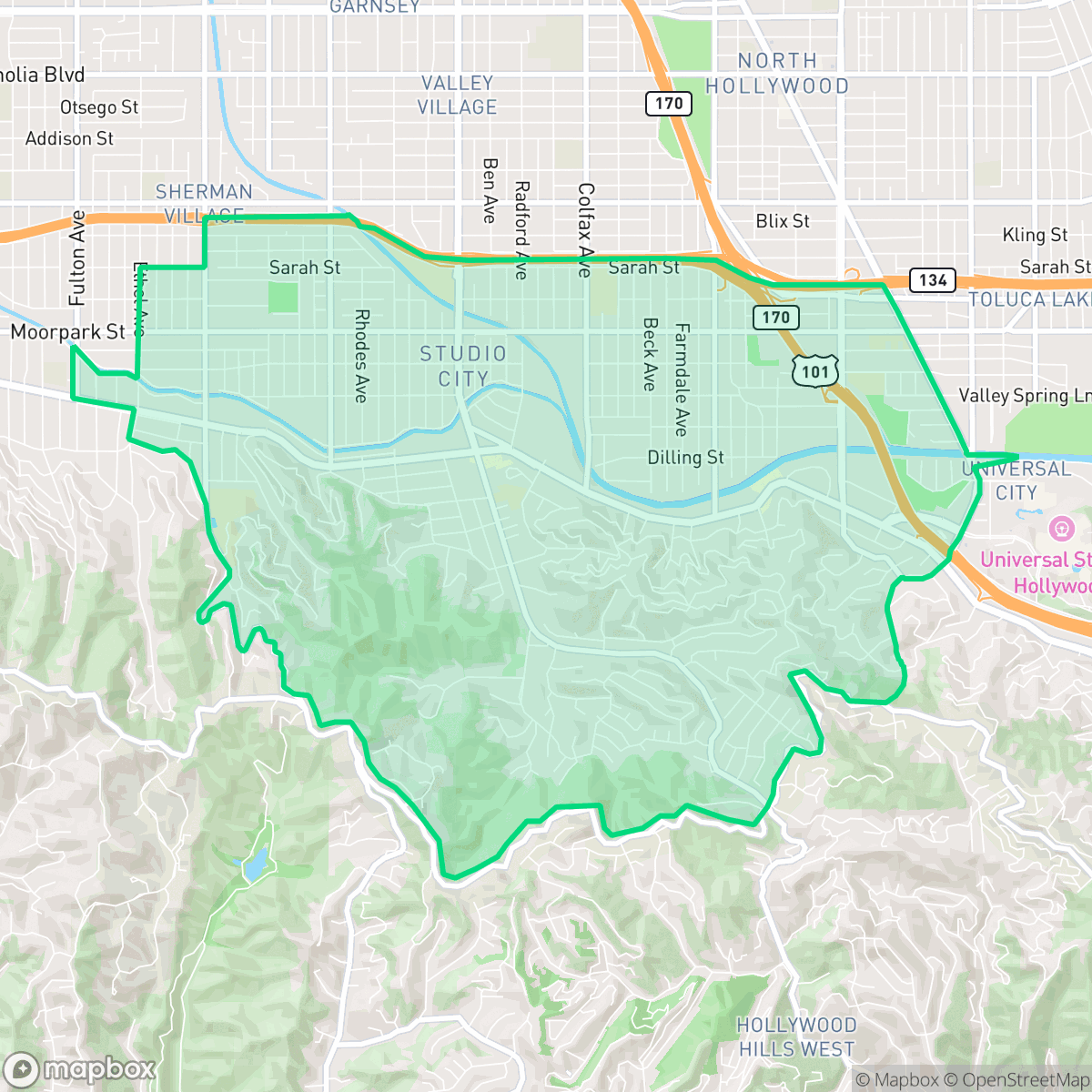
About Studio City
Originally known as Laurelwood, the southeast San Fernando Valley neighborhood of Studio City was renamed after pioneering filmmaker Mack Sennett established his 20-acre studio lot here in 1927. Now known as the Radford Studio Center (formerly CBS Studio Center), this iconic production hub became the birthplace of legendary television shows like Seinfeld and The Mary Tyler Moore Show. Ventura Boulevard serves as the neighborhood’s historic commercial spine, featuring landmarks like the 1938 Art Deco Studio City Theatre and a prominent Millard Sheets mosaic mural. Studio City also boasts significant architectural and historical sites, including Rudolph Schindler’s mid-century modern Laurelwood Apartments and the historic Campo de Cahuenga, where the 1847 Treaty of Cahuenga was signed, ending Mexican-American War hostilities in California.
The neighborhood functions as a dense suburban hub characterized by well-manicured properties, a high density of private swimming pools, and a lively social scene centered around diverse dining and cafe culture. Its layout facilitates a pedestrian-friendly environment with continuous sidewalks and clear crossings throughout most residential and arterial streets. The area maintains a strong sense of community through its local schools, including the highly-rated Carpenter Community Charter, which serves as a significant draw for families.
Prospective residents should consider the trade-offs associated with living in this bustling part of Los Angeles. While the neighborhood boasts excellent air quality and minimal industrial presence, it faces challenges regarding acoustic comfort due to elevated road traffic noise. Additionally, the area experiences high fire risk, requiring careful consideration of property safety features. Despite these factors, the region remains a highly desirable location for those seeking a blend of urban convenience and suburban comfort, supported by strong health insurance coverage and a stable, established residential profile.
Neighborhood Scores Across 15 Qualities
Residential structures offer a moderate amount of separation with varying levels of density. According to iHuus data, this area provides more buffer between neighbors than the typical Los Angeles neighborhood.
Sidewalks and crosswalks are widely available throughout the residential grid, though large freeway interchanges and the river canal create notable barriers for pedestrians. While the network is consistent in many areas, the overall walkability is slightly lower than the Los Angeles average due to these major infrastructure divides.
Large, well-maintained homes and a high density of private backyard pools create a landscape that is significantly more visually polished than the Los Angeles average. According to iHuus data, the area is characterized by manicured landscaping and spacious residential properties.
Wide street verges and a central public park with sports facilities provide more accessible walking areas for pets than the Los Angeles average. According to iHuus data, greenery is supplemented by residential tree coverage and nearby parkland.
Frequent open land and scattered homes provide a more semi-rural character than the typical Los Angeles landscape. This environment offers more greenery and less density than the city average according to iHuus data.
A blend of lively social hubs and quiet, suburban pockets defines the area, offering more activity and diverse dining options than the Los Angeles average. While many streets provide easy access to cafes and restaurants, some more remote or low-density sections remain primarily residential and quiet.
Frequent traffic and transit noise from nearby freeways and rail lines make this area significantly louder than the Los Angeles average. According to iHuus data, residents may experience consistent acoustic disturbances throughout the day.
Air quality remains consistently high with rare instances of elevated readings, performing similarly to the broader Los Angeles average according to iHuus data.
Industrial activity is virtually non-existent here, as the area is composed exclusively of residential and light commercial zones. According to iHuus data, this neighborhood lacks the warehouses, factories, or hazardous sites found more frequently in other parts of Los Angeles.
Health insurance accessibility is significantly higher than the Los Angeles average, according to iHuus data. Most residents in this area have access to comprehensive medical coverage.
Voting patterns and census indicators show a deeply liberal leaning that is slightly more pronounced than the Los Angeles average, according to iHuus data.
A diverse range of age groups exists here, including young professionals, families, and seniors. According to iHuus data, this demographic distribution is slightly more varied than the typical Los Angeles profile.
Residual flood risk exists within certain areas of the neighborhood, though safety levels remain significantly higher than the Los Angeles city average according to iHuus data.
Wildfire hazards in this area are significantly higher than the Los Angeles average, requiring residents to maintain rigorous fire prevention and emergency preparedness measures. According to iHuus data, the extreme level of risk necessitates maximum protection protocols for all properties.
Address-Level Insights for Studio City


iHuus Neighborhood Intelligence Insights
Get address-level neighborhood insights for Studio City
- Street-level scores — see how individual blocks compare, not just neighborhood averages
- Micro-zone boundaries — identify quiet pockets, flood boundaries, and walkable clusters before you visit
- 15 dimensions in full — walkability, noise, air quality, school quality, insurance coverage, population age profile, urban/rural index, and more
- Boundary risk alerts — know if your address sits near a block boundary where scores drop, the kind of detail no listing will ever mention
- School insights — individual school ratings and insights, not just district-level data
- Compare before you commit — side-by-side data across neighborhoods, down to block precision
No credit card required
Compare with Any Neighborhood
| Dimension | Studio City | Adams-Normandie |
|---|---|---|
| 🚶 Walkabilityavg 8.9 | ||
| 🔊 Acoustic Comfortavg 2.91 | ||
| 🤫 Privacy Indexavg 4.14 | ||
| 🎨 Visual Appealavg 6.58 | ||
| 🐕 Dog Friendlinessavg 5.04 | ||
| 🗺️ Urban-Rural Indexavg 5.96 | ||
| ✨ Neighborhood Vibeavg 5.07 | ||
| 🏥 Health Insurance Coverageavg 6.2 | ||
| 🌿 Air Qualityavg 8.12 | ||
| 🏭 Industrial Proximityavg 8.46 | ||
| 🌊 Flood Safetyavg 2.66 | ||
| 🗳️ Ideological Leanavg 9.56 | ||
| 👥 Population Age Profileavg 4.85 | ||
| 🔥 Fire Safetyavg 0.18 | ||
| 🏫 School Quality |
Studio City Rankings
School Districts Serving Studio City
School Insights for Studio City
Below average outcomes; significant attendance and academic challenges.
School Insights
See what's really behind every school rating near Studio City
- Individual school ratings — each school's own score with outcome context, not just a district average
- Enrollment & class size data — student-to-teacher ratio and how it compares to the state average
- Full demographics breakdown — ethnicity and gender composition for every school in the enrollment zone
- Every school in the district — all schools within the enrollment boundary ranked by rating, not just the closest one
- Grade levels & benchmarks — elementary through high school, with below/above state-average flags
No credit card required