Sherwood Forest, Los Angeles
Updated · 4,544 residents
Sherwood Forest is a serene, low-density residential enclave in Northridge defined by its lush, tree-lined streets and expansive private estates. While the area offers a quiet, car-dependent lifestyle, residents benefit from excellent air quality and a peaceful, purely residential atmosphere that remains largely free of industrial activity.
Key Highlights
About Sherwood Forest
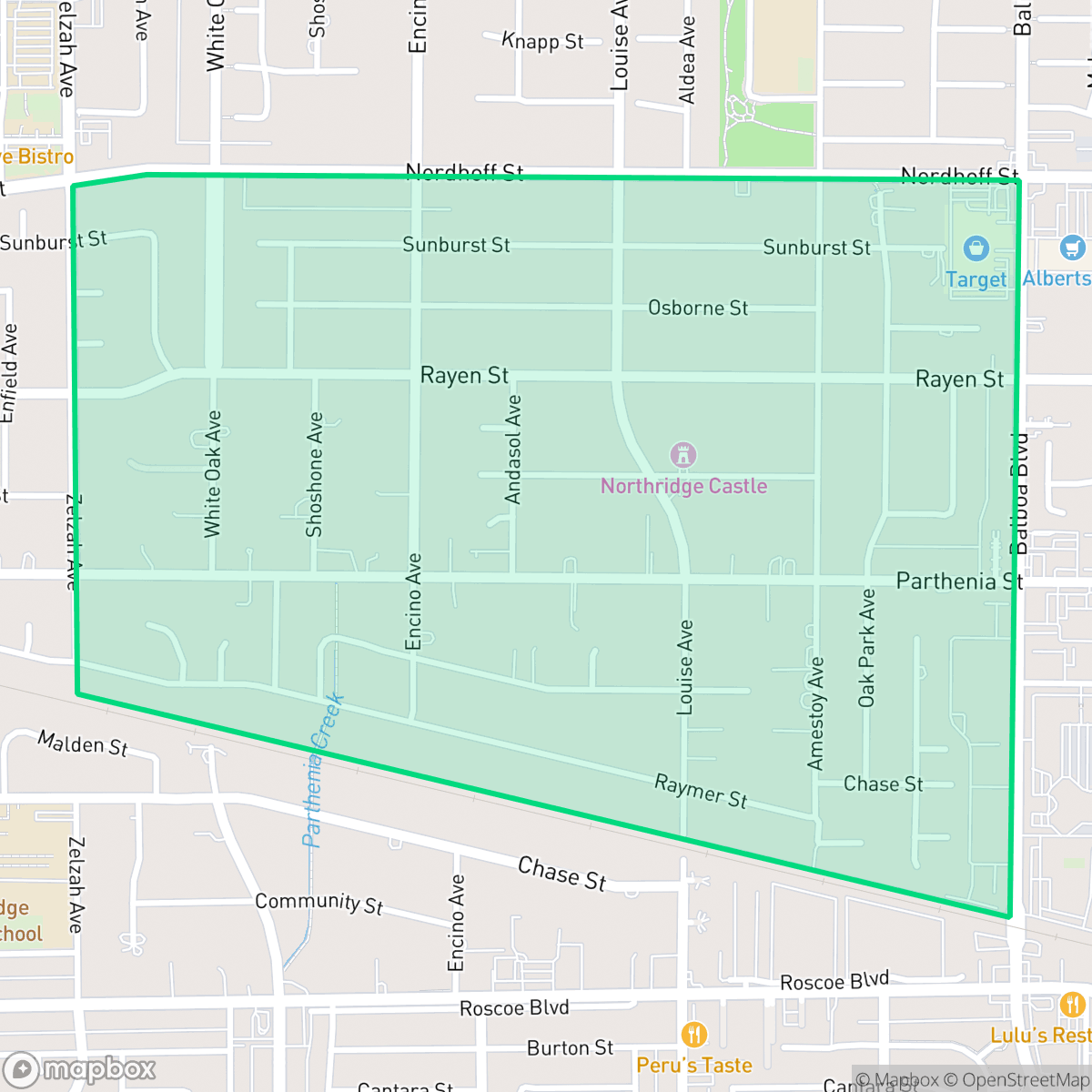
Located in the San Fernando Valley, Sherwood Forest is a serene, tree-lined residential enclave within Los Angeles's Northridge community. Originally developed in the 1920s and 1930s from former walnut orchards, the area was subdivided into large, lushly landscaped estates and "ranchettes". Realtors dubbed the neighborhood "Sherwood Forest" due to its abundant mature trees and the scenic, cedar-lined main thoroughfare of Parthenia Street. The area transitioned into a leafy suburban enclave during the post-World War II housing boom of the 1950s and 1960s. After decades of informal identity, the neighborhood received official recognition from the Los Angeles City Council in August 2012. Over the years, Sherwood Forest has been home to several notable figures, including actors Walter Brennan and Jim Davis, animator Abe Levitow, and comedian Richard Pryor.
The neighborhood functions as a secluded residential pocket within the San Fernando Valley, characterized by its wide streets and well-manicured properties. With high visual appeal and a focus on single-family living, the area provides a stable environment for those prioritizing privacy and a slower pace of life. While local amenities are sparse, the grid-like layout ensures consistent sidewalk access for pedestrians, though the overall lack of density makes it a predominantly vehicle-oriented community. Prospective residents should note that the area experiences moderate road traffic noise, which is a primary contributor to its acoustic profile. Life here is best suited for individuals or families seeking a quiet, suburban retreat who are comfortable with a short drive to reach commercial centers, schools, and transit hubs. The neighborhood maintains a strong sense of residential stability, though the trade-off for its tranquil, low-activity environment is a limited selection of walkable businesses and services.
Neighborhood Scores Across 15 Qualities
Housing density is moderate with a notable degree of spacing between neighbors. According to iHuus data, properties typically feature private rear yards and sufficient buffers between adjacent homes, offering a higher level of privacy than the Los Angeles average.
Continuous sidewalks and safe crossings are available on most streets within this suburban grid, though overall walkability is slightly below the Los Angeles average.
Large homes with private pools and well-maintained grounds create a landscape that is more visually polished than the Los Angeles average. According to iHuus data, the area features frequent upscale amenities and spacious residential lots.
Private fenced yards are common, but narrow sidewalks and a lack of public green spaces make this area slightly less dog friendly than the Los Angeles average. Residents may find fewer options for off-leash exercise according to iHuus data.
Open land and woodland are frequently interspersed with scattered homes, providing a more semi-rural atmosphere than the typical Los Angeles landscape. This area features a low-density suburban layout according to iHuus data, characterized by a mix of single-family residences and larger commercial blocks.
Activity levels are below the city average, as the area primarily consists of quiet, suburban blocks and light industrial zones. While some local dining options exist, the neighborhood is largely car-oriented with limited business density within walking distance.
Frequent noise from nearby freeway and railroad corridors impacts the area. According to iHuus data, acoustic disturbance levels are slightly higher than the Los Angeles average.
Air quality in this area remains consistently high, performing closely to the Los Angeles average. Residents can expect mostly clean air with only rare instances of elevated readings according to iHuus data.
Residential life remains largely uninterrupted by heavy industry, as the area consists primarily of housing and light commercial zones. According to iHuus data, this level of industrial separation is consistent with the broader Los Angeles average.
Health insurance access among residents is slightly above the Los Angeles average, according to iHuus data. This indicates a relatively high rate of coverage within the community.
Voting patterns and census indicators show a strong liberal leaning, though this is slightly less pronounced than the city average according to iHuus data.
A balanced blend of young professionals, families, and seniors characterizes the local community. According to iHuus data, this demographic spread is slightly more varied than the typical profile found across Los Angeles.
Properties in this area are located within a designated floodplain, which presents a higher risk of flooding than the Los Angeles average. According to iHuus data, residents should be aware that flood insurance is typically required for homes in this zone.
Address-Level Insights for Sherwood Forest


iHuus Neighborhood Intelligence Insights
Get address-level neighborhood insights for Sherwood Forest
- Street-level scores — see how individual blocks compare, not just neighborhood averages
- Micro-zone boundaries — identify quiet pockets, flood boundaries, and walkable clusters before you visit
- 15 dimensions in full — walkability, noise, air quality, school quality, insurance coverage, population age profile, urban/rural index, and more
- Boundary risk alerts — know if your address sits near a block boundary where scores drop, the kind of detail no listing will ever mention
- School insights — individual school ratings and insights, not just district-level data
- Compare before you commit — side-by-side data across neighborhoods, down to block precision
No credit card required
Compare with Any Neighborhood
| Dimension | Sherwood Forest | Adams-Normandie |
|---|---|---|
| 🚶 Walkabilityavg 8.9 | ||
| 🔊 Acoustic Comfortavg 2.91 | ||
| 🤫 Privacy Indexavg 4.14 | ||
| 🎨 Visual Appealavg 6.58 | ||
| 🐕 Dog Friendlinessavg 5.04 | ||
| 🗺️ Urban-Rural Indexavg 5.96 | ||
| ✨ Neighborhood Vibeavg 5.07 | ||
| 🏥 Health Insurance Coverageavg 6.2 | ||
| 🌿 Air Qualityavg 8.12 | ||
| 🏭 Industrial Proximityavg 8.46 | ||
| 🌊 Flood Safetyavg 2.66 | ||
| 🗳️ Ideological Leanavg 9.56 | ||
| 👥 Population Age Profileavg 4.85 | ||
| 🔥 Fire Safetyavg 0.18 | ||
| 🏫 School Quality |
Sherwood Forest Rankings
School Districts Serving Sherwood Forest
School Insights for Sherwood Forest
Below average outcomes; significant attendance and academic challenges.
School Insights
See what's really behind every school rating near Sherwood Forest
- Individual school ratings — each school's own score with outcome context, not just a district average
- Enrollment & class size data — student-to-teacher ratio and how it compares to the state average
- Full demographics breakdown — ethnicity and gender composition for every school in the enrollment zone
- Every school in the district — all schools within the enrollment boundary ranked by rating, not just the closest one
- Grade levels & benchmarks — elementary through high school, with below/above state-average flags
No credit card required