Sherman Oaks, Los Angeles
Updated · 72,774 residents
Sherman Oaks is a prominent San Fernando Valley neighborhood defined by the bustling Ventura Boulevard corridor and a mix of mid-century hillside homes and dense residential streets. While it offers high-performing local schools and a wealth of private amenities, residents should expect a car-dependent lifestyle and elevated noise levels from nearby highway traffic.
Key Highlights
About Sherman Oaks
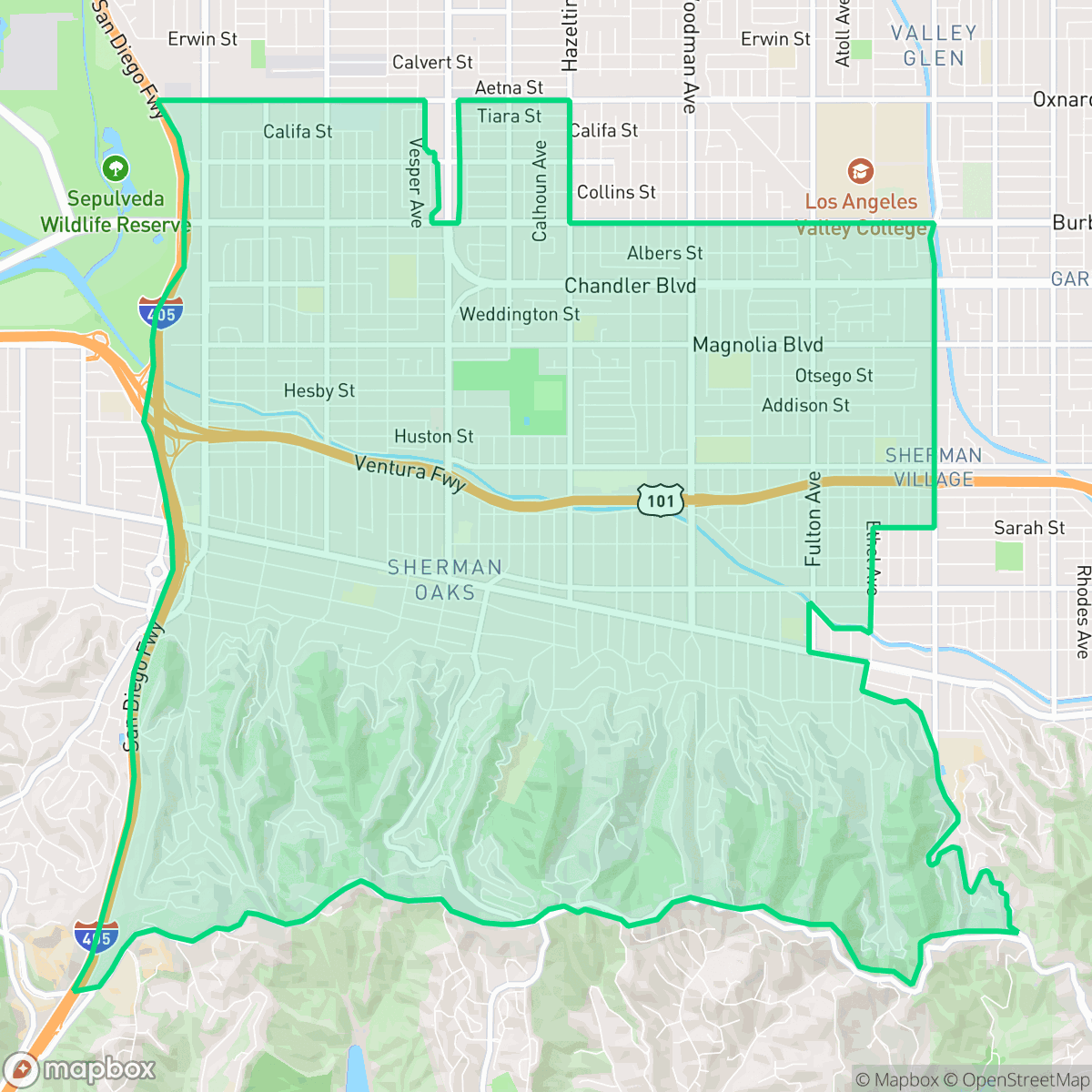
Founded in 1927, Sherman Oaks was developed by General Moses Hazeltine Sherman, a partner in the Los Angeles Suburban Homes Company who subdivided a 1,000-acre tract of land. The neighborhood’s name combines Sherman's surname with the area's native oak trees. Centered around the bustling Ventura Boulevard corridor, the neighborhood features a diverse architectural stock, ranging from 1920s Mission Revival estates like "The Magnolia" to a significant collection of mid-century modern homes designed by architects like Richard Dorman and Edward Fickett in the southern hills. A defining cultural landmark is the Sherman Oaks Galleria. Opened in 1980, it became a global symbol of teenage "Valley Girl" culture and was famously featured in films like Fast Times at Ridgemont High. Despite setbacks from the 1938 Los Angeles River flood and the 1994 Northridge earthquake, Sherman Oaks remains a premier San Fernando Valley destination.
The area is characterized by its distinct transition from the dense, flat suburban grid in the north to the quieter, winding hillside residential streets in the south. It maintains a high concentration of affluent single-family homes, many of which feature private backyard pools and well-manicured landscaping. The commercial life centers heavily on Ventura Boulevard, which provides a dense array of dining, retail, and service options that anchor the community's daily activity.
Prospective residents should note that the neighborhood is primarily car-dependent, as the grid is frequently interrupted by major highway interchanges that create pedestrian barriers. While the area boasts strong health insurance coverage and access to high-rated charter schools, the high density of housing leads to limited privacy between properties and notable noise levels from road traffic. It is well-suited for those seeking an established, affluent suburban environment with convenient access to major transit corridors, provided they are comfortable with the typical noise and density of a central Los Angeles suburb.
Neighborhood Scores Across 15 Qualities
Residential density provides more separation between neighbors than the Los Angeles average. Most homes feature distinct yards or modest buffers, though some areas contain more closely packed multi-unit structures.
Continuous sidewalks and clear crosswalks are available throughout most residential and commercial zones. While the pedestrian network is nearly as comprehensive as the city average, large highway interchanges and major arterials can create notable barriers to movement.
Manicured landscapes, large residential estates, and a high density of private backyard pools create an aesthetic that is notably more premium than the Los Angeles average. According to iHuus data, the area is characterized by well-maintained properties and spacious, affluent residential blocks.
Opportunities for dog walking vary by block, with some areas offering wide green verges and large athletic fields while others feature narrow sidewalks and limited public park access. According to iHuus data, the availability of public green space in Sherman Oaks is slightly above the city average.
Residential pockets feature a mix of single-family homes and apartment complexes that feel more open than the typical Los Angeles urban core. According to iHuus data, the area possesses a higher degree of open space and greenery compared to the city average.
Vibrant dining clusters and social spots are scattered throughout the area, though the neighborhood remains largely car-dependent with a rhythm similar to the city average. While some blocks offer walkable access to diverse restaurants, many residential sections are quiet and low-density.
Persistent noise from nearby freeways and flight paths makes this area louder than the Los Angeles average. Residents should expect significant acoustic disturbance from heavy transit corridors and regional infrastructure.
Air quality in this area is consistently high with rare instances of elevated readings. This level of cleanliness is roughly comparable to the average found throughout Los Angeles.
Industrial activity and heavy warehouses are virtually non-existent here, making this area cleaner and more residential than the Los Angeles average. According to iHuus data, the landscape is composed almost entirely of residential and light commercial zones without visible hazardous sites or heavy industrial plants.
Health insurance enrollment among residents is notably higher than the average for Los Angeles. This indicates a well-covered population according to iHuus data.
Voting patterns and census indicators reflect a predominantly liberal political leaning, which is consistent with the broader Los Angeles area. According to iHuus data, the ideological landscape here closely aligns with the city average.
Residents live alongside a balanced variety of young adults, families, and seniors. This demographic spread is slightly more diverse than the average found across Los Angeles, according to iHuus data.
Flood risk levels in this area are higher than the Los Angeles average. According to iHuus data, FEMA has not yet completed a detailed study to determine the specific level of risk for this neighborhood.
High fire hazard levels exist within this area, representing a much greater risk than the typical Los Angeles neighborhood. Residents should prioritize maximum protection measures and remain vigilant regarding wildfire safety according to iHuus data.
Address-Level Insights for Sherman Oaks


iHuus Neighborhood Intelligence Insights
Get address-level neighborhood insights for Sherman Oaks
- Street-level scores — see how individual blocks compare, not just neighborhood averages
- Micro-zone boundaries — identify quiet pockets, flood boundaries, and walkable clusters before you visit
- 15 dimensions in full — walkability, noise, air quality, school quality, insurance coverage, population age profile, urban/rural index, and more
- Boundary risk alerts — know if your address sits near a block boundary where scores drop, the kind of detail no listing will ever mention
- School insights — individual school ratings and insights, not just district-level data
- Compare before you commit — side-by-side data across neighborhoods, down to block precision
No credit card required
Compare with Any Neighborhood
| Dimension | Sherman Oaks | Adams-Normandie |
|---|---|---|
| 🚶 Walkabilityavg 8.9 | ||
| 🔊 Acoustic Comfortavg 2.91 | ||
| 🤫 Privacy Indexavg 4.14 | ||
| 🎨 Visual Appealavg 6.58 | ||
| 🐕 Dog Friendlinessavg 5.04 | ||
| 🗺️ Urban-Rural Indexavg 5.96 | ||
| ✨ Neighborhood Vibeavg 5.07 | ||
| 🏥 Health Insurance Coverageavg 6.2 | ||
| 🌿 Air Qualityavg 8.12 | ||
| 🏭 Industrial Proximityavg 8.46 | ||
| 🌊 Flood Safetyavg 2.66 | ||
| 🗳️ Ideological Leanavg 9.56 | ||
| 👥 Population Age Profileavg 4.85 | ||
| 🔥 Fire Safetyavg 0.18 | ||
| 🏫 School Quality |
Sherman Oaks Rankings
School Districts Serving Sherman Oaks
School Insights for Sherman Oaks
Below average outcomes; significant attendance and academic challenges.
School Insights
See what's really behind every school rating near Sherman Oaks
- Individual school ratings — each school's own score with outcome context, not just a district average
- Enrollment & class size data — student-to-teacher ratio and how it compares to the state average
- Full demographics breakdown — ethnicity and gender composition for every school in the enrollment zone
- Every school in the district — all schools within the enrollment boundary ranked by rating, not just the closest one
- Grade levels & benchmarks — elementary through high school, with below/above state-average flags
No credit card required