Shadow Hills, Los Angeles
Updated · 5,207 residents
Shadow Hills is a distinct equestrian-zoned enclave in the Verdugo Mountains known for its semi-rural character and expansive open spaces. While the area offers high visual appeal and significant privacy, residents rely heavily on vehicles due to extremely limited walkability and a lack of local commercial services.
Key Highlights
About Shadow Hills
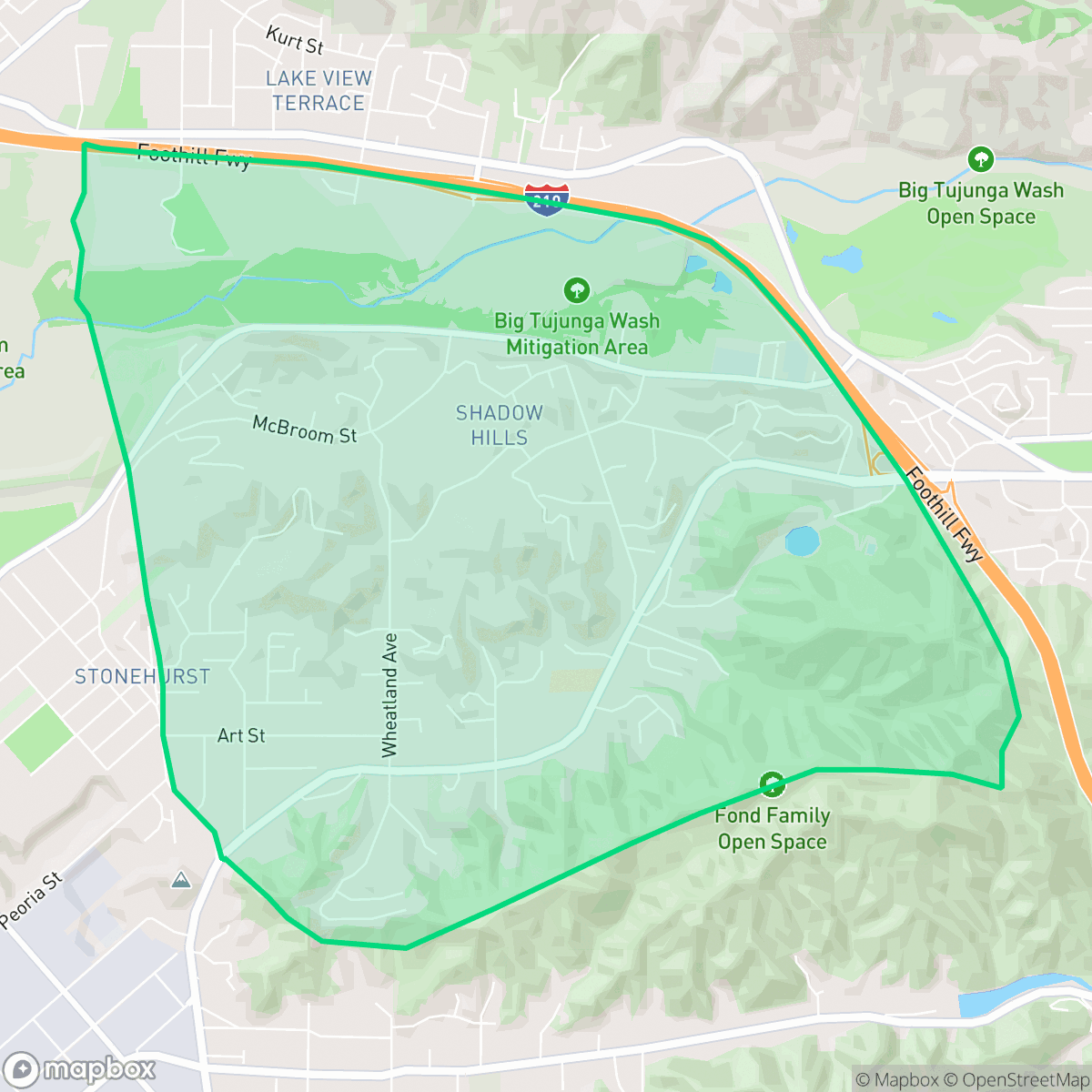
Nestled in the northwestern Verdugo Mountains, Shadow Hills was originally platted in 1907 by Dr. Homer Hansen as "Hansen Heights" before being annexed by Los Angeles in 1926 and renamed in 1947. Historically defined by its agricultural roots, early local landmarks included the 1920s wildflower-sown "Butterfly Gardens" and the popular Shadow Hills Rodeo grounds on Wheatland Avenue in the 1940s. Today, the neighborhood is celebrated as one of Los Angeles's last remaining dedicated equestrian-zoned communities, where residents maintain a strongly defended semi-rural lifestyle. Architecturally, Shadow Hills features a unique mix of rustic ranches, traditional adobe and river-stone homes, and notable midcentury modern residences, including designs by John Lautner.
The area maintains a unique identity as one of the few remaining places in Los Angeles where residents can keep horses, defined by its low-density housing and proximity to vast natural canyons. According to iHuus data, the neighborhood excels in visual appeal and dog friendliness, making it a quiet retreat for those who prioritize space over urban convenience. The landscape is characterized by scattered, diverse architectural styles ranging from midcentury modern to rustic ranch homes, set against a backdrop of rugged terrain.
Living here requires a trade-off between serenity and accessibility. The neighborhood has very few local businesses, necessitating frequent trips to surrounding areas for daily needs. Residents should be aware of the high fire safety risk and persistent noise from nearby highway traffic, which impacts acoustic comfort. It is best suited for individuals or families who prefer a secluded, rural-like lifestyle and are comfortable with a car-dependent environment.
Neighborhood Scores Across 15 Qualities
Residential lots feature significant separation between homes, providing much more privacy than the average Los Angeles neighborhood. According to iHuus data, the area is characterized by large property footprints and reduced proximity to neighbors.
Lack of sidewalks makes pedestrian travel difficult, though the low traffic volume provides a peaceful environment for walking. This level of walkability is notably lower than the average found throughout Los Angeles.
Large residential properties and upscale amenities provide a highly aesthetic environment that is notably more visually pleasing than the Los Angeles average. According to iHuus data, the area is characterized by expansive driveways and well-maintained landscapes.
Expansive green spaces and wide, low-traffic paths provide ample space for walking pets. According to iHuus data, this area offers significantly more accessibility for dogs than the Los Angeles average.
Vast hilly open spaces and low building density characterize this area, offering a much more rural feel than the Los Angeles average. According to iHuus data, the landscape is dominated by natural canyons and scattered homes set within woodland.
Extremely low commercial activity and vast open spaces create a tranquil, rural atmosphere that is significantly less active than the Los Angeles average. Residents will find very few local destinations or social hubs, as most daily needs require car-oriented travel to find essential services.
Frequent noise disturbances from nearby transit infrastructure are common here. According to iHuus data, acoustic comfort in this area is lower than the Los Angeles average.
Air quality remains mostly clean with only rare instances of elevated readings. This level of air purity is roughly comparable to the average seen across Los Angeles.
Industrial presence is virtually nonexistent in this area, making it significantly more residential than the Los Angeles average. According to iHuus data, the landscape is characterized by quiet streets and open green spaces, though some minor commercial structures and a water reservoir are present.
Health insurance access among residents is notably higher than the Los Angeles average, according to iHuus data.
Political perspectives in this area are split relatively evenly between conservative and liberal leanings. This distribution is notably more balanced than the strongly progressive lean seen across much of Los Angeles.
A varied mix of young adults, families, and older residents defines the local demographic. This age distribution is slightly more balanced than the average found across Los Angeles, according to iHuus data.
Flood risk in this area is higher than the Los Angeles average, though precise risk levels remain undetermined due to a lack of detailed federal studies. According to iHuus data, residents should remain aware of potential drainage considerations in this part of the hills.
Wildfire vulnerability is significantly higher here than in the rest of Los Angeles. Residents must prioritize maximum fire prevention and emergency preparedness due to the extreme hazard level identified in iHuus data.
Address-Level Insights for Shadow Hills


iHuus Neighborhood Intelligence Insights
Get address-level neighborhood insights for Shadow Hills
- Street-level scores — see how individual blocks compare, not just neighborhood averages
- Micro-zone boundaries — identify quiet pockets, flood boundaries, and walkable clusters before you visit
- 15 dimensions in full — walkability, noise, air quality, school quality, insurance coverage, population age profile, urban/rural index, and more
- Boundary risk alerts — know if your address sits near a block boundary where scores drop, the kind of detail no listing will ever mention
- School insights — individual school ratings and insights, not just district-level data
- Compare before you commit — side-by-side data across neighborhoods, down to block precision
No credit card required
Compare with Any Neighborhood
| Dimension | Shadow Hills | Adams-Normandie |
|---|---|---|
| 🚶 Walkabilityavg 8.9 | ||
| 🔊 Acoustic Comfortavg 2.91 | ||
| 🤫 Privacy Indexavg 4.14 | ||
| 🎨 Visual Appealavg 6.58 | ||
| 🐕 Dog Friendlinessavg 5.04 | ||
| 🗺️ Urban-Rural Indexavg 5.96 | ||
| ✨ Neighborhood Vibeavg 5.07 | ||
| 🏥 Health Insurance Coverageavg 6.2 | ||
| 🌿 Air Qualityavg 8.12 | ||
| 🏭 Industrial Proximityavg 8.46 | ||
| 🌊 Flood Safetyavg 2.66 | ||
| 🗳️ Ideological Leanavg 9.56 | ||
| 👥 Population Age Profileavg 4.85 | ||
| 🔥 Fire Safetyavg 0.18 | ||
| 🏫 School Quality |
Shadow Hills Rankings
School Districts Serving Shadow Hills
School Insights for Shadow Hills
Below average outcomes; significant attendance and academic challenges.
School Insights
See what's really behind every school rating near Shadow Hills
- Individual school ratings — each school's own score with outcome context, not just a district average
- Enrollment & class size data — student-to-teacher ratio and how it compares to the state average
- Full demographics breakdown — ethnicity and gender composition for every school in the enrollment zone
- Every school in the district — all schools within the enrollment boundary ranked by rating, not just the closest one
- Grade levels & benchmarks — elementary through high school, with below/above state-average flags
No credit card required