San Pedro, Los Angeles
Updated · 72,845 residents
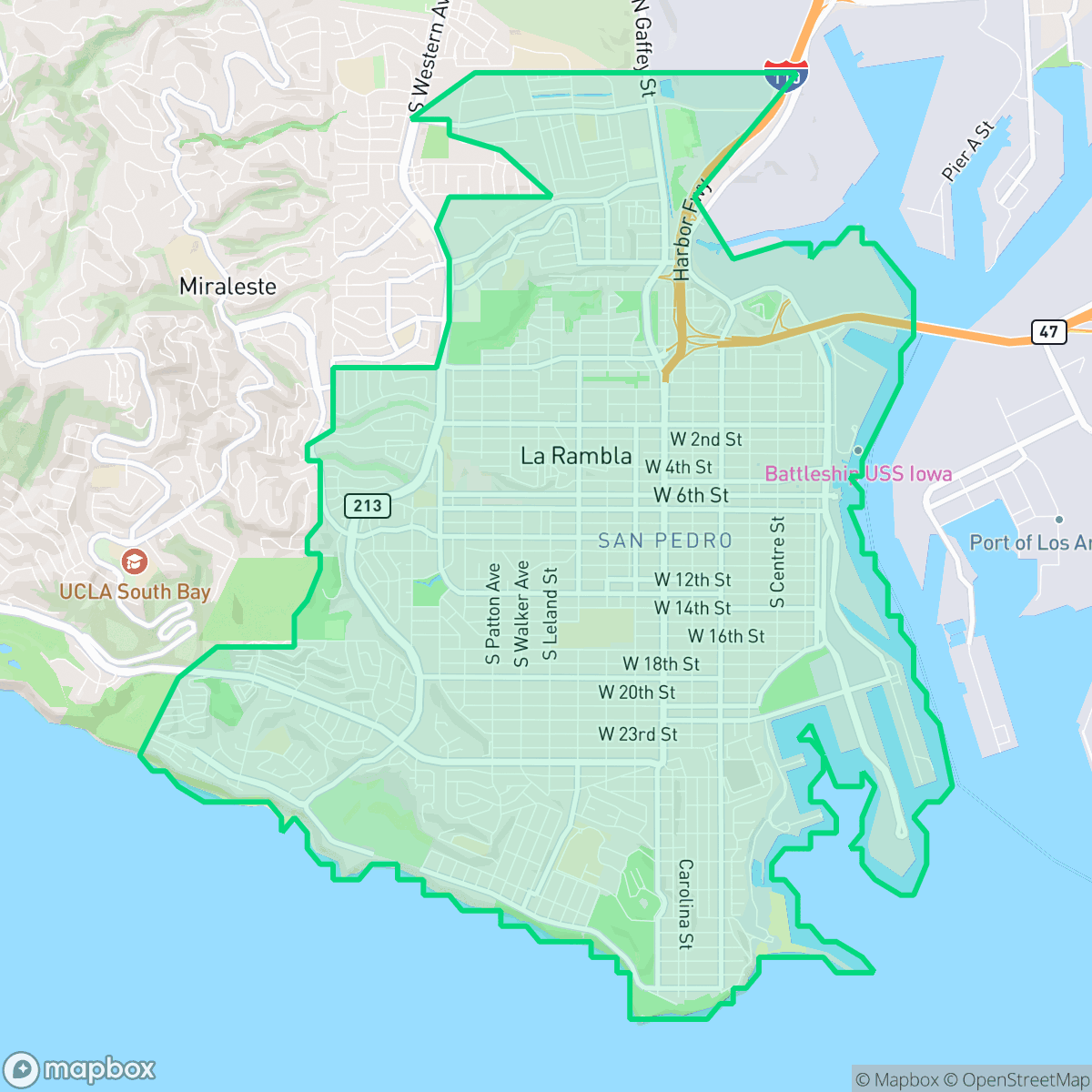
San Pedro is a historic maritime community defined by its coastal landscape and exceptional walkability. Residents enjoy a dense, grid-based residential environment with easy access to regional parks and local schools, though the area is characterized by tightly packed housing and proximity to active industrial port operations.
Key Highlights
About San Pedro
San Pedro, situated on the Palos Verdes Peninsula, was originally the homeland of the Tongva people before becoming part of Alta California’s first Spanish land grant, Rancho San Pedro, in 1784. Developed as a key maritime hub by Phineas Banning, the former independent city incorporated in 1888 and consolidated with Los Angeles in 1909 to secure the city’s deepwater port. San Pedro’s unique cultural identity is anchored by its historic Croatian and Italian-American communities, which originally thrived on the local fishing and canning industries. Notable architectural landmarks define its coastal landscape, including the Victorian-style Point Fermin Lighthouse (1874), the military installations of Fort MacArthur (1914), and the Spanish Colonial Revival-style Harbor House (1926), originally built as an Army and Navy YMCA.
The area offers a distinct coastal identity shaped by its relationship with the Port of Los Angeles and a well-defined grid of walkable streets. Families and professionals are drawn to the neighborhood for its high-performing local schools and access to recreational spaces like Point Fermin Park. The local atmosphere balances a quiet, suburban feel with the steady activity of a major working harbor, providing a unique blend of residential life and maritime industry.
Prospective residents should note that the neighborhood features high-density housing with minimal private yard space and limited acoustic privacy due to road traffic. While the area provides excellent pedestrian access to daily amenities, the proximity to heavy industrial port facilities and major shipping infrastructure remains a significant factor for those considering the location. It is best suited for individuals who value a highly walkable, community-focused environment and are comfortable with the bustling, industrial-adjacent nature of a major port town.
Neighborhood Scores Across 15 Qualities
Residential structures are frequently positioned close together with limited private yard space. This level of density is roughly in line with the average found throughout Los Angeles.
A comprehensive grid of sidewalks and clearly marked crosswalks makes navigating the area on foot easy. This pedestrian-friendly environment is even more robust than the average for Los Angeles.
Visual landscapes range from affluent coastal estates with manicured grounds to dense, urban tract housing. This mix of large properties and high-density residential areas results in a level of visual appeal that is nearly consistent with the Los Angeles average.
Access to waterfront trails, Point Fermin Park, and various sidewalk verges makes this area more dog friendly than the Los Angeles average. While some industrial blocks have limited greenery, many residential sections offer continuous walking paths and ample public park space for pets.
Residential streets and greenery exist in roughly equal measure with heavy industrial and port infrastructure. This balance of suburban housing and maritime logistics is slightly more varied than the Los Angeles average, according to iHuus data.
A varied landscape of lively coastal dining hubs and quiet, industrial-suburban pockets creates a social energy slightly above the city average. While certain districts offer diverse dining and walkable amenities, other areas remain primarily residential and car-dependent.
Frequent sounds from nearby railroad tracks and major freeways characterize the area. According to iHuus data, the acoustic environment is slightly more disruptive than the Los Angeles average.
Air quality remains mostly clean with infrequent periods of elevated readings. This level of air quality is slightly lower than the average seen across Los Angeles.
Residential and light commercial zones dominate the landscape, offering a notable absence of heavy industrial hazards compared to the city average. While some areas near the waterfront interface with maritime logistics, much of the neighborhood remains free of large warehouses or industrial chimneys.
Health insurance access is slightly below the Los Angeles average. According to iHuus data, a portion of the resident population remains uninsured.
Political leanings in this area lean liberal, though this tendency is less pronounced than the citywide average according to iHuus data.
A balanced variety of age groups resides here, including young professionals, families, and seniors. This demographic spread is slightly more varied than the average found across Los Angeles.
Significant flood risk exists due to the area being located within a 100-year floodplain, which is higher than the average for Los Angeles. According to iHuus data, residents may find that flood insurance is a typical requirement for properties in this neighborhood.
Fire hazards in this area are exceptionally high, representing a risk level that is slightly greater than the average for Los Angeles. Residents should be prepared for stringent safety protocols and significant wildfire mitigation requirements according to iHuus data.
Address-Level Insights for San Pedro


iHuus Neighborhood Intelligence Insights
Get address-level neighborhood insights for San Pedro
- Street-level scores — see how individual blocks compare, not just neighborhood averages
- Micro-zone boundaries — identify quiet pockets, flood boundaries, and walkable clusters before you visit
- 15 dimensions in full — walkability, noise, air quality, school quality, insurance coverage, population age profile, urban/rural index, and more
- Boundary risk alerts — know if your address sits near a block boundary where scores drop, the kind of detail no listing will ever mention
- School insights — individual school ratings and insights, not just district-level data
- Compare before you commit — side-by-side data across neighborhoods, down to block precision
No credit card required
Compare with Any Neighborhood
| Dimension | San Pedro | Adams-Normandie |
|---|---|---|
| 🚶 Walkabilityavg 8.9 | ||
| 🔊 Acoustic Comfortavg 2.91 | ||
| 🤫 Privacy Indexavg 4.14 | ||
| 🎨 Visual Appealavg 6.58 | ||
| 🐕 Dog Friendlinessavg 5.04 | ||
| 🗺️ Urban-Rural Indexavg 5.96 | ||
| ✨ Neighborhood Vibeavg 5.07 | ||
| 🏥 Health Insurance Coverageavg 6.2 | ||
| 🌿 Air Qualityavg 8.12 | ||
| 🏭 Industrial Proximityavg 8.46 | ||
| 🌊 Flood Safetyavg 2.66 | ||
| 🗳️ Ideological Leanavg 9.56 | ||
| 👥 Population Age Profileavg 4.85 | ||
| 🔥 Fire Safetyavg 0.18 | ||
| 🏫 School Quality |
San Pedro Rankings
School Districts Serving San Pedro
School Insights for San Pedro
Below average outcomes; significant attendance and academic challenges.
School Insights
See what's really behind every school rating near San Pedro
- Individual school ratings — each school's own score with outcome context, not just a district average
- Enrollment & class size data — student-to-teacher ratio and how it compares to the state average
- Full demographics breakdown — ethnicity and gender composition for every school in the enrollment zone
- Every school in the district — all schools within the enrollment boundary ranked by rating, not just the closest one
- Grade levels & benchmarks — elementary through high school, with below/above state-average flags
No credit card required