Playa Vista, Los Angeles
Updated · 3,903 residents
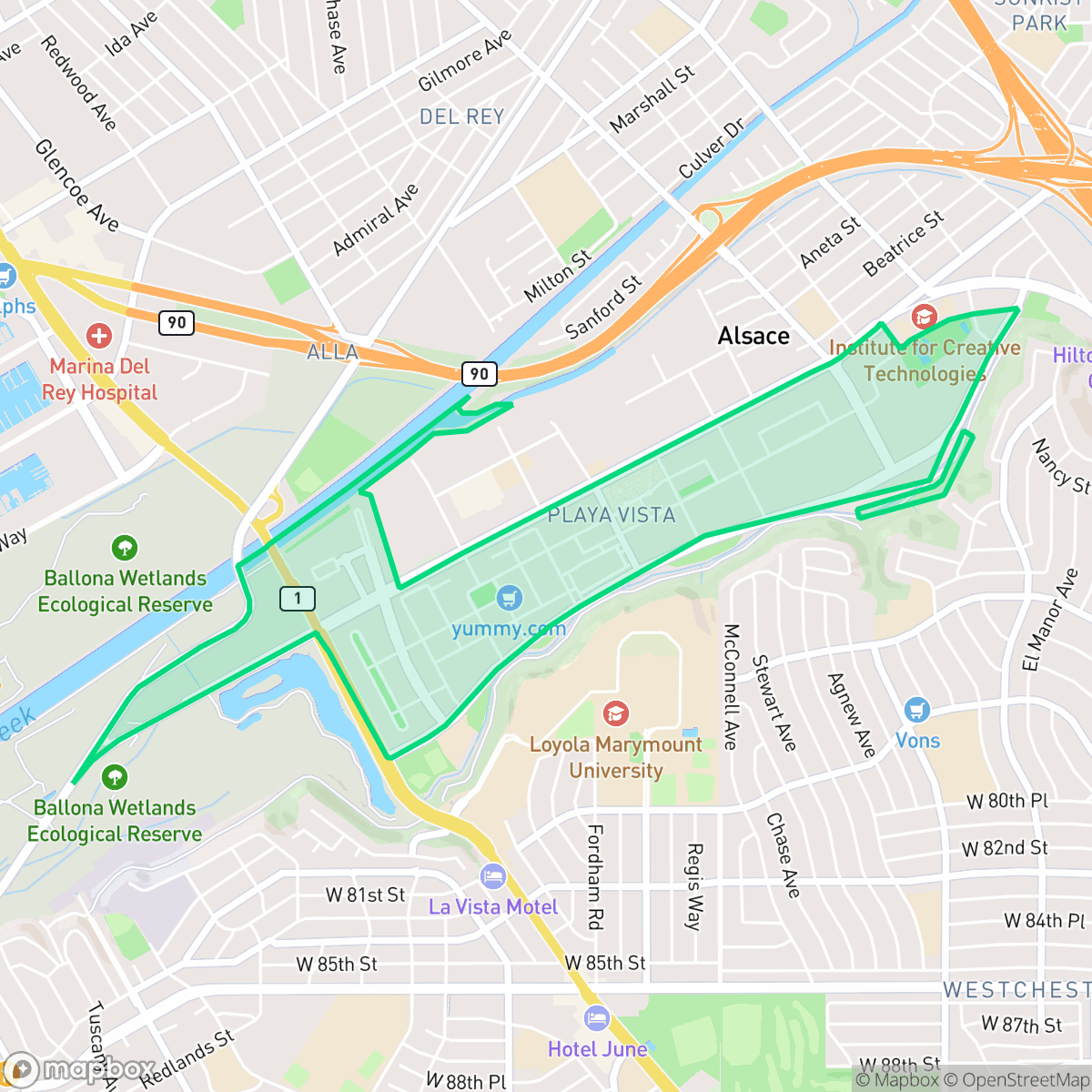
Playa Vista is a master-planned Los Angeles community that serves as a highly walkable hub for tech professionals and families. The area features modern architecture and extensive green spaces, though it experiences significant noise levels from surrounding road traffic.
Key Highlights
About Playa Vista
Once inhabited by the Tongva at the village of Guashna, the land that is now Playa Vista became part of Rancho La Ballona in 1839. In 1940, aviator Howard Hughes purchased the flat wetlands to establish the Hughes Aircraft Company headquarters and a private airfield. Here, he constructed the historic Hercules Campus, featuring the massive wood-framed hangar where the legendary H-4 Hercules "Spruce Goose" was built. Following the aerospace era, these historic hangars served as Hollywood sound stages for films like Titanic and Avatar. Since its master-planned development began in 2002, Playa Vista has preserved hundreds of acres of the adjacent Ballona Wetlands while transforming into a prominent hub of "Silicon Beach." Today, the neighborhood blends high-tech corporate campuses for giants like Google and YouTube with vibrant, walkable community spaces centered around the Runway retail and entertainment district.
The neighborhood functions as a dense, modern enclave that prioritizes pedestrian connectivity through a network of dedicated paths and sidewalks. Residents benefit from high-quality community amenities, including well-maintained parks and proximity to the Ballona Wetlands, which contribute to a high level of dog friendliness. The area maintains a consistent aesthetic characterized by contemporary multi-family buildings and manicured landscaping, reflecting its recent development as a primary center for Silicon Beach.
While the community offers excellent access to local services and high health insurance coverage, prospective residents should consider the trade-offs of urban density. The area is notably loud due to high-volume road traffic, and the close proximity of residential units results in limited privacy compared to traditional single-family neighborhoods. It is best suited for individuals or families who value a walkable, tech-adjacent lifestyle and are comfortable with the noise profile of a busy, master-planned suburban environment.
Neighborhood Scores Across 15 Qualities
Residential spacing varies between dense multi-family complexes and more traditional housing. According to iHuus data, levels of privacy are slightly higher than the Los Angeles average due to a mix of building types and buffer zones between neighbors.
Extensive sidewalk networks, dedicated pedestrian paths, and marked crosswalks make navigating the area on foot easy. According to iHuus data, the connectivity of these walkways and greenbelts is even higher than the Los Angeles average.
Well-maintained residential properties and modern developments with high-end amenities provide a more polished aesthetic than the Los Angeles average. According to iHuus data, the area features prominent solar-equipped architecture and professional landscaping.
Expansive wetlands, wide trails, and connected green corridors provide significantly more space for walking pets than the Los Angeles average. Extensive parkland and vegetated creek paths offer a safe environment away from heavy traffic.
Large-scale commercial warehouses and multi-story residential complexes are interspersed with significant green spaces and nearby wetland ecosystems. This area offers more open land and natural scenery than the typical Los Angeles urban landscape, according to iHuus data.
Residential life here is characterized by a steady but subdued pace, sitting slightly below the city average for urban activity. While certain pockets offer walkable dining and social hubs, other areas remain largely quiet and dependent on driving due to a heavy presence of industrial and low-density zones.
Persistent noise from nearby freeways and flight paths makes this area louder than the Los Angeles average. According to iHuus data, the proximity to major transit corridors impacts the overall acoustic comfort of the neighborhood.
Air quality remains consistently high with rare instances of elevated readings. This level of air purity is roughly in line with the average for Los Angeles.
Residential and light commercial zones dominate the landscape, with no warehouses or heavy machinery detected near housing. According to iHuus data, this area is notably cleaner of industrial facilities than much of Los Angeles.
Health insurance accessibility is significantly higher than the Los Angeles average according to iHuus data. Most residents in this area are covered by comprehensive health plans.
Voting patterns and census indicators reflect a deeply progressive political environment that is slightly more liberal than the Los Angeles average, according to iHuus data.
Residents live alongside a relatively even distribution of young professionals, families, and older adults. This demographic spread is slightly more balanced across age brackets than the broader Los Angeles area.
Flood risk in this area is higher than the Los Angeles average. According to iHuus data, the precise risk level remains undetermined because a detailed federal study has not yet been completed for this specific zone.
Address-Level Insights for Playa Vista


iHuus Neighborhood Intelligence Insights
Get address-level neighborhood insights for Playa Vista
- Street-level scores — see how individual blocks compare, not just neighborhood averages
- Micro-zone boundaries — identify quiet pockets, flood boundaries, and walkable clusters before you visit
- 15 dimensions in full — walkability, noise, air quality, school quality, insurance coverage, population age profile, urban/rural index, and more
- Boundary risk alerts — know if your address sits near a block boundary where scores drop, the kind of detail no listing will ever mention
- School insights — individual school ratings and insights, not just district-level data
- Compare before you commit — side-by-side data across neighborhoods, down to block precision
No credit card required
Compare with Any Neighborhood
| Dimension | Playa Vista | Adams-Normandie |
|---|---|---|
| 🚶 Walkabilityavg 8.9 | ||
| 🔊 Acoustic Comfortavg 2.91 | ||
| 🤫 Privacy Indexavg 4.14 | ||
| 🎨 Visual Appealavg 6.58 | ||
| 🐕 Dog Friendlinessavg 5.04 | ||
| 🗺️ Urban-Rural Indexavg 5.96 | ||
| ✨ Neighborhood Vibeavg 5.07 | ||
| 🏥 Health Insurance Coverageavg 6.2 | ||
| 🌿 Air Qualityavg 8.12 | ||
| 🏭 Industrial Proximityavg 8.46 | ||
| 🌊 Flood Safetyavg 2.66 | ||
| 🗳️ Ideological Leanavg 9.56 | ||
| 👥 Population Age Profileavg 4.85 | ||
| 🔥 Fire Safetyavg 0.18 | ||
| 🏫 School Quality |
Playa Vista Rankings
School Districts Serving Playa Vista
School Insights for Playa Vista
Below average outcomes; significant attendance and academic challenges.
School Insights
See what's really behind every school rating near Playa Vista
- Individual school ratings — each school's own score with outcome context, not just a district average
- Enrollment & class size data — student-to-teacher ratio and how it compares to the state average
- Full demographics breakdown — ethnicity and gender composition for every school in the enrollment zone
- Every school in the district — all schools within the enrollment boundary ranked by rating, not just the closest one
- Grade levels & benchmarks — elementary through high school, with below/above state-average flags
No credit card required