Playa Del Rey, Los Angeles
Updated · 14,645 residents
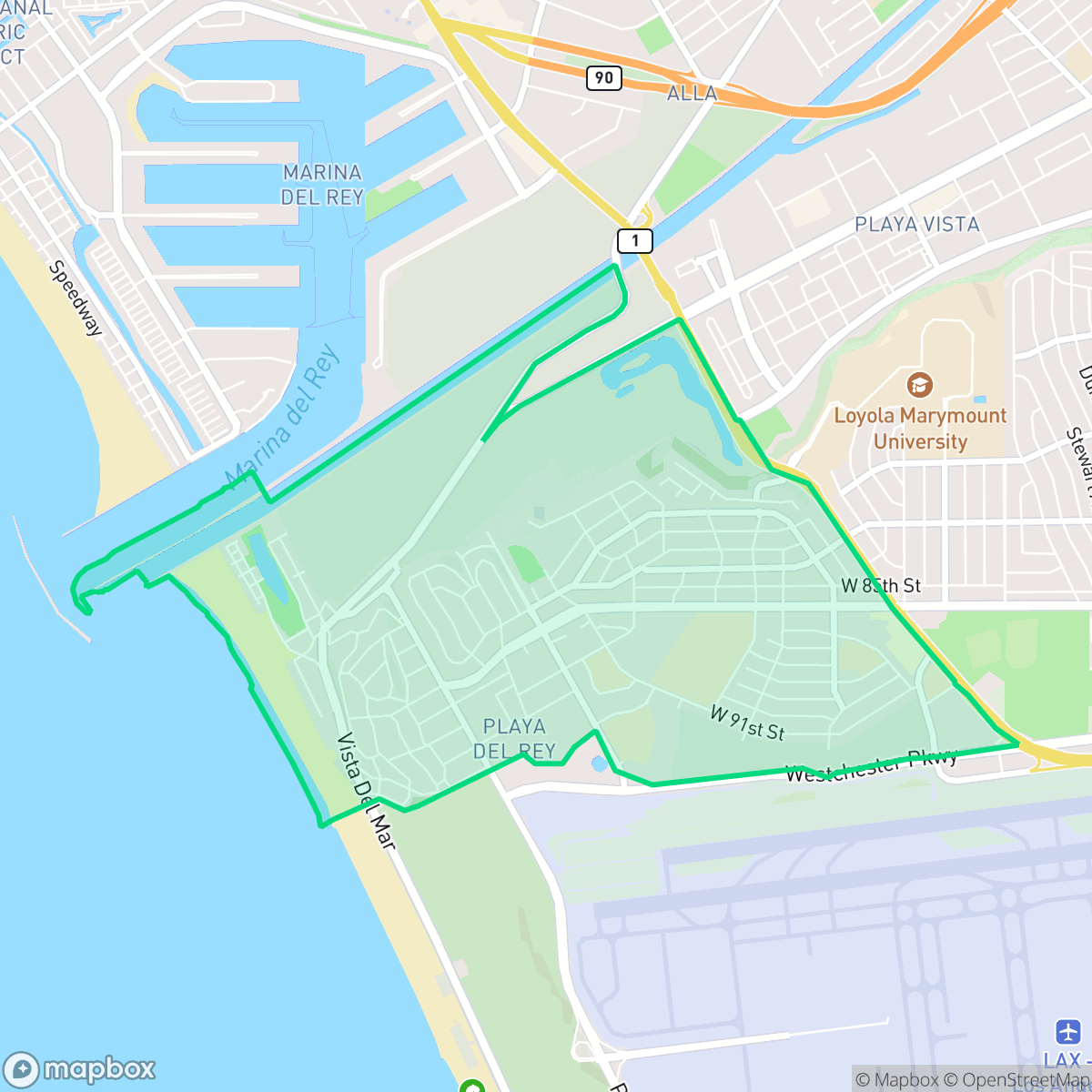
Playa Del Rey is a coastal residential community defined by its proximity to the Pacific Ocean and a quiet, suburban atmosphere. While the area offers high walkability and excellent access to outdoor spaces, residents should be aware of significant noise levels from nearby airport operations and road traffic.
Key Highlights
About Playa Del Rey
Originally a wetland inhabited by the Tongva, Playa del Rey saw its first major development attempt in the 1870s with the dredging of Port Ballona Harbor. In 1921, developers Dickinson & Gillespie began transforming the coastal sand dunes into "Palisades del Rey," a resort community of custom beach homes that attracted Hollywood elites like Cecil B. DeMille. The 1922 Spanish Colonial Revival style Dickinson & Gillespie Building remains a local landmark. Playa del Rey underwent a dramatic transformation between 1966 and 1975 when its southern neighborhood, Surfridge, was condemned and demolished via eminent domain to facilitate the expansion of nearby Los Angeles International Airport (LAX). Today, this vacant, fenced-off coastal dune area serves as a protected sanctuary for the endangered El Segundo blue butterfly.
The neighborhood functions as a dense suburban pocket featuring a mix of single-family homes and multi-story apartment complexes. It maintains a high degree of visual appeal, characterized by manicured landscaping, private pools, and proximity to natural wetlands. It serves as a residential retreat that balances suburban density with immediate access to coastal recreation and green spaces, offering an established environment for those who value proximity to the water.
Potential residents should consider the trade-off between the area's aesthetic appeal and its acoustic environment. Due to its proximity to LAX and major roadways, the neighborhood experiences elevated noise levels that may impact those sensitive to sound. The area is best suited for individuals who prioritize a walkable lifestyle and coastal access over absolute silence, and who appreciate a community that remains largely residential and institutional in its land use.
Neighborhood Scores Across 15 Qualities
Housing layouts offer a mix of shared walls and narrow side yards, providing slightly more separation between neighbors than the Los Angeles average. According to iHuus data, the area features a blend of multi-family buildings and closely spaced single-family homes.
Pedestrians benefit from a comprehensive sidewalk network and clearly marked crosswalks that are more extensive than the Los Angeles average. Many streets feature sidewalks on both sides and integrated pathways near greenbelts, according to iHuus data.
Large homes, private pools, and well-maintained landscaping create a highly aesthetic environment that is notably more polished than the Los Angeles average. Modern developments and expansive driveways contribute to a premium visual character throughout the area.
Extensive wetlands, nature trails, and large public parks provide significantly more outdoor space for pets than the Los Angeles average. Wide grass verges and accessible green belts throughout the residential areas offer ample opportunities for walking and exercise.
Frequent open spaces and proximity to wetland ecosystems provide a more open landscape than much of Los Angeles. Residential areas feature a mix of single-family homes and multi-story complexes set within a lush, suburban environment.
Residential streets and coastal pockets are notably tranquil and low-density, offering far less social energy and commercial density than the Los Angeles average. Most dining and essential services are tucked into small clusters, making the area feel more suburban and car-dependent than bustling.
Persistent noise from nearby freeway traffic and flight paths makes this area significantly louder than the Los Angeles average. Residents may experience frequent disturbances from heavy transit activity according to iHuus data.
Air quality remains consistently good with rare instances of elevated readings. This level of air purity is roughly comparable to the Los Angeles average, according to iHuus data.
Industrial presence is minimal in this area, which contains no large-scale manufacturing or heavy warehouses. According to iHuus data, the neighborhood features a higher concentration of residential and recreational spaces compared to the city average.
Health insurance accessibility is notably higher than the Los Angeles average, according to iHuus data. Most residents in this area possess comprehensive medical coverage.
Voting patterns and census indicators reflect a predominantly liberal political leaning that is slightly more pronounced than the Los Angeles average.
Residents encounter a balanced distribution of young professionals, families, and seniors. This demographic variety is slightly more diverse than the typical Los Angeles age profile, according to iHuus data.
Flood risk in this area is notably higher than the Los Angeles average, though official assessments from FEMA remain incomplete. Residents should note that current data indicates a moderate level of uncertainty regarding long-term flood safety according to iHuus data.
Address-Level Insights for Playa Del Rey


iHuus Neighborhood Intelligence Insights
Get address-level neighborhood insights for Playa Del Rey
- Street-level scores — see how individual blocks compare, not just neighborhood averages
- Micro-zone boundaries — identify quiet pockets, flood boundaries, and walkable clusters before you visit
- 15 dimensions in full — walkability, noise, air quality, school quality, insurance coverage, population age profile, urban/rural index, and more
- Boundary risk alerts — know if your address sits near a block boundary where scores drop, the kind of detail no listing will ever mention
- School insights — individual school ratings and insights, not just district-level data
- Compare before you commit — side-by-side data across neighborhoods, down to block precision
No credit card required
Compare with Any Neighborhood
| Dimension | Playa Del Rey | Adams-Normandie |
|---|---|---|
| 🚶 Walkabilityavg 8.9 | ||
| 🔊 Acoustic Comfortavg 2.91 | ||
| 🤫 Privacy Indexavg 4.14 | ||
| 🎨 Visual Appealavg 6.58 | ||
| 🐕 Dog Friendlinessavg 5.04 | ||
| 🗺️ Urban-Rural Indexavg 5.96 | ||
| ✨ Neighborhood Vibeavg 5.07 | ||
| 🏥 Health Insurance Coverageavg 6.2 | ||
| 🌿 Air Qualityavg 8.12 | ||
| 🏭 Industrial Proximityavg 8.46 | ||
| 🌊 Flood Safetyavg 2.66 | ||
| 🗳️ Ideological Leanavg 9.56 | ||
| 👥 Population Age Profileavg 4.85 | ||
| 🔥 Fire Safetyavg 0.18 | ||
| 🏫 School Quality |
Playa Del Rey Rankings
School Districts Serving Playa Del Rey
School Insights for Playa Del Rey
Below average outcomes; significant attendance and academic challenges.
School Insights
See what's really behind every school rating near Playa Del Rey
- Individual school ratings — each school's own score with outcome context, not just a district average
- Enrollment & class size data — student-to-teacher ratio and how it compares to the state average
- Full demographics breakdown — ethnicity and gender composition for every school in the enrollment zone
- Every school in the district — all schools within the enrollment boundary ranked by rating, not just the closest one
- Grade levels & benchmarks — elementary through high school, with below/above state-average flags
No credit card required