Pico-Union, Los Angeles
Updated · 26,961 residents
Pico-Union is a densely populated, highly walkable district in Los Angeles known for its rich prewar architectural heritage and vibrant Central American cultural presence. According to iHuus data, residents enjoy exceptional pedestrian connectivity, though the area features limited green space and a dense, urban environment with minimal private outdoor amenities.
Key Highlights
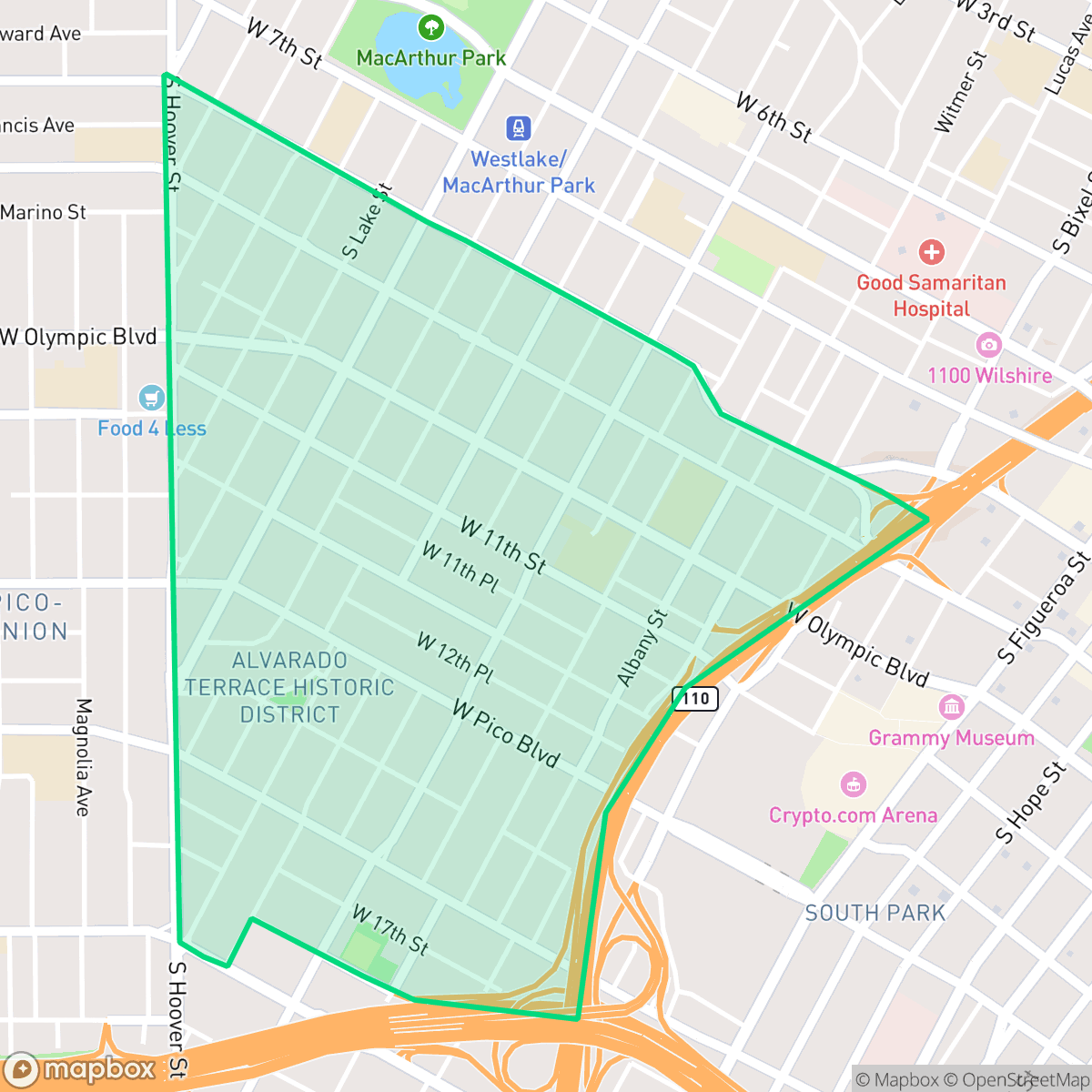
About Pico-Union
Located within the original 1781 boundaries of El Pueblo de Los Angeles, Pico-Union developed between 1880 and 1930 as an affluent suburb connected to downtown by streetcars. Today, it is celebrated for its exceptionally diverse prewar architecture, preserved within the Alvarado Terrace and South Bonnie Brae historic districts, which feature Queen Anne cottages, Craftsman bungalows, and Powell Place—one of the city’s shortest brick-paved streets. Notable landmarks include the 1909 Pico Union Project, Los Angeles's oldest standing synagogue building, and the 1925 Gothic Revival Angelica Lutheran Church. In the late 1970s and 1980s, the neighborhood transformed into a vital gateway for Salvadoran and Guatemalan refugees fleeing civil wars. This enduring Central American heritage is officially honored by the El Salvador Community Corridor along Vermont Avenue, marked by local pupuserías, murals, and vibrant street life.
The neighborhood functions as a high-density urban core characterized by a tight grid of streets and a mix of historic residential structures and multi-story apartment blocks. Its location near major transit corridors and downtown Los Angeles facilitates a lively atmosphere, supported by a diverse array of local dining options ranging from bakeries to regional specialty restaurants. The area maintains a strong sense of community rooted in its long-standing status as a gateway for immigrant populations, which is reflected in the active street life along major thoroughfares.
Prospective residents should note that the area presents specific livability trade-offs, particularly regarding privacy and acoustic comfort. The high-density layout results in closely spaced buildings with shared walls, and traffic noise remains a constant factor due to the proximity of major roadways. While the neighborhood boasts excellent walkability and high air quality, it lacks significant public parks or green spaces, making it better suited for those who prioritize urban accessibility over private outdoor amenities. According to iHuus, individuals moving to the area should also be aware of the limited availability of local health insurance coverage and the high-density infrastructure that defines this part of the city.
Neighborhood Scores Across 15 Qualities
Dense urban configurations and shared walls create minimal separation between buildings, resulting in much lower privacy levels than the Los Angeles average.
Extensive sidewalk networks and frequent crosswalks provide excellent pedestrian connectivity throughout this dense urban grid. While the area offers superior walkability compared to the Los Angeles average, certain sections are interrupted by high-traffic freeway interchanges.
Standard apartment blocks and commercial structures define the skyline, offering a functional urban landscape that is less visually lush than the Los Angeles average. Most residential areas feature boxy rooflines and small yards with very few private luxury amenities.
Extremely dense pavement and concrete surfaces dominate the landscape, making it difficult to find grassy areas for pets. While proximity to MacArthur Park offers some relief, the lack of neighborhood parks and sidewalk greenery is notably lower than the city average, according to iHuus data.
Extensive pavement and multi-story buildings dominate the landscape with very little natural ground cover. This environment is significantly more built-up and lacks the greenery found in much of the city.
Dense, high-rise blocks and diverse dining options create an atmosphere that is significantly more active than the Los Angeles average. This high-energy landscape offers a rich variety of local eateries and landmarks, though much of the activity is concentrated near major transit corridors.
Frequent noise from nearby freeways and rail lines characterizes this area. According to iHuus data, acoustic levels are slightly higher than the Los Angeles average.
Air quality in this area is exceptionally high with minimal health concerns. According to iHuus data, these levels are notably better than the average seen across Los Angeles.
Residential and commercial uses dominate the area, with a lack of heavy industrial facilities or hazardous sites compared to the city average. While some larger warehouses are located near the freeway corridors, the neighborhood remains largely free of heavy manufacturing or significant industrial hazards according to iHuus data.
Health insurance accessibility is notably lower than the Los Angeles average. Residents may face significant challenges in accessing employer-sponsored or private medical plans according to iHuus data.
Voting patterns and census indicators reflect a deeply liberal political identity that is slightly more pronounced than the average for Los Angeles.
Residents live alongside a balanced variety of young adults, families, and seniors. This demographic spread is largely consistent with the broader Los Angeles area, according to iHuus data.
Flood risk in this area is significantly higher than the Los Angeles average. Residents should prepare for potential challenges regarding flood safety and higher insurance premiums.
Address-Level Insights for Pico-Union


iHuus Neighborhood Intelligence Insights
Get address-level neighborhood insights for Pico-Union
- Street-level scores — see how individual blocks compare, not just neighborhood averages
- Micro-zone boundaries — identify quiet pockets, flood boundaries, and walkable clusters before you visit
- 15 dimensions in full — walkability, noise, air quality, school quality, insurance coverage, population age profile, urban/rural index, and more
- Boundary risk alerts — know if your address sits near a block boundary where scores drop, the kind of detail no listing will ever mention
- School insights — individual school ratings and insights, not just district-level data
- Compare before you commit — side-by-side data across neighborhoods, down to block precision
No credit card required
Compare with Any Neighborhood
| Dimension | Pico-Union | Adams-Normandie |
|---|---|---|
| 🚶 Walkabilityavg 8.9 | ||
| 🔊 Acoustic Comfortavg 2.91 | ||
| 🤫 Privacy Indexavg 4.14 | ||
| 🎨 Visual Appealavg 6.58 | ||
| 🐕 Dog Friendlinessavg 5.04 | ||
| 🗺️ Urban-Rural Indexavg 5.96 | ||
| ✨ Neighborhood Vibeavg 5.07 | ||
| 🏥 Health Insurance Coverageavg 6.2 | ||
| 🌿 Air Qualityavg 8.12 | ||
| 🏭 Industrial Proximityavg 8.46 | ||
| 🌊 Flood Safetyavg 2.66 | ||
| 🗳️ Ideological Leanavg 9.56 | ||
| 👥 Population Age Profileavg 4.85 | ||
| 🔥 Fire Safetyavg 0.18 | ||
| 🏫 School Quality |
Pico-Union Rankings
School Districts Serving Pico-Union
School Insights for Pico-Union
Below average outcomes; significant attendance and academic challenges.
School Insights
See what's really behind every school rating near Pico-Union
- Individual school ratings — each school's own score with outcome context, not just a district average
- Enrollment & class size data — student-to-teacher ratio and how it compares to the state average
- Full demographics breakdown — ethnicity and gender composition for every school in the enrollment zone
- Every school in the district — all schools within the enrollment boundary ranked by rating, not just the closest one
- Grade levels & benchmarks — elementary through high school, with below/above state-average flags
No credit card required