Pico-Robertson, Los Angeles
Updated · 20,311 residents
Pico-Robertson is a highly walkable, dense urban enclave that serves as a central hub for the local Jewish community. Residents benefit from a pedestrian-friendly grid filled with diverse dining and services, though the area is defined by closely packed housing and noticeable ambient noise from road traffic.
Key Highlights
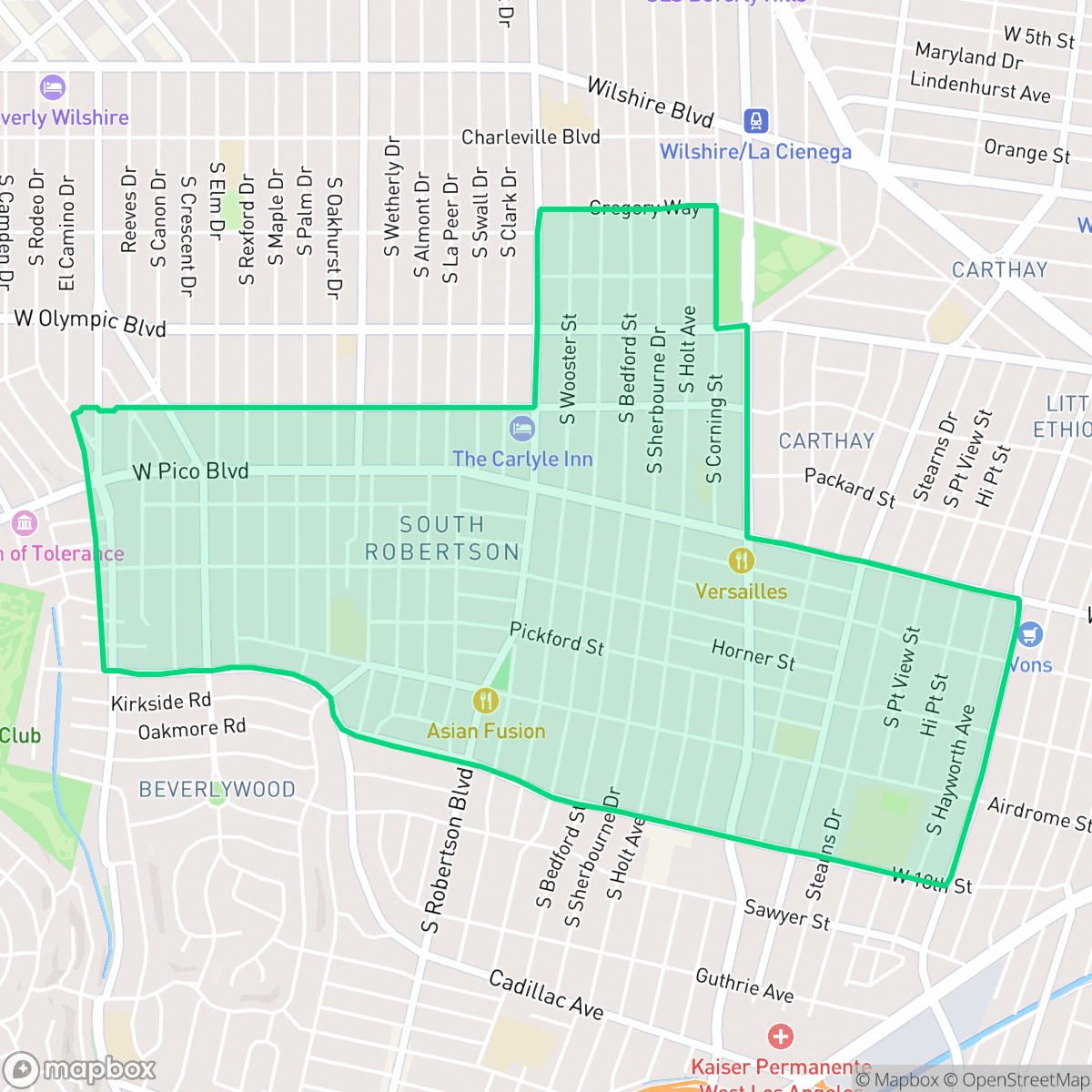
About Pico-Robertson
Once an expanse of farms and oil fields atop the Beverly Hills and La Brea oil fields, Pico-Robertson began its transformation in the 1910s when German Ashkenazi Jews first settled the area. By the late 1930s, the neighborhood was fully built out with a walkable mix of single-family homes and apartment buildings. Following World War II, it grew into a prominent Jewish enclave, which further expanded in the 1980s with the arrival of Orthodox families and Iranian Jews fleeing the 1979 revolution. Today, Pico-Robertson is celebrated as the spiritual heartland of Los Angeles’s Jewish community. It is defined by its vibrant, highly walkable "Kosher Economy" along Pico Boulevard, numerous synagogues, and major cultural landmarks like the Simon Wiesenthal Center and the Museum of Tolerance.
The neighborhood features a dense urban fabric composed of a mix of multi-family apartments and single-family homes. According to iHuus data, the area maintains a high walkability score, supported by a consistent grid of sidewalks that makes daily errands easy to complete on foot. The district is strictly residential and light commercial in nature, ensuring that residents remain free from industrial hazards while having access to a variety of local businesses and cultural institutions.
Prospective residents should consider that the high density of the area results in limited privacy and elevated noise levels from surrounding streets. While the neighborhood offers excellent access to community resources, it lacks significant public green space, relying instead on narrow sidewalk verges. It is best suited for those who prioritize a convenient, transit-oriented lifestyle and proximity to local amenities over expansive private yards or the quiet atmosphere of low-density suburban environments.
Neighborhood Scores Across 15 Qualities
Residential structures are closely packed with limited buffers between properties, mirroring the average density found across Los Angeles. Many buildings and apartment complexes share side yards or are positioned with very minimal distance between them.
A complete network of sidewalks and frequent crosswalks makes navigating the area on foot very easy. This dense grid provides superior pedestrian connectivity compared to the Los Angeles average.
Large homes with private pools and well-maintained landscaping characterize much of the area, providing a more polished aesthetic than the Los Angeles average. While some denser apartment blocks exist, the neighborhood is defined by its high-end residential properties and manicured greenery.
Abundant green space from nearby golf courses and school athletic fields provides better walking options than the city average. However, some residential sectors feature narrow sidewalk verges and limited public parks for pet exercise.
Residential streets feature a blend of tree-lined single-family homes and multi-unit apartment blocks. This density of housing and greenery is roughly comparable to the broader Los Angeles area.
Local dining and social hubs provide a notable concentration of activity that is significantly more lively than the Los Angeles average. This energy varies from quiet, green suburban blocks to denser, mid-rise districts filled with diverse restaurants and local landmarks according to iHuus data.
Frequent noise from nearby freeway traffic and transit corridors is a persistent feature of this area. This level of acoustic disturbance is slightly higher than the city average, according to iHuus data.
Air quality remains consistently good with only rare instances of elevated readings, performing similarly to the broader Los Angeles area according to iHuus data.
Industrial hazards, warehouses, and heavy manufacturing are absent from the area. This neighborhood offers a cleaner environment than the Los Angeles average, as it is composed strictly of residential and light commercial structures.
Health insurance access among residents is notably higher than the Los Angeles average, according to iHuus data.
Voting patterns and census indicators show a highly progressive political climate that is only slightly less liberal than the broader Los Angeles average.
Residents live alongside a diverse range of age groups, including young professionals, families, and seniors. This demographic spread is roughly in line with the broader Los Angeles area, according to iHuus data.
Property within the 100-year floodplain presents a higher risk of inundation than most of Los Angeles; according to iHuus data, residents should anticipate that flood insurance will likely be a requirement for local properties.
Address-Level Insights for Pico-Robertson


iHuus Neighborhood Intelligence Insights
Get address-level neighborhood insights for Pico-Robertson
- Street-level scores — see how individual blocks compare, not just neighborhood averages
- Micro-zone boundaries — identify quiet pockets, flood boundaries, and walkable clusters before you visit
- 15 dimensions in full — walkability, noise, air quality, school quality, insurance coverage, population age profile, urban/rural index, and more
- Boundary risk alerts — know if your address sits near a block boundary where scores drop, the kind of detail no listing will ever mention
- School insights — individual school ratings and insights, not just district-level data
- Compare before you commit — side-by-side data across neighborhoods, down to block precision
No credit card required
Compare with Any Neighborhood
| Dimension | Pico-Robertson | Adams-Normandie |
|---|---|---|
| 🚶 Walkabilityavg 8.9 | ||
| 🔊 Acoustic Comfortavg 2.91 | ||
| 🤫 Privacy Indexavg 4.14 | ||
| 🎨 Visual Appealavg 6.58 | ||
| 🐕 Dog Friendlinessavg 5.04 | ||
| 🗺️ Urban-Rural Indexavg 5.96 | ||
| ✨ Neighborhood Vibeavg 5.07 | ||
| 🏥 Health Insurance Coverageavg 6.2 | ||
| 🌿 Air Qualityavg 8.12 | ||
| 🏭 Industrial Proximityavg 8.46 | ||
| 🌊 Flood Safetyavg 2.66 | ||
| 🗳️ Ideological Leanavg 9.56 | ||
| 👥 Population Age Profileavg 4.85 | ||
| 🔥 Fire Safetyavg 0.18 | ||
| 🏫 School Quality |
Pico-Robertson Rankings
School Districts Serving Pico-Robertson
School Insights for Pico-Robertson
Below average outcomes; significant attendance and academic challenges.
School Insights
See what's really behind every school rating near Pico-Robertson
- Individual school ratings — each school's own score with outcome context, not just a district average
- Enrollment & class size data — student-to-teacher ratio and how it compares to the state average
- Full demographics breakdown — ethnicity and gender composition for every school in the enrollment zone
- Every school in the district — all schools within the enrollment boundary ranked by rating, not just the closest one
- Grade levels & benchmarks — elementary through high school, with below/above state-average flags
No credit card required