Park La Brea, Los Angeles
Updated · 4,610 residents
Park La Brea is a highly walkable urban enclave in the Miracle Mile district, known for its dense collection of modernist towers and garden townhouses. Residents benefit from proximity to cultural hubs like LACMA and a variety of local dining options, though the area experiences notable road noise and limited residential privacy.
Key Highlights
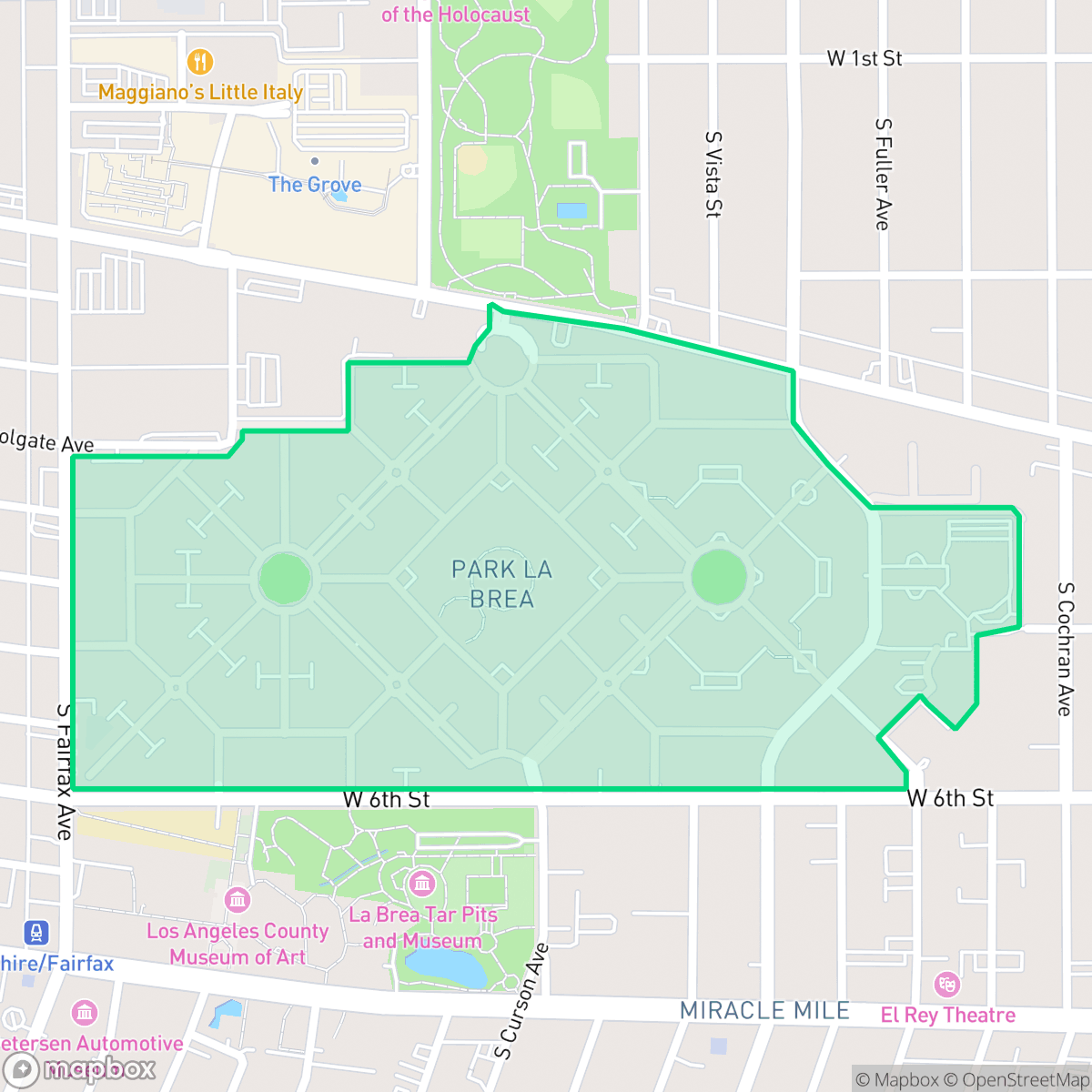
About Park La Brea
Developed by the Metropolitan Life Insurance Company starting in 1941, Park La Brea is a historic 160-acre residential community in Los Angeles’s Miracle Mile district. Built on land that was once part of the Mexican-era Rancho La Brea, the complex was designed to alleviate post-World War II housing shortages. Architects Leonard Schultze & Associates and Earl T. Heitschmidt, alongside landscape architect Tommy Tomson, created an intricate, geometric street layout featuring octagonal and diagonal grids. The neighborhood's distinctive architecture blends low-rise, Hollywood Regency-style garden townhouses with eighteen 13-story, X-shaped modernist towers completed in 1952. Housing over 10,000 residents in more than 4,200 units, Park La Brea remains the largest housing development west of the Mississippi River and a landmark of mid-century urban planning.
Centrally located in the Miracle Mile, this dense residential community offers a high degree of walkability and access to world-class cultural institutions. According to iHuus data, the area maintains a lively atmosphere supported by its proximity to museums and diverse culinary offerings, including popular local dining spots. The layout encourages pedestrian movement, making it a convenient choice for those who prioritize proximity to urban amenities over the seclusion of traditional single-family housing.
Prospective residents should note that the high-density nature of the community results in a lower privacy index and consistent noise levels from surrounding road traffic. While the neighborhood boasts excellent air quality and a strong sense of community, it is best suited for those comfortable with urban living in a compact, multi-story environment. The area is particularly welcoming to pet owners due to its abundant green spaces, though individuals should be aware of the regional risks regarding flood and fire safety.
Neighborhood Scores Across 15 Qualities
Residential structures and apartment blocks are situated closely together with minimal setbacks. This density results in a level of privacy that is roughly comparable to the city average, according to iHuus data.
Extensive sidewalk networks and marked crosswalks make navigating the area on foot very easy. According to iHuus data, the neighborhood offers superior walkability compared to the Los Angeles average due to its continuous pedestrian paths and proximity to retail zones.
Manicured grounds and visible upscale amenities like rooftop pools contribute to a well-maintained atmosphere that is consistent with the city average. This high-density area maintains a sense of order through shared amenities and polished landscaping, according to iHuus data.
Extensive green spaces within the complex and nearby LACMA park provide ample walking areas that are notably more accessible than the city average. Wide paths and street-side greenery offer a secure environment for pet owners.
Balanced streetscapes and green spaces create a suburban atmosphere that is consistent with the Los Angeles average. This mix of mid-rise residential towers and garden apartments provides an even distribution of built environment and open space according to iHuus data.
Social activity varies between dense pockets of dining and museums and quieter, more suburban-style streets. This level of liveliness is roughly in line with the broader Los Angeles area, according to iHuus data.
Frequent noise from nearby freeways and transit corridors impacts the area. According to iHuus data, acoustic comfort levels are higher than the Los Angeles average, though significant sounds from major thoroughfares remain present.
Air quality remains consistently high with minimal health concerns. According to iHuus data, the air quality in this area is better than the Los Angeles average.
Industrial facilities and warehouses are entirely absent from the area, providing a cleaner environment than much of Los Angeles. According to iHuus data, the landscape consists exclusively of residential and light commercial zones with no detectable heavy manufacturing or pollution sources.
Health insurance access is significantly higher than the Los Angeles average, ensuring most residents have reliable medical coverage. According to iHuus data, nearly all inhabitants in this area are covered by a health plan.
Voting patterns and census indicators reflect a deeply liberal political leaning that is slightly more pronounced than the Los Angeles average.
A balanced mix of young professionals, families, and seniors characterizes the local community. This demographic distribution is slightly more varied than the typical Los Angeles profile, according to iHuus data.
Flood risk in this area is higher than the Los Angeles average; however, the lack of a detailed FEMA study means the precise level of danger remains undetermined.
Address-Level Insights for Park La Brea


iHuus Neighborhood Intelligence Insights
Get address-level neighborhood insights for Park La Brea
- Street-level scores — see how individual blocks compare, not just neighborhood averages
- Micro-zone boundaries — identify quiet pockets, flood boundaries, and walkable clusters before you visit
- 15 dimensions in full — walkability, noise, air quality, school quality, insurance coverage, population age profile, urban/rural index, and more
- Boundary risk alerts — know if your address sits near a block boundary where scores drop, the kind of detail no listing will ever mention
- School insights — individual school ratings and insights, not just district-level data
- Compare before you commit — side-by-side data across neighborhoods, down to block precision
No credit card required
Compare with Any Neighborhood
| Dimension | Park La Brea | Adams-Normandie |
|---|---|---|
| 🚶 Walkabilityavg 8.9 | ||
| 🔊 Acoustic Comfortavg 2.91 | ||
| 🤫 Privacy Indexavg 4.14 | ||
| 🎨 Visual Appealavg 6.58 | ||
| 🐕 Dog Friendlinessavg 5.04 | ||
| 🗺️ Urban-Rural Indexavg 5.96 | ||
| ✨ Neighborhood Vibeavg 5.07 | ||
| 🏥 Health Insurance Coverageavg 6.2 | ||
| 🌿 Air Qualityavg 8.12 | ||
| 🏭 Industrial Proximityavg 8.46 | ||
| 🌊 Flood Safetyavg 2.66 | ||
| 🗳️ Ideological Leanavg 9.56 | ||
| 👥 Population Age Profileavg 4.85 | ||
| 🔥 Fire Safetyavg 0.18 | ||
| 🏫 School Quality |
Park La Brea Rankings
School Districts Serving Park La Brea
School Insights for Park La Brea
Below average outcomes; significant attendance and academic challenges.
School Insights
See what's really behind every school rating near Park La Brea
- Individual school ratings — each school's own score with outcome context, not just a district average
- Enrollment & class size data — student-to-teacher ratio and how it compares to the state average
- Full demographics breakdown — ethnicity and gender composition for every school in the enrollment zone
- Every school in the district — all schools within the enrollment boundary ranked by rating, not just the closest one
- Grade levels & benchmarks — elementary through high school, with below/above state-average flags
No credit card required