Pacoima, Los Angeles
Updated · 73,909 residents
Pacoima is a dense, grid-based neighborhood in the San Fernando Valley known for its rich cultural heritage and extensive mural art. While residents benefit from a highly walkable street layout, the area is characterized by tightly packed housing and significant noise from nearby freeways and industrial activity.
Key Highlights
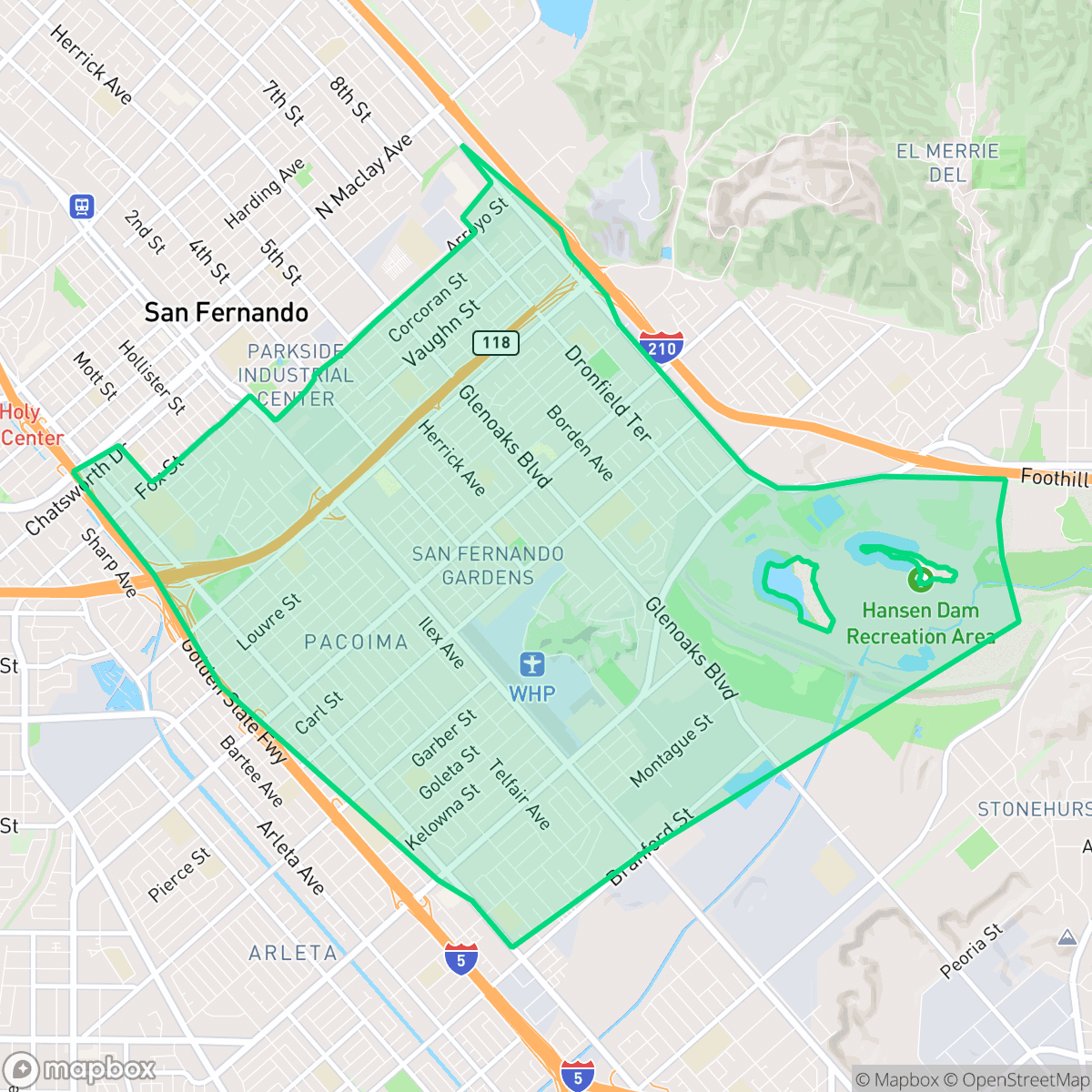
About Pacoima
Established in 1887 on ancestral Tataviam land (originally *Pakoinga*), Pacoima transitioned from a planned suburb into a thriving agricultural hub after an 1891 flood. Due to racially restrictive covenants elsewhere in the San Fernando Valley, it became a vital mid-century enclave for Black, Japanese, and Latino families. Key landmarks include the 1950 Joe Louis Homes—built to bypass redlining—and the historic StylesVille Barbershop, the Valley’s oldest continuously operating Black-owned barbershop. The neighborhood's civil rights legacy was heavily shaped by Reverend Hillery T. Broadous of Calvary Baptist Church. Culturally, Pacoima is celebrated as the home of rock legend Ritchie Valens and gospel icon Andraé Crouch, as well as for its vibrant "Mural Mile," which showcases the community's rich artistic heritage.
This neighborhood features a classic suburban grid layout that provides consistent pedestrian access with sidewalks on both sides of most residential streets. The landscape is a blend of mid-century tract housing and industrial zones, with large-scale warehouses and logistics centers situated near major transit corridors. Residents have access to a variety of local dining options, particularly along the main commercial arterials, which contribute to the area's distinct local character. According to iHuus data, the community remains a central hub for San Fernando Valley culture, balancing its historical roots with the demands of a modern, working-class suburban environment.
Prospective residents should note that the area is quite dense, with homes often spaced less than ten meters apart, which limits private outdoor space. The neighborhood experiences elevated noise levels primarily due to road traffic from surrounding highways and the presence of nearby industrial operations. While the school landscape is varied, featuring a mix of charter and traditional district schools, families often navigate a range of academic outcomes. It is best suited for those who prioritize a walkable, grid-based neighborhood with a strong sense of community history over the quietude and privacy found in lower-density suburban settings.
Neighborhood Scores Across 15 Qualities
Residential structures are often closely packed with minimal side-yard separation, though density remains slightly above the Los Angeles average. According to iHuus data, the area features a mix of tightly spaced homes and apartment complexes alongside more traditional suburban layouts.
Most residential streets feature consistent sidewalks and marked crosswalks, though heavy traffic from nearby highways and industrial zones can create barriers for pedestrians. This level of walkability is largely comparable to the rest of Los Angeles.
Standard tract housing and apartment blocks dominate the landscape, characterized by uniform rooflines and small yards. According to iHuus data, the area offers a utilitarian aesthetic that sits below the Los Angeles average for visual variety and greenery.
Public park access and wide green verges are sparse throughout much of the neighborhood, making it less dog friendly than the Los Angeles average. While some areas benefit from proximity to large golf courses and school fields, most residential blocks rely on private fenced yards for greenery.
Frequent open land and scattered homes provide a more semi-rural feel than much of the Los Angeles area. Residents will notice a landscape defined by a mix of single-family housing and expansive industrial or recreational spaces.
Suburban streets and industrial corridors create a subdued atmosphere with limited local commerce. Most dining and essential services require a vehicle, as the business landscape is sparser than the Los Angeles average.
Frequent noise from nearby railroad tracks and heavy freeway traffic creates a loud environment. This level of acoustic disturbance is higher than the typical experience found across Los Angeles.
Air quality is consistently good with rare instances of elevated readings, staying very close to the Los Angeles city average according to iHuus data.
Logistics hubs, large warehouses, and Whiteman Airport introduce notable noise and traffic from semi-trucks, making industrial proximity lower than the Los Angeles average. While many areas remain primarily residential, certain pockets near major freeways and shipping yards present higher levels of activity and potential pollution.
Health insurance coverage among residents is slightly higher than the Los Angeles average, according to iHuus data. This level of coverage provides a relatively consistent baseline for access to medical services within the community.
Voting patterns and census indicators show a highly liberal political leaning that is consistent with the broader Los Angeles area, according to iHuus data.
Residents live alongside a balanced mix of young adults, families, and seniors. According to iHuus data, the age distribution is slightly more varied than the average found across Los Angeles.
Significant flood hazards are present in this area, which is notably higher than the Los Angeles average. Residents should anticipate potential complications with property insurance costs and flood mitigation requirements.
Fire safety conditions in this area are notably lower than the Los Angeles average, according to iHuus data. Residents should be aware of increased vulnerability to wildfire-related hazards.
Address-Level Insights for Pacoima


iHuus Neighborhood Intelligence Insights
Get address-level neighborhood insights for Pacoima
- Street-level scores — see how individual blocks compare, not just neighborhood averages
- Micro-zone boundaries — identify quiet pockets, flood boundaries, and walkable clusters before you visit
- 15 dimensions in full — walkability, noise, air quality, school quality, insurance coverage, population age profile, urban/rural index, and more
- Boundary risk alerts — know if your address sits near a block boundary where scores drop, the kind of detail no listing will ever mention
- School insights — individual school ratings and insights, not just district-level data
- Compare before you commit — side-by-side data across neighborhoods, down to block precision
No credit card required
Compare with Any Neighborhood
| Dimension | Pacoima | Adams-Normandie |
|---|---|---|
| 🚶 Walkabilityavg 8.9 | ||
| 🔊 Acoustic Comfortavg 2.91 | ||
| 🤫 Privacy Indexavg 4.14 | ||
| 🎨 Visual Appealavg 6.58 | ||
| 🐕 Dog Friendlinessavg 5.04 | ||
| 🗺️ Urban-Rural Indexavg 5.96 | ||
| ✨ Neighborhood Vibeavg 5.07 | ||
| 🏥 Health Insurance Coverageavg 6.2 | ||
| 🌿 Air Qualityavg 8.12 | ||
| 🏭 Industrial Proximityavg 8.46 | ||
| 🌊 Flood Safetyavg 2.66 | ||
| 🗳️ Ideological Leanavg 9.56 | ||
| 👥 Population Age Profileavg 4.85 | ||
| 🔥 Fire Safetyavg 0.18 | ||
| 🏫 School Quality |
Pacoima Rankings
School Districts Serving Pacoima
School Insights for Pacoima
Below average outcomes; significant attendance and academic challenges.
School Insights
See what's really behind every school rating near Pacoima
- Individual school ratings — each school's own score with outcome context, not just a district average
- Enrollment & class size data — student-to-teacher ratio and how it compares to the state average
- Full demographics breakdown — ethnicity and gender composition for every school in the enrollment zone
- Every school in the district — all schools within the enrollment boundary ranked by rating, not just the closest one
- Grade levels & benchmarks — elementary through high school, with below/above state-average flags
No credit card required