Pacific Palisades, Los Angeles
Updated · 26,173 residents
Pacific Palisades is a coastal community defined by its hilly terrain, high visual appeal, and proximity to the Pacific Ocean. While the area offers excellent access to parks and dog-friendly green spaces, it remains a quiet, car-dependent residential enclave with limited commercial density.
Key Highlights
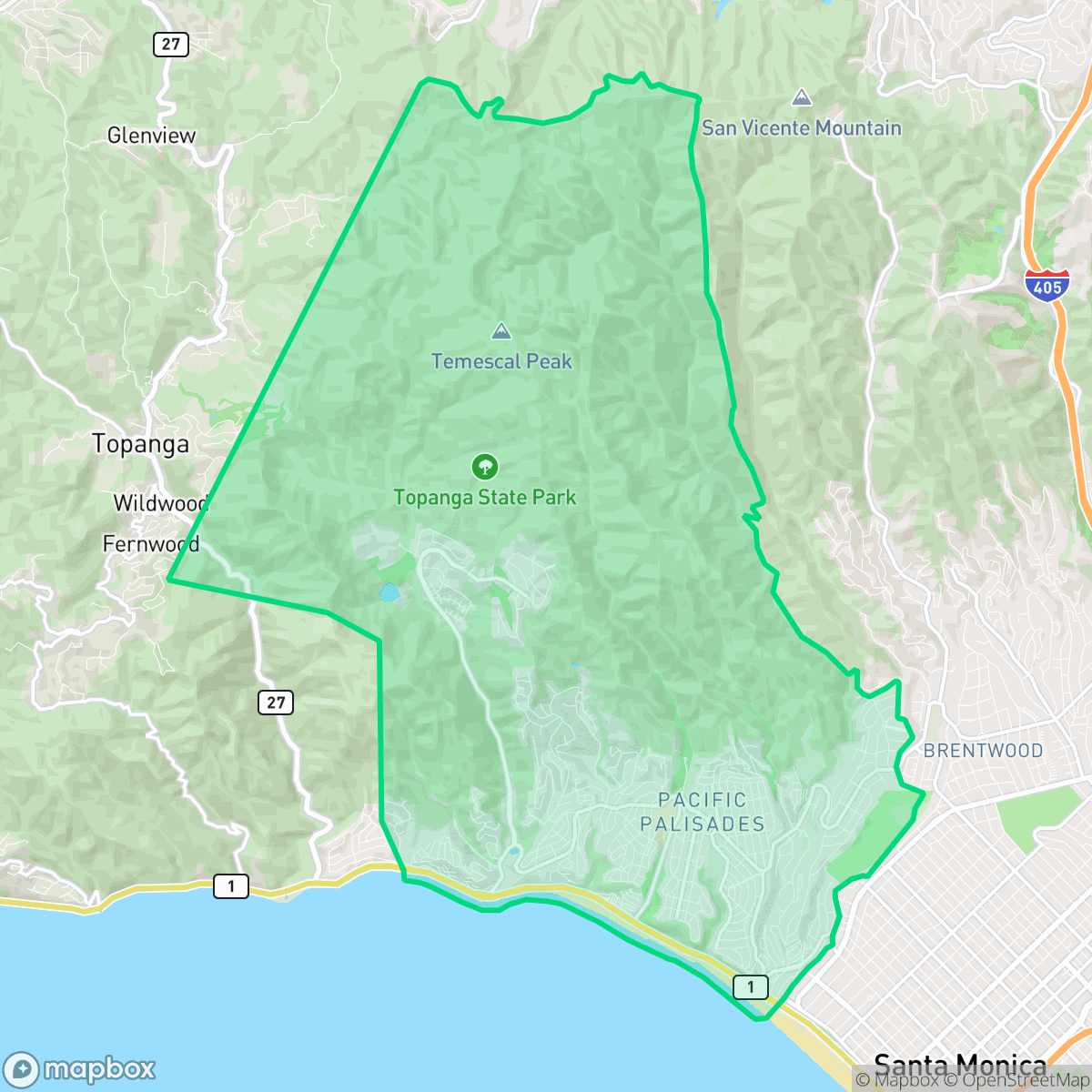
About Pacific Palisades
Originally part of the 1839 Mexican land grant Rancho Boca de Santa Monica, Pacific Palisades was formally established in 1921 by a Methodist organization led by Reverend Charles H. Scott. The founders envisioned a religious and educational commune, centering early development around the "Alphabet Streets" and the historic 1924 Business Block building. During the 1930s and 1940s, the neighborhood became a prominent refuge for German-Jewish intellectuals and artists fleeing the Holocaust, including Thomas Mann and Lion Feuchtwanger, who gathered at the historic Villa Aurora. Architecturally, the area is renowned for Mid-Century Modern masterpieces, most notably Charles and Ray Eames' landmark Eames House (Case Study House No. 8). Other cultural landmarks defining its coastal character include the Getty Villa and the Self-Realization Fellowship Lake Shrine.
The area is characterized by its affluent, low-density residential layout, featuring large custom homes and manicured landscapes that contribute to its high visual appeal. Residents benefit from significant open space and proximity to the coast, which supports an active lifestyle for pet owners and outdoor enthusiasts. According to iHuus data, the neighborhood maintains a suburban structure with a mix of residential blocks and scattered local services, requiring residents to rely on vehicles for most daily errands. The community provides a serene atmosphere, though it is punctuated by a steady rhythm of residential life rather than high-intensity commercial activity.
Prospective residents should consider the trade-off between the quiet, secluded character of the neighborhood and its limited walkability. While the area provides access to highly rated schools like Palisades Charter High and Canyon Charter Elementary, it is located in a high-risk fire zone that necessitates careful planning and awareness. The community is well-suited for families and individuals seeking a peaceful, affluent environment with strong health insurance coverage and a stable, liberal-leaning social fabric.
Neighborhood Scores Across 15 Qualities
Residential spacing provides more seclusion than the typical Los Angeles neighborhood, as many homes feature vegetation buffers and private yards. According to iHuus data, while some hillside structures are closely positioned, most properties maintain a notable distance from their neighbors.
Pedestrian infrastructure includes sidewalks and dedicated crossings on many streets, though walkability is lower than the Los Angeles average. Many residential areas feature consistent sidewalks on main roads and low-traffic streets, according to iHuus data.
Expansive custom estates, private pools, and meticulously maintained landscaping create a highly scenic environment that is notably more visually polished than the Los Angeles average. According to iHuus data, the area is characterized by low density residential properties with significant privacy buffers.
Wide green verges and connected parkland trails provide highly secure walking environments. According to iHuus data, the abundance of continuous green space and large public fields makes this area significantly more dog friendly than the Los Angeles average.
Frequent open land and woodland areas provide a more semi-rural atmosphere than most of Los Angeles. This character is shaped by scattered homes and hillside developments, according to iHuus data.
Low-density residential life and vast open spaces dominate the landscape, offering a serene environment with significantly less activity than the city average. Most daily errands and social gatherings require a vehicle, as local businesses are scattered and lack a concentrated commercial character.
Frequent noise from nearby major roadways and transit corridors is present, though levels are only slightly higher than the Los Angeles average. According to iHuus data, residents may experience intermittent disturbances from heavy vehicle traffic and nearby infrastructure.
Air quality remains consistently high with rare instances of elevated readings, performing nearly in line with the Los Angeles average according to iHuus data.
Industrial presence is nonexistent here, as the area consists entirely of residential and light commercial zones. According to iHuus data, this lack of warehouses or hazardous facilities makes the neighborhood much cleaner of industrial impact than the Los Angeles average.
Health insurance access is exceptionally high among residents, significantly surpassing the average seen across Los Angeles. According to iHuus data, nearly all inhabitants are covered by a health plan.
Voting patterns and census indicators reflect a predominantly liberal leaning that is very similar to the broader Los Angeles area, according to iHuus data.
A diverse range of age groups resides here, including young professionals, families, and seniors. This demographic spread is more balanced than the average seen across Los Angeles, according to iHuus data.
Residual flood risks exist within certain areas of the neighborhood, though the safety level remains significantly higher than the Los Angeles average according to iHuus data.
High vulnerability to wildfires persists in this area, matching the severe risk levels found across the rest of Los Angeles. According to iHuus data, residents must prioritize maximum fire protection measures and preparedness due to the extreme hazard level.
Address-Level Insights for Pacific Palisades


iHuus Neighborhood Intelligence Insights
Get address-level neighborhood insights for Pacific Palisades
- Street-level scores — see how individual blocks compare, not just neighborhood averages
- Micro-zone boundaries — identify quiet pockets, flood boundaries, and walkable clusters before you visit
- 15 dimensions in full — walkability, noise, air quality, school quality, insurance coverage, population age profile, urban/rural index, and more
- Boundary risk alerts — know if your address sits near a block boundary where scores drop, the kind of detail no listing will ever mention
- School insights — individual school ratings and insights, not just district-level data
- Compare before you commit — side-by-side data across neighborhoods, down to block precision
No credit card required
Compare with Any Neighborhood
| Dimension | Pacific Palisades | Adams-Normandie |
|---|---|---|
| 🚶 Walkabilityavg 8.9 | ||
| 🔊 Acoustic Comfortavg 2.91 | ||
| 🤫 Privacy Indexavg 4.14 | ||
| 🎨 Visual Appealavg 6.58 | ||
| 🐕 Dog Friendlinessavg 5.04 | ||
| 🗺️ Urban-Rural Indexavg 5.96 | ||
| ✨ Neighborhood Vibeavg 5.07 | ||
| 🏥 Health Insurance Coverageavg 6.2 | ||
| 🌿 Air Qualityavg 8.12 | ||
| 🏭 Industrial Proximityavg 8.46 | ||
| 🌊 Flood Safetyavg 2.66 | ||
| 🗳️ Ideological Leanavg 9.56 | ||
| 👥 Population Age Profileavg 4.85 | ||
| 🔥 Fire Safetyavg 0.18 | ||
| 🏫 School Quality |
Pacific Palisades Rankings
School Districts Serving Pacific Palisades
School Insights for Pacific Palisades
Below average outcomes; significant attendance and academic challenges.
School Insights
See what's really behind every school rating near Pacific Palisades
- Individual school ratings — each school's own score with outcome context, not just a district average
- Enrollment & class size data — student-to-teacher ratio and how it compares to the state average
- Full demographics breakdown — ethnicity and gender composition for every school in the enrollment zone
- Every school in the district — all schools within the enrollment boundary ranked by rating, not just the closest one
- Grade levels & benchmarks — elementary through high school, with below/above state-average flags
No credit card required