Northridge, Los Angeles
Updated · 77,095 residents
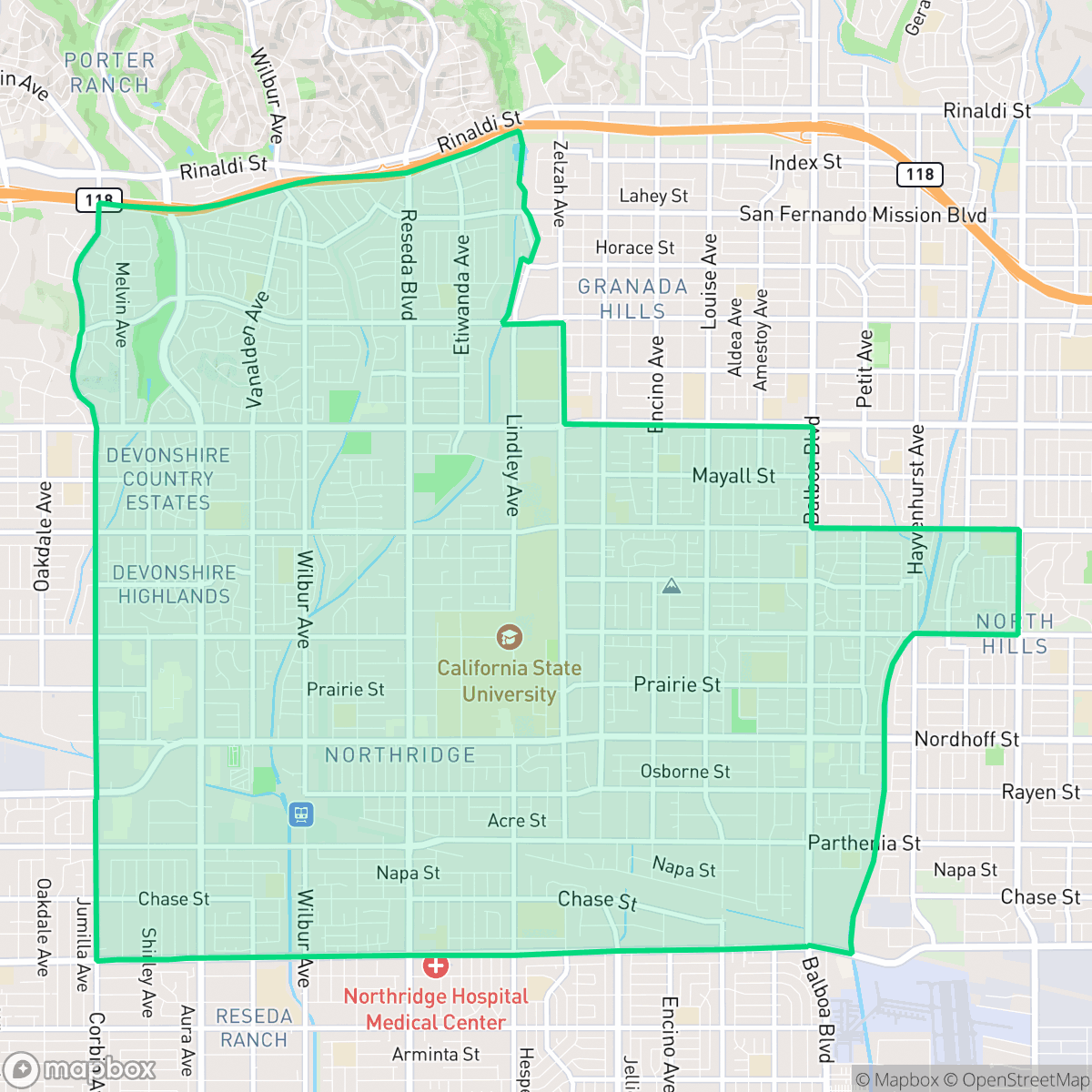
Northridge is a manicured, suburban community in the San Fernando Valley known for its well-maintained homes and high walkability. Residents enjoy a quiet, semi-rural atmosphere with easy access to extensive pedestrian infrastructure and local educational institutions.
Key Highlights
About Northridge
Originally settled as the agricultural community of Zelzah in 1908, the area was renamed Northridge in 1938 to reflect its topography. Once known for its citrus and walnut orchards, the neighborhood famously earned the moniker 'Horse Capital of the West' during its era as a ranching hub for Hollywood stars. Following World War II, Northridge underwent a rapid suburban transformation, replacing rural tracts with single-family homes. The neighborhood gained international prominence as the epicenter of the 1994 Northridge earthquake, a defining event in its modern history. Today, Northridge is anchored by California State University, Northridge (CSUN), which has served as a primary cultural and educational driver since its establishment in 1956, and the expansive Northridge Fashion Center, a long-standing commercial landmark that reflects the area's mid-century transition into a major residential and institutional center within the San Fernando Valley.
The neighborhood is defined by its upscale, polished aesthetic and an abundance of private backyard pools. The presence of California State University, Northridge, provides a youthful energy that complements the area's balanced age distribution. While it maintains a quiet, suburban rhythm, the community offers high connectivity for pedestrians through a network of continuous sidewalks and well-marked intersections, which, according to iHuus data, makes it more accessible than many other parts of the city. The area is primarily residential with minimal industrial presence, fostering a calm environment for its diverse population of families and professionals. While the neighborhood is highly accessible on foot, most major dining and social hubs require a vehicle to reach. Prospective residents should note that the area experiences a steady hum from nearby traffic and carries an elevated risk of flooding in certain zones. Despite these factors, the community benefits from high levels of health insurance coverage and generally clean air, making it a stable choice for those seeking a balanced suburban lifestyle.
Neighborhood Scores Across 15 Qualities
Residential spacing offers a balanced mix of private yards and closely situated homes. According to iHuus data, this level of separation between neighbors is notably higher than the Los Angeles average.
Continuous sidewalks and clearly marked crosswalks at major intersections facilitate easy pedestrian movement throughout the residential and commercial zones. This level of connectivity is slightly above the Los Angeles average, according to iHuus data.
Well-maintained properties and a high density of private backyard pools create a polished aesthetic that is noticeably more upscale than the Los Angeles average. According to iHuus data, the area features frequent large homes and manicured landscapes.
Wide sidewalk verges and large public sports fields provide reliable space for walking pets. This level of accessibility for dog owners is slightly higher than the average for Los Angeles.
Sprawling suburban layouts with single-family homes and commercial strips characterize this area. According to iHuus data, the presence of open land and scattered development makes this neighborhood slightly more semi-rural than the Los Angeles average.
Suburban streets and green spaces provide a calm atmosphere, though most dining and social hubs require a car to reach. Activity levels are slightly lower than the city average, as many areas are characterized by serene residential blocks and light industrial pockets.
Continuous noise from nearby busy thoroughfares is a common feature here, though levels remain more moderate than the city average according to iHuus data.
Air quality remains mostly clean with only rare instances of elevated readings. According to iHuus data, the air quality in Northridge is slightly below the Los Angeles city average.
Industrial presence is minimal here, as the area consists almost entirely of residential, educational, and light commercial land use. According to iHuus data, this neighborhood lacks the heavy warehouses or hazardous industrial facilities found more frequently in other parts of the city.
Health insurance access is more prevalent here than in most parts of Los Angeles. According to iHuus data, a significant majority of the local population maintains coverage.
Voting patterns and census indicators show a predominantly liberal leaning, though this tendency is slightly less pronounced than the average found across Los Angeles.
A balanced range of young adults, families, and older residents characterizes the area. According to iHuus data, this age distribution is very similar to the broader Los Angeles average.
Flood risk is higher than the Los Angeles average due to parts of the area falling within a designated floodplain. Residents should account for the potential necessity of flood insurance according to iHuus data.
Address-Level Insights for Northridge


iHuus Neighborhood Intelligence Insights
Get address-level neighborhood insights for Northridge
- Street-level scores — see how individual blocks compare, not just neighborhood averages
- Micro-zone boundaries — identify quiet pockets, flood boundaries, and walkable clusters before you visit
- 15 dimensions in full — walkability, noise, air quality, school quality, insurance coverage, population age profile, urban/rural index, and more
- Boundary risk alerts — know if your address sits near a block boundary where scores drop, the kind of detail no listing will ever mention
- School insights — individual school ratings and insights, not just district-level data
- Compare before you commit — side-by-side data across neighborhoods, down to block precision
No credit card required
Compare with Any Neighborhood
| Dimension | Northridge | Adams-Normandie |
|---|---|---|
| 🚶 Walkabilityavg 8.9 | ||
| 🔊 Acoustic Comfortavg 2.91 | ||
| 🤫 Privacy Indexavg 4.14 | ||
| 🎨 Visual Appealavg 6.58 | ||
| 🐕 Dog Friendlinessavg 5.04 | ||
| 🗺️ Urban-Rural Indexavg 5.96 | ||
| ✨ Neighborhood Vibeavg 5.07 | ||
| 🏥 Health Insurance Coverageavg 6.2 | ||
| 🌿 Air Qualityavg 8.12 | ||
| 🏭 Industrial Proximityavg 8.46 | ||
| 🌊 Flood Safetyavg 2.66 | ||
| 🗳️ Ideological Leanavg 9.56 | ||
| 👥 Population Age Profileavg 4.85 | ||
| 🔥 Fire Safetyavg 0.18 | ||
| 🏫 School Quality |
Northridge Rankings
School Districts Serving Northridge
School Insights for Northridge
Below average outcomes; significant attendance and academic challenges.
School Insights
See what's really behind every school rating near Northridge
- Individual school ratings — each school's own score with outcome context, not just a district average
- Enrollment & class size data — student-to-teacher ratio and how it compares to the state average
- Full demographics breakdown — ethnicity and gender composition for every school in the enrollment zone
- Every school in the district — all schools within the enrollment boundary ranked by rating, not just the closest one
- Grade levels & benchmarks — elementary through high school, with below/above state-average flags
No credit card required