Northridge West Neighborhood Council District, Los Angeles
Updated · 21,252 residents
Northridge West is a well-manicured suburban community known for its high-performing charter schools and classic ranch-style architecture. While the neighborhood offers a highly walkable grid layout with consistent sidewalks, residents remain largely dependent on vehicles for daily errands and commuting.
Key Highlights
About Northridge West Neighborhood Council District
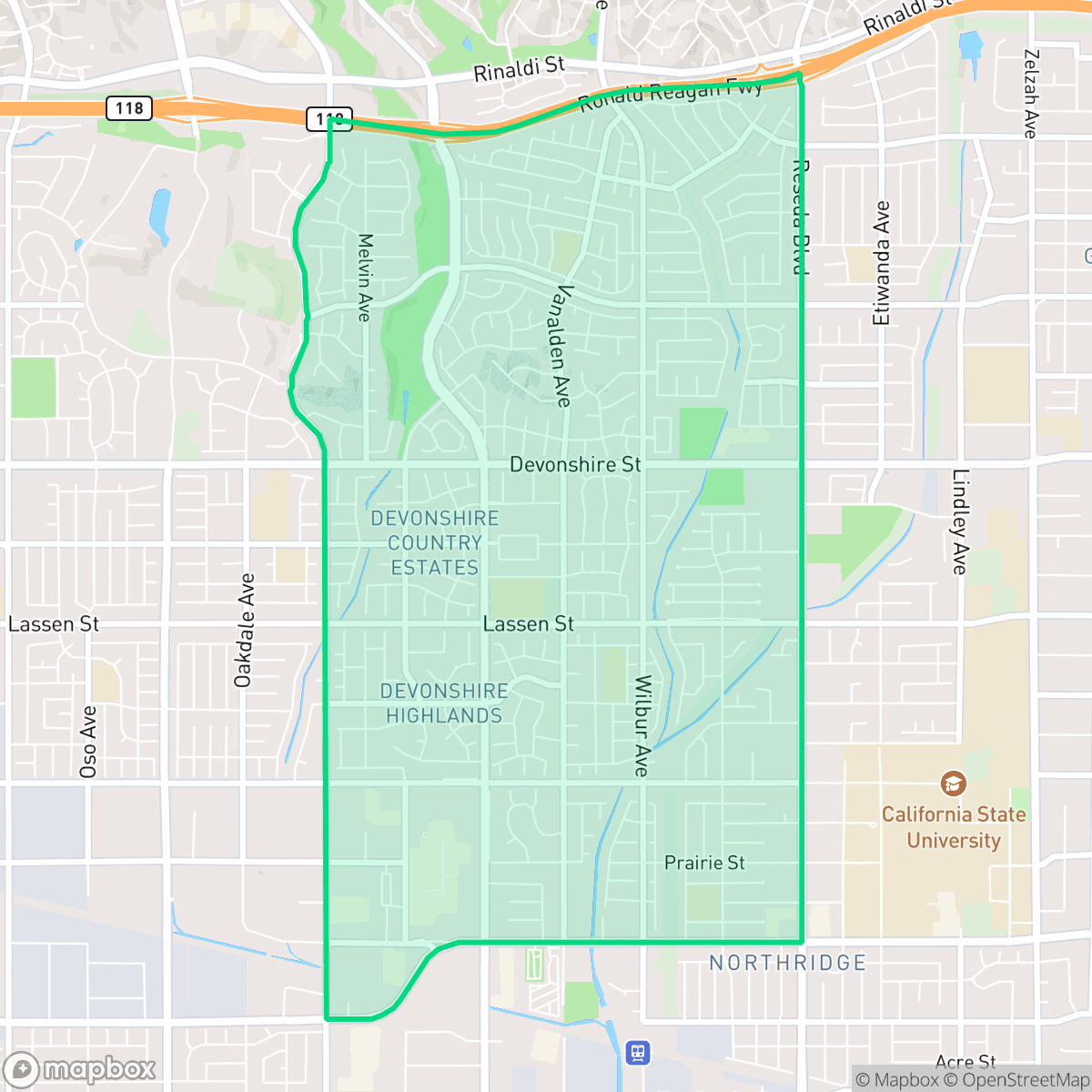
The Northridge West Neighborhood Council District, bounded by the 118 Freeway, Reseda Boulevard, Nordhoff Street, and Corbin Avenue, has a rich agricultural and equestrian heritage. Once part of the vast citrus groves and ranchos of the San Fernando Valley, the area earned a reputation during the mid-20th century as part of the "Horse Capital of the West". Its most prominent historic landmark is the Oakridge Estate (Historic-Cultural Monument #484) on Devonshire Street. Built in 1937 as an Irish farmhouse designed by legendary architect Paul R. Williams, it was originally the 130-acre Marwyck Ranch, a thoroughbred breeding farm co-founded by actress Barbara Stanwyck and Zeppo Marx. Later owned by actor Jack Oakie, the estate is now preserved as a public park. Following World War II, the district transitioned into a suburban residential community characterized by classic Ranch-style home subdivisions.
This district functions as a stable residential enclave in the San Fernando Valley, defined by its blend of single-family homes, private pools, and established landscaping. The area is particularly recognized for its academic environment, featuring top-rated institutions such as Beckford Charter for Enriched Studies and Alfred B. Nobel Charter Middle. Its infrastructure supports a quiet, suburban lifestyle, with well-defined streets that provide reliable pedestrian access despite the overall car-oriented nature of the local economy.
Prospective residents should note that the neighborhood experiences moderate noise levels primarily due to local road traffic. While the area maintains excellent air quality and a lack of industrial hazards, it faces significant challenges regarding fire safety. It is best suited for families and professionals seeking a quiet, community-focused environment with access to strong educational resources, provided they are comfortable with a suburban lifestyle that prioritizes residential privacy over immediate access to dense urban amenities.
Neighborhood Scores Across 15 Qualities
Housing density is higher than the Los Angeles average, featuring a mix of multi-family units with shared walls and single-family homes with private yards. According to iHuus data, residents can expect varied distances between neighbors, ranging from closely packed apartment blocks to suburban layouts with modest yard buffers.
Comprehensive sidewalk networks and well-defined street grids provide safe and continuous pedestrian access throughout the area. According to iHuus data, the level of walkability remains slightly below the city average.
Large single-family homes and well-maintained landscapes characterize this area, which offers higher visual appeal than the Los Angeles average. Many properties feature private backyard pools and manicured lawns, though some sections consist of more standard tract housing and apartment blocks.
Walking routes are supported by consistent sidewalks and large public park areas with baseball fields, making the area slightly more dog friendly than the Los Angeles average. According to iHuus data, availability of space for pets varies by street, with some sections offering wide green verges and others consisting of more paved environments.
Frequent open land and scattered homes among woodlands provide a more semi-rural atmosphere than the typical Los Angeles landscape, according to iHuus data.
A blend of quiet suburban streets and active commercial pockets creates a social energy that is slightly higher than the city average. While some areas offer diverse dining and social hubs, many parts of the neighborhood remain car-dependent with limited walkable amenities.
Steady sounds from nearby busy streets create a consistent ambient hum. This level of acoustic activity is notably higher than the typical noise levels found across the rest of Los Angeles.
Air quality in this area remains consistently good with only rare instances of elevated readings. This level of air purity is roughly in line with the average seen throughout Los Angeles.
Residential and light commercial zones dominate this area, providing a significant reduction in heavy industrial hazards compared to the Los Angeles average. According to iHuus data, the landscape is characterized by housing and retail centers without the presence of large-scale warehouses or heavy manufacturing facilities.
Health insurance accessibility is notably higher than the Los Angeles average, according to iHuus data. Most residents in this area have access to medical coverage.
Political leanings in this area lean liberal, though the community is slightly less progressive than the Los Angeles average according to iHuus data.
Residents live in an area with a diverse mix of young adults, families, and seniors. This age distribution is slightly more varied than the average seen across Los Angeles.
Flood risk in this area is higher than the Los Angeles average, though a detailed study from FEMA has not yet been completed for this specific location.
Address-Level Insights for Northridge West Neighborhood Council District


iHuus Neighborhood Intelligence Insights
Get address-level neighborhood insights for Northridge West Neighborhood Council District
- Street-level scores — see how individual blocks compare, not just neighborhood averages
- Micro-zone boundaries — identify quiet pockets, flood boundaries, and walkable clusters before you visit
- 15 dimensions in full — walkability, noise, air quality, school quality, insurance coverage, population age profile, urban/rural index, and more
- Boundary risk alerts — know if your address sits near a block boundary where scores drop, the kind of detail no listing will ever mention
- School insights — individual school ratings and insights, not just district-level data
- Compare before you commit — side-by-side data across neighborhoods, down to block precision
No credit card required
Compare with Any Neighborhood
| Dimension | Northridge West Neighborhood Council District | Adams-Normandie |
|---|---|---|
| 🚶 Walkabilityavg 8.9 | ||
| 🔊 Acoustic Comfortavg 2.91 | ||
| 🤫 Privacy Indexavg 4.14 | ||
| 🎨 Visual Appealavg 6.58 | ||
| 🐕 Dog Friendlinessavg 5.04 | ||
| 🗺️ Urban-Rural Indexavg 5.96 | ||
| ✨ Neighborhood Vibeavg 5.07 | ||
| 🏥 Health Insurance Coverageavg 6.2 | ||
| 🌿 Air Qualityavg 8.12 | ||
| 🏭 Industrial Proximityavg 8.46 | ||
| 🌊 Flood Safetyavg 2.66 | ||
| 🗳️ Ideological Leanavg 9.56 | ||
| 👥 Population Age Profileavg 4.85 | ||
| 🔥 Fire Safetyavg 0.18 | ||
| 🏫 School Quality |
Northridge West Neighborhood Council District Rankings
School Districts Serving Northridge West Neighborhood Council District
School Insights for Northridge West Neighborhood Council District
Below average outcomes; significant attendance and academic challenges.
School Insights
See what's really behind every school rating near Northridge West Neighborhood Council District
- Individual school ratings — each school's own score with outcome context, not just a district average
- Enrollment & class size data — student-to-teacher ratio and how it compares to the state average
- Full demographics breakdown — ethnicity and gender composition for every school in the enrollment zone
- Every school in the district — all schools within the enrollment boundary ranked by rating, not just the closest one
- Grade levels & benchmarks — elementary through high school, with below/above state-average flags
No credit card required