North Hollywood West Neighborhood Council District, Los Angeles
Updated · 22,423 residents
North Hollywood West is a dense, suburban neighborhood characterized by a mix of single-family homes and light industrial corridors. While the area offers high walkability and convenient access to local parks, residents should be prepared for significant road noise and limited privacy due to the close proximity of neighboring structures.
Key Highlights
About North Hollywood West Neighborhood Council District
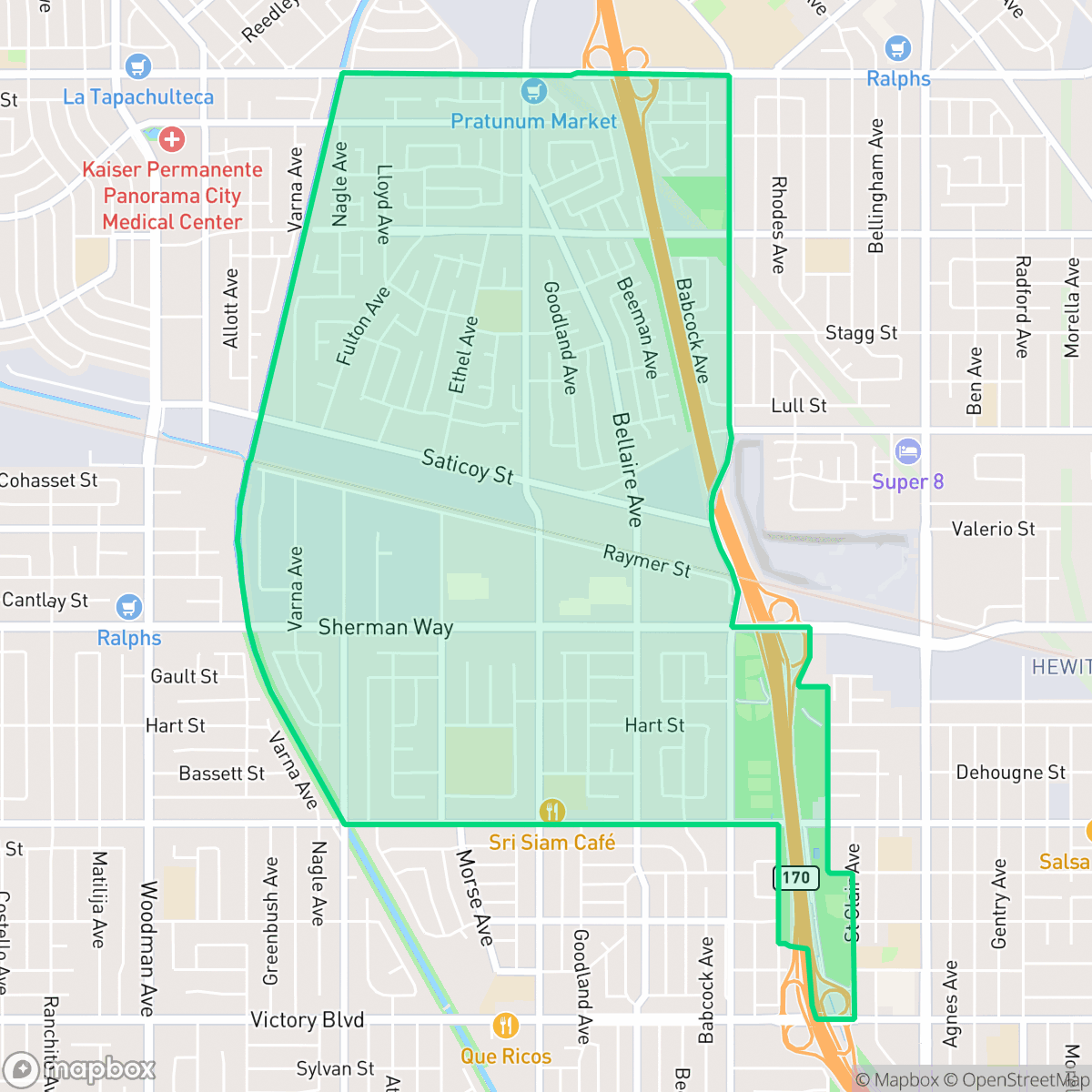
The North Hollywood West Neighborhood Council (NoHoWest) district in Los Angeles is bounded by Roscoe Boulevard, Vanowen Street, Whitsett Avenue, and the Tujunga Wash. The area’s utility history is anchored by the North Hollywood West wellfield, which has supplied groundwater to the city since Lankershim Well #4 was drilled in 1924. Its industrial past includes the Hewitt Landfill site, which began in 1923 as a sand and gravel quarry operated by the Consumers Rock and Gravel Company. A prominent local landmark is Valley Plaza Park, bisected by the 170 Freeway and connected by a historic 1960 concrete pedestrian overpass. The district also shares key community hubs like the Valley Plaza Library and the Whitsett Sports Complex, which host local recreation and civic gatherings.
The neighborhood is a dense, suburban environment defined by a grid of single-family residences interspersed with light industrial zones and warehouses. It maintains a high degree of walkability, supported by a consistent sidewalk network and pedestrian infrastructure that connects residential blocks to local amenities. Despite its industrial proximity, the area remains a functional residential hub, with various dining options and community facilities providing a modest level of local activity. According to iHuus data, the neighborhood balances its urban-industrial layout with a consistent grid system that ensures high pedestrian safety throughout most residential streets.
Potential residents should note that the area experiences high levels of ambient noise from nearby road traffic, which is a primary consideration for those seeking a quiet environment. Privacy is also a factor, as the dense layout results in closely spaced homes with minimal buffers. The area is best suited for those who prioritize accessibility and proximity to transit corridors over suburban seclusion, and who are comfortable with the visual and auditory realities of a mixed-use urban-industrial landscape.
Neighborhood Scores Across 15 Qualities
Residential spacing varies from shared-wall apartment complexes to houses with small side yards. According to iHuus data, this level of density provides more personal buffer than the Los Angeles average.
Pedestrian access is reliable due to a consistent sidewalk network and clear crosswalks at major intersections. While some large arterial roads and industrial areas create minor barriers, the neighborhood remains slightly below the city average for overall walkability.
Residential pockets featuring manicured lawns and private pools sit alongside denser, mixed-use areas and industrial warehouses. This visual landscape remains slightly above the Los Angeles average due to the presence of well-maintained, affluent properties.
Access to public green space and walking paths varies across the district; while some areas feature large sports fields and wide verges, other sections are dominated by industrial pavement or private yards. Overall, pet owners will find more walking opportunities here than in many other parts of Los Angeles.
Residential streets and green spaces exist in roughly equal measure to commercial zones. This area features a suburban layout with a blend of single-family homes, apartment complexes, and industrial corridors that is slightly more developed than the city average.
Suburban and industrial landscapes define this area, providing a calmer atmosphere than most of Los Angeles. While some pockets feature diverse dining options, much of the neighborhood is car-dependent due to the prevalence of warehouses and limited walkable business density.
Frequent noise from nearby freeways and railroad tracks characterizes the area. This level of acoustic disturbance is slightly higher than the average found across Los Angeles.
Air quality remains consistently good with rare instances of elevated readings. This level of air purity is roughly in line with the average seen across Los Angeles.
Large warehouses and logistics hubs along the southern and northern edges introduce some noise and heavy vehicle traffic; however, much of the district remains predominantly residential with minimal heavy industrial hazards. This level of industrial proximity is notably higher than the city average for Los Angeles.
Health insurance coverage among residents is higher than the average for Los Angeles. According to iHuus data, most members of the community have access to medical coverage.
Voting patterns and census indicators reflect a very liberal leaning that is slightly below the broader Los Angeles average, according to iHuus data.
Residents live alongside a balanced mix of young professionals, families, and seniors. This demographic distribution is largely consistent with the broader Los Angeles area, according to iHuus data.
Flood risk in this area is significantly higher than the city average. Residents should anticipate elevated or potentially prohibitive insurance costs due to the neighborhood's vulnerability to flooding.
Address-Level Insights for North Hollywood West Neighborhood Council District


iHuus Neighborhood Intelligence Insights
Get address-level neighborhood insights for North Hollywood West Neighborhood Council District
- Street-level scores — see how individual blocks compare, not just neighborhood averages
- Micro-zone boundaries — identify quiet pockets, flood boundaries, and walkable clusters before you visit
- 15 dimensions in full — walkability, noise, air quality, school quality, insurance coverage, population age profile, urban/rural index, and more
- Boundary risk alerts — know if your address sits near a block boundary where scores drop, the kind of detail no listing will ever mention
- School insights — individual school ratings and insights, not just district-level data
- Compare before you commit — side-by-side data across neighborhoods, down to block precision
No credit card required
Compare with Any Neighborhood
| Dimension | North Hollywood West Neighborhood Council District | Adams-Normandie |
|---|---|---|
| 🚶 Walkabilityavg 8.9 | ||
| 🔊 Acoustic Comfortavg 2.91 | ||
| 🤫 Privacy Indexavg 4.14 | ||
| 🎨 Visual Appealavg 6.58 | ||
| 🐕 Dog Friendlinessavg 5.04 | ||
| 🗺️ Urban-Rural Indexavg 5.96 | ||
| ✨ Neighborhood Vibeavg 5.07 | ||
| 🏥 Health Insurance Coverageavg 6.2 | ||
| 🌿 Air Qualityavg 8.12 | ||
| 🏭 Industrial Proximityavg 8.46 | ||
| 🌊 Flood Safetyavg 2.66 | ||
| 🗳️ Ideological Leanavg 9.56 | ||
| 👥 Population Age Profileavg 4.85 | ||
| 🔥 Fire Safetyavg 0.18 | ||
| 🏫 School Quality |
North Hollywood West Neighborhood Council District Rankings
School Districts Serving North Hollywood West Neighborhood Council District
School Insights for North Hollywood West Neighborhood Council District
Below average outcomes; significant attendance and academic challenges.
School Insights
See what's really behind every school rating near North Hollywood West Neighborhood Council District
- Individual school ratings — each school's own score with outcome context, not just a district average
- Enrollment & class size data — student-to-teacher ratio and how it compares to the state average
- Full demographics breakdown — ethnicity and gender composition for every school in the enrollment zone
- Every school in the district — all schools within the enrollment boundary ranked by rating, not just the closest one
- Grade levels & benchmarks — elementary through high school, with below/above state-average flags
No credit card required