North Hills West Neighborhood Council District, Los Angeles
Updated · 16,030 residents
North Hills West is a quiet, suburban enclave in the San Fernando Valley characterized by its grid-based residential layout and well-maintained properties. While the area offers high walkability for a suburban neighborhood, residents should be aware of consistent noise levels originating from nearby freeway traffic.
Key Highlights
About North Hills West Neighborhood Council District
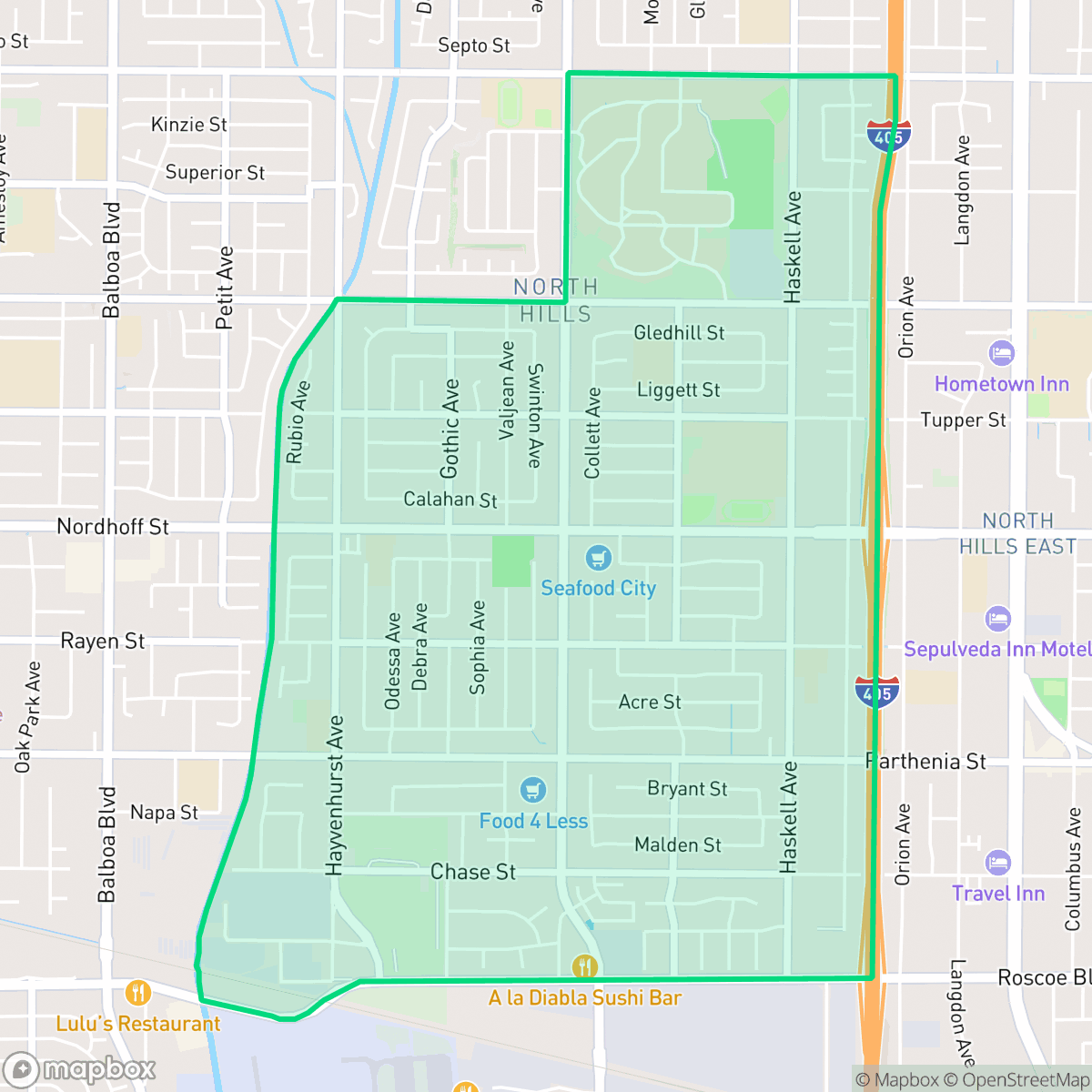
Originally part of the Rancho Ex-Mission San Fernando, the North Hills West area was developed in 1915 as an agricultural community called Mission Acres, featuring one-acre plots for farming and poultry. In 1927, residents renamed the area Sepulveda. Following World War II, the neighborhood transitioned from rural chicken ranches to a suburban tract of single-family homes. In 1992, residents living west of the San Diego Freeway (I-405) successfully voted to secede from the eastern portion, establishing the name North Hills to distinguish their community. This led to the official designation of the North Hills West Neighborhood Council District, bounded by the I-405, Bull Creek, Roscoe Boulevard, and Devonshire Street. A major local landmark is the sprawling Sepulveda Veterans Affairs Medical Center, which opened in 1955. The neighborhood also features "The Onion," a unique, round Mid-Century Modern sanctuary built in 1964.
The area maintains a dense suburban atmosphere, defined by its mix of single-family homes and institutional properties. With high visual appeal, many residences feature private backyard pools and well-manicured driveways. The neighborhood benefits from a consistent sidewalk network, making it relatively accessible for pedestrians compared to other parts of Los Angeles. According to iHuus data, the community is primarily residential, offering a stable environment with strong health insurance coverage rates among its population.
Prospective residents should consider the trade-offs of living in this part of the city. While it provides a calm, established suburban setting, the proximity to major transit corridors results in a noticeable acoustic impact from road traffic. The area is well-suited for families and individuals seeking a traditional suburban lifestyle with access to local educational institutions, though those sensitive to noise may find the environment challenging.
Neighborhood Scores Across 15 Qualities
Residential spacing offers a moderate level of separation between neighbors, providing more privacy than the Los Angeles average. While some multi-family buildings and closely spaced houses exist, many properties maintain distinct side yards and detached structures.
Sidewalks and crosswalks are consistent across most residential streets, though high-traffic arterials and a major freeway create significant barriers to easy movement. According to iHuus data, the pedestrian infrastructure is slightly less connected than the average for Los Angeles.
Manicured landscapes and a high density of private backyard pools characterize the area. According to iHuus data, the visual quality of properties and amenities is notably higher than the Los Angeles average.
Dog walking options are somewhat restricted due to narrow sidewalk verges and a lack of large public parks, falling slightly below the city average. Most residents rely on private fenced backyards for pet exercise.
Open land and scattered greenery are more frequent here than in most parts of Los Angeles. This area maintains a semi-rural feel with a mix of woodland, fields, and low-density residential pockets, according to iHuus data.
Suburban streets and light industrial zones provide a calm atmosphere, but limited local business density makes the area less active than the Los Angeles average. Most dining and essential services require a vehicle, though some walkable paths connect select social spots and greenery.
Frequent traffic and transit sounds from nearby freeways and rail lines create a significantly noisier environment than the Los Angeles average. According to iHuus data, residents may experience persistent acoustic disturbances due to this proximity to major transportation corridors.
Air quality remains consistently high with rare instances of elevated readings. This level of cleanliness is largely in line with the average across Los Angeles.
Residential and institutional uses dominate the area, with very few warehouses or heavy industrial hazards present. According to iHuus data, the neighborhood maintains a slightly lower level of industrial proximity compared to the city average.
Health insurance coverage among residents is relatively high, sitting slightly above the Los Angeles city average according to iHuus data.
Voting patterns and census indicators show a strong liberal leaning, though this tendency is slightly less pronounced than the Los Angeles city average.
Residents live alongside a balanced mix of young professionals, families, and seniors. This demographic spread is slightly more varied than the typical Los Angeles profile, according to iHuus data.
Flood risk is notable in this area because portions of the neighborhood fall within a designated floodplain. According to iHuus data, this level of vulnerability is slightly higher than the average for Los Angeles.
Address-Level Insights for North Hills West Neighborhood Council District


iHuus Neighborhood Intelligence Insights
Get address-level neighborhood insights for North Hills West Neighborhood Council District
- Street-level scores — see how individual blocks compare, not just neighborhood averages
- Micro-zone boundaries — identify quiet pockets, flood boundaries, and walkable clusters before you visit
- 15 dimensions in full — walkability, noise, air quality, school quality, insurance coverage, population age profile, urban/rural index, and more
- Boundary risk alerts — know if your address sits near a block boundary where scores drop, the kind of detail no listing will ever mention
- School insights — individual school ratings and insights, not just district-level data
- Compare before you commit — side-by-side data across neighborhoods, down to block precision
No credit card required
Compare with Any Neighborhood
| Dimension | North Hills West Neighborhood Council District | Adams-Normandie |
|---|---|---|
| 🚶 Walkabilityavg 8.9 | ||
| 🔊 Acoustic Comfortavg 2.91 | ||
| 🤫 Privacy Indexavg 4.14 | ||
| 🎨 Visual Appealavg 6.58 | ||
| 🐕 Dog Friendlinessavg 5.04 | ||
| 🗺️ Urban-Rural Indexavg 5.96 | ||
| ✨ Neighborhood Vibeavg 5.07 | ||
| 🏥 Health Insurance Coverageavg 6.2 | ||
| 🌿 Air Qualityavg 8.12 | ||
| 🏭 Industrial Proximityavg 8.46 | ||
| 🌊 Flood Safetyavg 2.66 | ||
| 🗳️ Ideological Leanavg 9.56 | ||
| 👥 Population Age Profileavg 4.85 | ||
| 🔥 Fire Safetyavg 0.18 | ||
| 🏫 School Quality |
North Hills West Neighborhood Council District Rankings
School Districts Serving North Hills West Neighborhood Council District
School Insights for North Hills West Neighborhood Council District
Below average outcomes; significant attendance and academic challenges.
School Insights
See what's really behind every school rating near North Hills West Neighborhood Council District
- Individual school ratings — each school's own score with outcome context, not just a district average
- Enrollment & class size data — student-to-teacher ratio and how it compares to the state average
- Full demographics breakdown — ethnicity and gender composition for every school in the enrollment zone
- Every school in the district — all schools within the enrollment boundary ranked by rating, not just the closest one
- Grade levels & benchmarks — elementary through high school, with below/above state-average flags
No credit card required