Mount Washington, Los Angeles
Updated · 19,140 residents
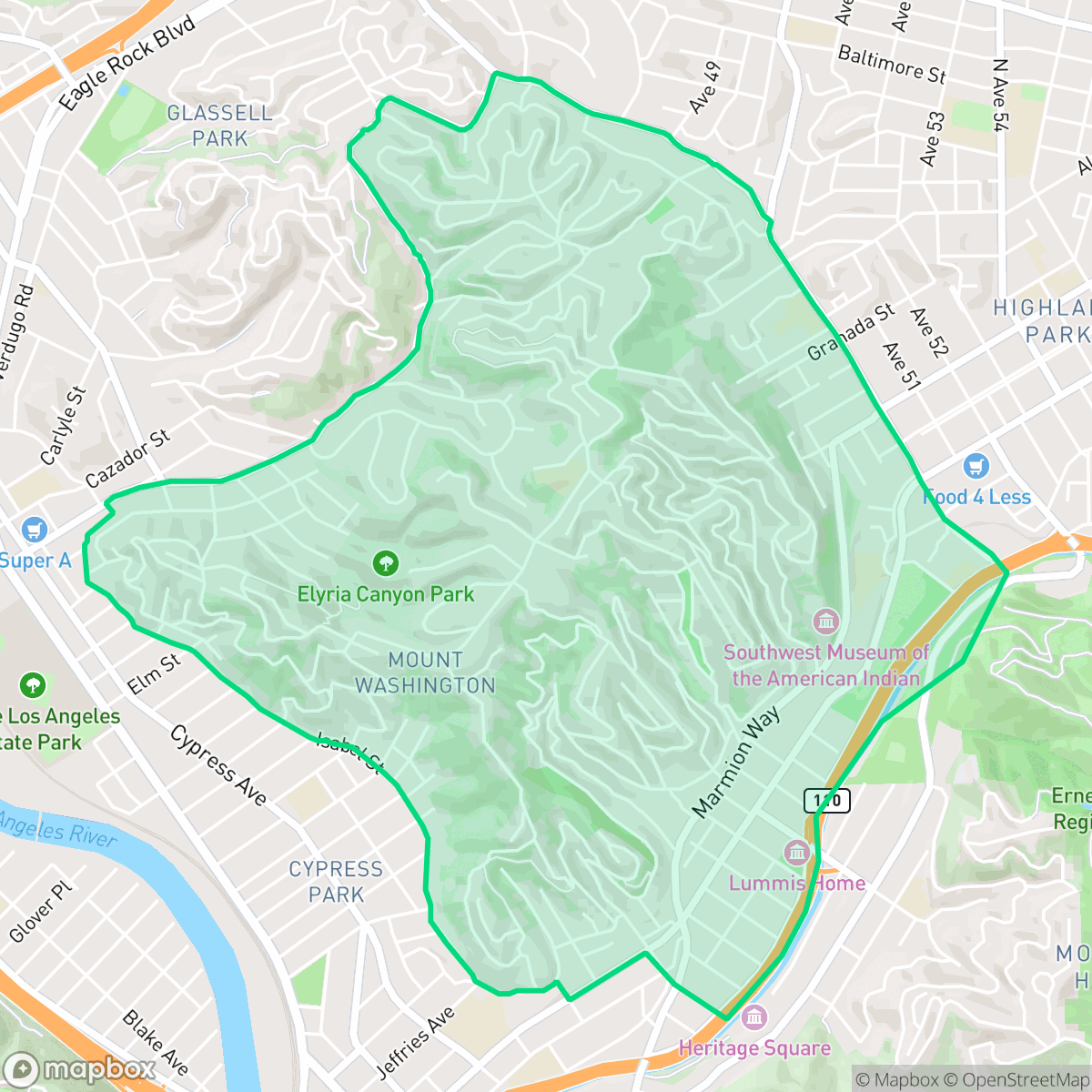
Mount Washington is a quiet, hilly enclave in Northeast Los Angeles characterized by its lush greenery and distinct architectural diversity. While it offers high visual appeal and a semi-rural atmosphere, the neighborhood remains a car-dependent area with limited commercial activity. According to iHuus data, residents benefit from excellent air quality and a lack of industrial hazards, though the steep terrain makes walking challenging in many sections.
Key Highlights
About Mount Washington
Founded in 1909 by developer Robert Marsh, Mount Washington began as a hilltop subdivision in Northeast Los Angeles's San Rafael Hills. To attract buyers to the steep terrain, Marsh built the Mount Washington Hotel at the summit and a funicular railway to transport passengers. The Mission-style hotel, once a retreat for silent film stars like Charlie Chaplin, was purchased in 1925 by Paramahansa Yogananda and remains the international headquarters of the Self-Realization Fellowship. The neighborhood is also home to the historic Southwest Museum, established in 1907, and Eldred Street, one of the steepest streets in the United States. Characterized by its rustic, winding roads, Mount Washington features an eclectic mix of architectural styles, ranging from early Craftsman bungalows to mid-century modern masterpieces designed by Richard Neutra, Gregory Ain, and John Lautner.
The area functions as a serene retreat from the dense urban core of Los Angeles. It maintains a semi-rural aesthetic with significant natural topography and greenbelts, providing a high level of privacy compared to the city average. The residential landscape is predominantly quiet, with low building density that emphasizes the natural beauty of the San Rafael Hills. Residents enjoy a strong sense of community and a highly progressive ideological environment, supported by local amenities like the Audubon Center at Debs Park.
Living here requires a trade-off between tranquility and accessibility. While the neighborhood boasts top-tier educational options like Mt. Washington Elementary, the steep, winding roads and limited commercial density mean that daily errands typically require a vehicle. Prospective residents should also be aware of the environmental context, as the area faces significant fire safety risks despite its high air quality scores. According to iHuus data, it is best suited for those who prioritize a quiet, scenic environment over a walkable, high-energy urban lifestyle.
Neighborhood Scores Across 15 Qualities
Residential spacing varies between tightly packed homes and more secluded hillside lots with mature tree buffers. According to iHuus data, this neighborhood offers more separation between neighbors than the Los Angeles average.
Extensive sidewalk networks and low-traffic residential streets provide safe conditions for pedestrians, though some steeper hillside roads lack continuous paths. This level of accessibility is nearly comparable to the city average according to iHuus data.
Manicured landscapes and large custom homes with private pools provide a premium aesthetic that sits above the Los Angeles average. Many properties feature expansive grounds and significant greenery, according to iHuus data.
Abundant canyon-side trails and adjacent hillsides provide much better access to natural exercise areas for pets than the city average. Many residential streets offer continuous sidewalks and nearby green spaces for outdoor activity.
Lush natural topography and significant greenbelts define this area, providing a more semi-rural atmosphere than much of the surrounding Los Angeles landscape. Residents can expect a landscape characterized by steep, unbuilt hillsides and integrated canyon spaces.
Suburban streets and green spaces provide a serene setting with a lower level of activity than the Los Angeles average. While scattered dining and social spots exist, the area is primarily characterized by low-density housing and a car-dependent landscape.
Persistent sounds from nearby freeways and transit corridors characterize the area. According to iHuus data, acoustic comfort levels in Mount Washington are slightly below the city average.
Air quality remains mostly clean with rare instances of elevated readings, performing slightly below the Los Angeles average according to iHuus data.
Industrial presence is virtually nonexistent in this area, as the landscape consists almost entirely of residential and light commercial structures. According to iHuus data, this neighborhood offers a cleaner environment regarding industrial hazards and warehouses compared to the Los Angeles average.
Health insurance access among residents is below the Los Angeles average, according to iHuus data. This indicates a higher proportion of uninsured individuals living in the area compared to most of the city.
Voting patterns and census indicators show a highly liberal political leaning that is even more pronounced than the Los Angeles average. This political landscape is reflected in the local community engagement and demographic trends identified by iHuus data.
Residents live alongside a balanced mix of young adults, families, and older populations. This age distribution is consistent with the broader Los Angeles area according to iHuus data.
Significant flood risk exists here due to the area's location within a designated floodplain. This level of risk is notably higher than the average for Los Angeles, and residents should anticipate that flood insurance is typically required.
High levels of fire hazard are present in this area, significantly exceeding the average fire safety risk found throughout Los Angeles. Residents should be aware of the extreme fire danger and the need for stringent protection measures, according to iHuus data.
Address-Level Insights for Mount Washington


iHuus Neighborhood Intelligence Insights
Get address-level neighborhood insights for Mount Washington
- Street-level scores — see how individual blocks compare, not just neighborhood averages
- Micro-zone boundaries — identify quiet pockets, flood boundaries, and walkable clusters before you visit
- 15 dimensions in full — walkability, noise, air quality, school quality, insurance coverage, population age profile, urban/rural index, and more
- Boundary risk alerts — know if your address sits near a block boundary where scores drop, the kind of detail no listing will ever mention
- School insights — individual school ratings and insights, not just district-level data
- Compare before you commit — side-by-side data across neighborhoods, down to block precision
No credit card required
Compare with Any Neighborhood
| Dimension | Mount Washington | Adams-Normandie |
|---|---|---|
| 🚶 Walkabilityavg 8.9 | ||
| 🔊 Acoustic Comfortavg 2.91 | ||
| 🤫 Privacy Indexavg 4.14 | ||
| 🎨 Visual Appealavg 6.58 | ||
| 🐕 Dog Friendlinessavg 5.04 | ||
| 🗺️ Urban-Rural Indexavg 5.96 | ||
| ✨ Neighborhood Vibeavg 5.07 | ||
| 🏥 Health Insurance Coverageavg 6.2 | ||
| 🌿 Air Qualityavg 8.12 | ||
| 🏭 Industrial Proximityavg 8.46 | ||
| 🌊 Flood Safetyavg 2.66 | ||
| 🗳️ Ideological Leanavg 9.56 | ||
| 👥 Population Age Profileavg 4.85 | ||
| 🔥 Fire Safetyavg 0.18 | ||
| 🏫 School Quality |
Mount Washington Rankings
School Districts Serving Mount Washington
School Insights for Mount Washington
Below average outcomes; significant attendance and academic challenges.
School Insights
See what's really behind every school rating near Mount Washington
- Individual school ratings — each school's own score with outcome context, not just a district average
- Enrollment & class size data — student-to-teacher ratio and how it compares to the state average
- Full demographics breakdown — ethnicity and gender composition for every school in the enrollment zone
- Every school in the district — all schools within the enrollment boundary ranked by rating, not just the closest one
- Grade levels & benchmarks — elementary through high school, with below/above state-average flags
No credit card required