Montecito Heights, Los Angeles
Updated · 8,582 residents
Montecito Heights is a quiet, low-density neighborhood defined by its hilly terrain and proximity to the expansive Ernest E. Debs Regional Park. Residents enjoy excellent air quality and a highly dog-friendly environment, though the area remains largely car-dependent with limited local nightlife or commercial services.
Key Highlights
About Montecito Heights
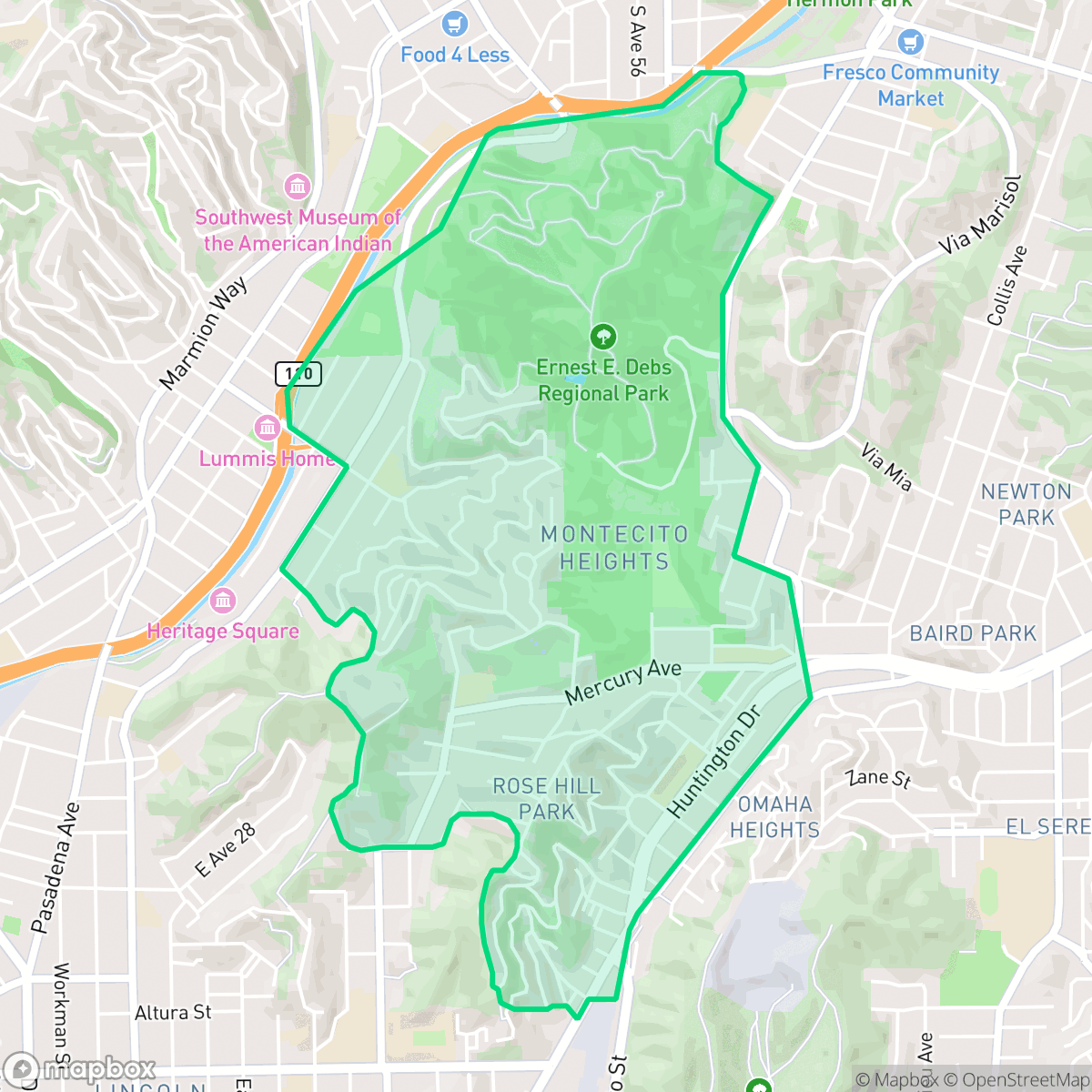
Montecito Heights, known as the "Wilderness in the City," sits on the Monterey Hills overlooking the Arroyo Seco. Originally part of the 1781 Spanish Pueblo de Los Angeles, its northeast corner is marked by a plaque in Ernest E. Debs Regional Park. Spurred by nearby developments, the Mutual Home Building Company began planning the neighborhood in 1910, envisioning an affluent suburb with a hilltop hotel that went unbuilt due to the 1929 crash. Alongside Pasadena, it became a center for the Arts and Crafts movement. Prominent figures like eccentric journalist Charles Lummis built his hand-crafted river-rock home, El Alisal, here. While early development was sparse, the advent of cantilever engineering in the 1950s allowed midcentury modern homes to sprout on its steep hillsides. Today, it is home to the Heritage Square Museum's preserved Victorian structures.
The area functions as a peaceful residential enclave, characterized by its low-density housing and significant open green spaces. According to iHuus data, the neighborhood provides a quiet atmosphere with minimal industrial presence, making it ideal for those who prioritize a rural feel within the city limits. Its topography offers scenic views, while the abundance of trails in the surrounding hills supports an active, outdoor-oriented lifestyle. Residents benefit from a clean environment and a strong sense of seclusion that is increasingly rare within the greater Los Angeles basin.
Prospective residents should note that the neighborhood is primarily car-dependent, as daily errands often require driving to nearby commercial centers. While the community offers a high degree of privacy, it faces notable environmental challenges, including a high risk of wildfire. Families may consider the local school options within the Los Angeles Unified School District, which include campuses like Latona Avenue Elementary and Huntington Drive Elementary, though academic performance across the district remains varied.
Neighborhood Scores Across 15 Qualities
Residential spacing provides a moderate level of separation between neighbors, which is slightly higher than the Los Angeles average. According to iHuus data, the area features a mix of closely packed homes and larger estates that offer varying degrees of buffer between properties.
Sidewalks and crosswalks are well established along main arterials and low-traffic streets, though the steep canyon topography and major freeway corridors can occasionally disrupt continuous pedestrian paths. This level of walkability is slightly lower than the Los Angeles average.
Hillside properties featuring private pools and manicured landscapes mix with standard suburban housing and apartment complexes. This visual character is consistent with the broader Los Angeles average.
Abundant canyon parkland, large public parks, and accessible trails provide much more green space for pets than the Los Angeles average. Extensive sidewalks and open residential spaces offer safe walking routes away from heavy traffic.
Frequent open land and scattered homes among hillsides provide a more spacious, semi-rural character than the typical Los Angeles urban mix. According to iHuus data, this area features significant greenery and natural topography compared to the city average.
Low-density residential pockets and light industrial zones create a serene but low-activity environment. According to iHuus data, local business options and social spots are sparse, making the area less active than the Los Angeles average.
Persistent sounds from nearby freeways and railroad tracks are common throughout the area. This level of acoustic disturbance is slightly higher than the typical experience found elsewhere in Los Angeles.
Air quality in this area is generally high with infrequent periods of poor visibility. According to iHuus data, levels are roughly comparable to the rest of Los Angeles.
Industrial activity and heavy warehouses are absent from this area, making it more residential than the Los Angeles average. According to iHuus data, the neighborhood consists almost entirely of residential, recreational, and light commercial spaces with no detectable industrial hazards.
Health insurance access among residents is slightly lower than the average seen across Los Angeles. According to iHuus data, a significant portion of the population remains uninsured.
Voting patterns and census indicators show a predominantly liberal political leaning that is even more pronounced than the Los Angeles city average, according to iHuus data.
Residents live alongside a balanced mix of young adults, families, and older individuals. This age distribution is consistent with the average found across Los Angeles.
Properties in this area are situated within a known floodplain, which may necessitate flood insurance. According to iHuus data, the risk level is higher than the typical level found across Los Angeles.
Wildfire danger is significantly higher here than in most parts of Los Angeles. Residents should prioritize extreme fire protection measures and stay informed on local evacuation protocols according to iHuus data.
Address-Level Insights for Montecito Heights


iHuus Neighborhood Intelligence Insights
Get address-level neighborhood insights for Montecito Heights
- Street-level scores — see how individual blocks compare, not just neighborhood averages
- Micro-zone boundaries — identify quiet pockets, flood boundaries, and walkable clusters before you visit
- 15 dimensions in full — walkability, noise, air quality, school quality, insurance coverage, population age profile, urban/rural index, and more
- Boundary risk alerts — know if your address sits near a block boundary where scores drop, the kind of detail no listing will ever mention
- School insights — individual school ratings and insights, not just district-level data
- Compare before you commit — side-by-side data across neighborhoods, down to block precision
No credit card required
Compare with Any Neighborhood
| Dimension | Montecito Heights | Adams-Normandie |
|---|---|---|
| 🚶 Walkabilityavg 8.9 | ||
| 🔊 Acoustic Comfortavg 2.91 | ||
| 🤫 Privacy Indexavg 4.14 | ||
| 🎨 Visual Appealavg 6.58 | ||
| 🐕 Dog Friendlinessavg 5.04 | ||
| 🗺️ Urban-Rural Indexavg 5.96 | ||
| ✨ Neighborhood Vibeavg 5.07 | ||
| 🏥 Health Insurance Coverageavg 6.2 | ||
| 🌿 Air Qualityavg 8.12 | ||
| 🏭 Industrial Proximityavg 8.46 | ||
| 🌊 Flood Safetyavg 2.66 | ||
| 🗳️ Ideological Leanavg 9.56 | ||
| 👥 Population Age Profileavg 4.85 | ||
| 🔥 Fire Safetyavg 0.18 | ||
| 🏫 School Quality |
Montecito Heights Rankings
School Districts Serving Montecito Heights
School Insights for Montecito Heights
Below average outcomes; significant attendance and academic challenges.
School Insights
See what's really behind every school rating near Montecito Heights
- Individual school ratings — each school's own score with outcome context, not just a district average
- Enrollment & class size data — student-to-teacher ratio and how it compares to the state average
- Full demographics breakdown — ethnicity and gender composition for every school in the enrollment zone
- Every school in the district — all schools within the enrollment boundary ranked by rating, not just the closest one
- Grade levels & benchmarks — elementary through high school, with below/above state-average flags
No credit card required