Mission Hills, Los Angeles
Updated · 22,109 residents
Mission Hills is a suburban community in the San Fernando Valley known for its quiet, manicured residential streets and Spanish colonial heritage. While the area offers a generally walkable environment with clean air, residents often experience significant noise from nearby freeway and rail infrastructure.
Key Highlights
About Mission Hills
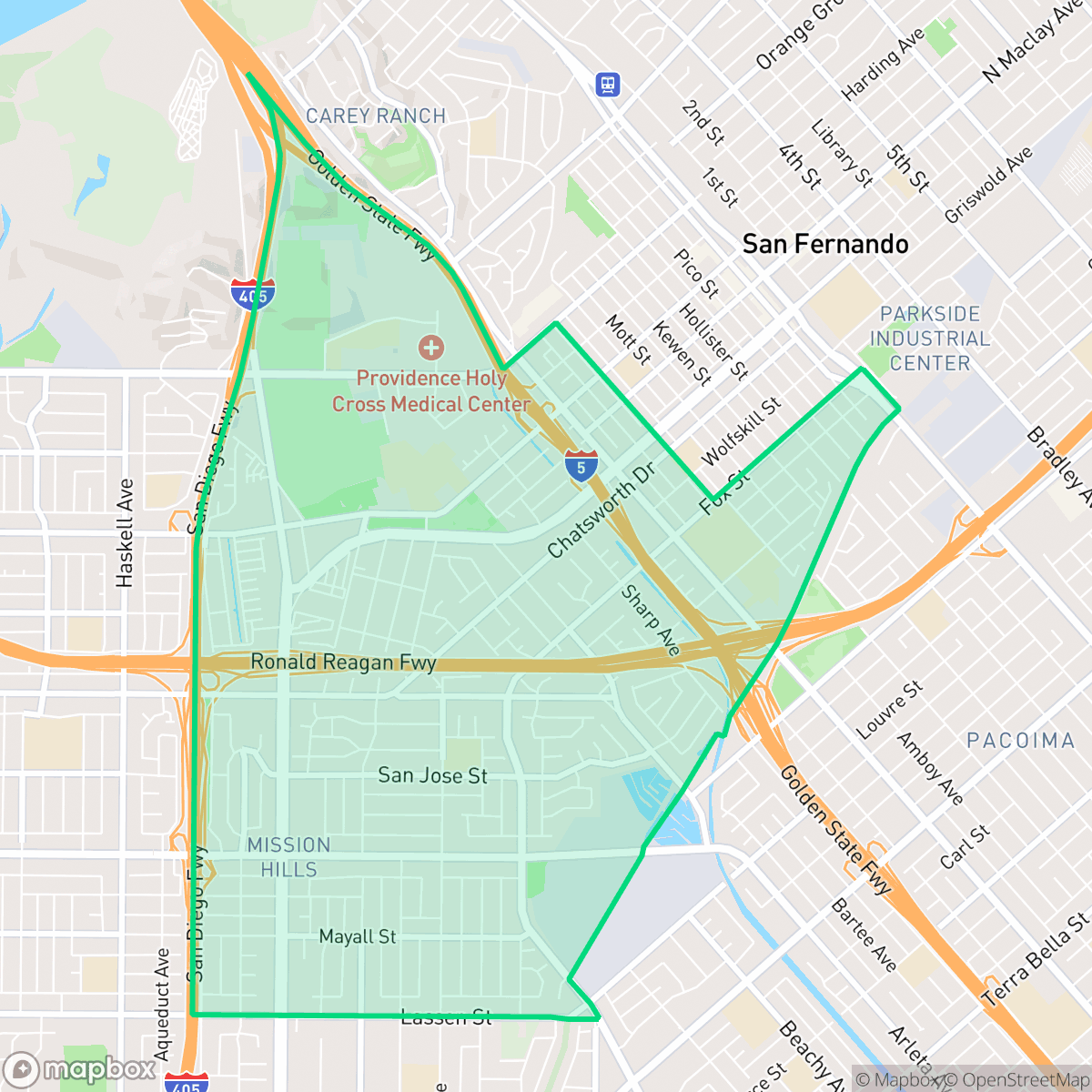
Mission Hills, located in the San Fernando Valley, is defined by its proximity to the Mission San Fernando Rey de España, founded in 1797. Originally known as Dennis Park during its early 1950s suburban development, the community officially adopted the name Mission Hills in 1956. The area’s historical significance is anchored by the 1834 Andrés Pico Adobe, the second-oldest residence in Los Angeles, and the Memory Garden in Brand Park. Once part of the vast Rancho Ex-Mission San Fernando, the neighborhood transitioned from agricultural land to a post-war residential suburb. Today, it remains a distinct community characterized by its Spanish colonial heritage, the San Fernando Mission Cemetery, and its role as a regional crossroads near the junction of the I-5 and I-405 freeways.
The neighborhood offers a balanced suburban landscape characterized by well-maintained properties and a high density of private swimming pools. It maintains a quiet atmosphere that contrasts with the busier urban centers of Los Angeles, providing a more secluded feel for its multi-generational population. The area is primarily residential with light commercial pockets, ensuring a separation from heavy industrial activity and maintaining a consistent visual appeal throughout its streets.
Prospective residents should note that the area is situated within a designated floodplain, which warrants consideration during the home-buying process. While the sidewalk network is comprehensive and supports local walking, the proximity to major freeways and rail lines leads to elevated noise levels. Schools fall under the Los Angeles Unified School District, which offers a range of specialized programs alongside broader systemic challenges. The neighborhood is well-suited for those seeking a stable, suburban environment with convenient access to major regional transit arteries.
Neighborhood Scores Across 15 Qualities
Residential spacing varies from closely packed homes with shared property lines to suburban layouts with private yards. This level of separation offers more seclusion than the city average.
Residential and commercial streets feature continuous sidewalks and marked crosswalks, though proximity to high-speed arterials and the nearby freeway reduces overall pedestrian comfort compared to the city average. According to iHuus data, the sidewalk network is comprehensive on most streets despite significant barriers created by heavy traffic zones.
Large homes and well-maintained landscapes with a high density of private swimming pools define much of the area. This level of visual upkeep and property scale is roughly in line with the Los Angeles average.
Private fenced backyards are common, but residents will find fewer large public parks or wide green verges for off-leash exercise compared to the city average. According to iHuus data, sidewalks often lack significant grassy buffers between the street and residential properties.
Residential streets and green spaces exist in relatively equal measure, creating a suburban landscape that is slightly more developed than the Los Angeles average. The area features a combination of single-family homes, mid-sized apartment complexes, and pockets of commercial or industrial infrastructure.
Suburban streets and green spaces define much of the area, offering a calmer rhythm than the Los Angeles average. While some pockets near the railway provide lively dining options, many parts of the neighborhood are primarily residential with limited commercial activity within walking distance.
Frequent traffic and transit noise from nearby freeways and rail lines characterize this area. According to iHuus data, acoustic comfort in Mission Hills is significantly lower than the Los Angeles average.
Air quality remains mostly clean with only rare instances of elevated readings. This level of air purity is roughly in line with the Los Angeles average, according to iHuus data.
Primarily residential and light commercial, this area lacks heavy industrial hazards or large-scale warehouses. According to iHuus data, the neighborhood maintains a level of industrial separation that is slightly better than the city average.
Health insurance coverage among residents is slightly above the Los Angeles city average, according to iHuus data.
Voting patterns and census indicators reflect a deeply liberal political landscape that is consistent with the broader Los Angeles area, according to iHuus data.
Residents live among a diverse range of age groups, spanning young professionals to seniors. This demographic spread is slightly more varied than the average seen across Los Angeles.
Significant flood risk exists within this area due to its location in a designated floodplain. According to iHuus data, the susceptibility to flooding is notably higher than the average for Los Angeles.
Address-Level Insights for Mission Hills


iHuus Neighborhood Intelligence Insights
Get address-level neighborhood insights for Mission Hills
- Street-level scores — see how individual blocks compare, not just neighborhood averages
- Micro-zone boundaries — identify quiet pockets, flood boundaries, and walkable clusters before you visit
- 15 dimensions in full — walkability, noise, air quality, school quality, insurance coverage, population age profile, urban/rural index, and more
- Boundary risk alerts — know if your address sits near a block boundary where scores drop, the kind of detail no listing will ever mention
- School insights — individual school ratings and insights, not just district-level data
- Compare before you commit — side-by-side data across neighborhoods, down to block precision
No credit card required
Compare with Any Neighborhood
| Dimension | Mission Hills | Adams-Normandie |
|---|---|---|
| 🚶 Walkabilityavg 8.9 | ||
| 🔊 Acoustic Comfortavg 2.91 | ||
| 🤫 Privacy Indexavg 4.14 | ||
| 🎨 Visual Appealavg 6.58 | ||
| 🐕 Dog Friendlinessavg 5.04 | ||
| 🗺️ Urban-Rural Indexavg 5.96 | ||
| ✨ Neighborhood Vibeavg 5.07 | ||
| 🏥 Health Insurance Coverageavg 6.2 | ||
| 🌿 Air Qualityavg 8.12 | ||
| 🏭 Industrial Proximityavg 8.46 | ||
| 🌊 Flood Safetyavg 2.66 | ||
| 🗳️ Ideological Leanavg 9.56 | ||
| 👥 Population Age Profileavg 4.85 | ||
| 🔥 Fire Safetyavg 0.18 | ||
| 🏫 School Quality |
Mission Hills Rankings
School Districts Serving Mission Hills
School Insights for Mission Hills
Below average outcomes; significant attendance and academic challenges.
School Insights
See what's really behind every school rating near Mission Hills
- Individual school ratings — each school's own score with outcome context, not just a district average
- Enrollment & class size data — student-to-teacher ratio and how it compares to the state average
- Full demographics breakdown — ethnicity and gender composition for every school in the enrollment zone
- Every school in the district — all schools within the enrollment boundary ranked by rating, not just the closest one
- Grade levels & benchmarks — elementary through high school, with below/above state-average flags
No credit card required