Mid City, Los Angeles
Updated · 88,999 residents
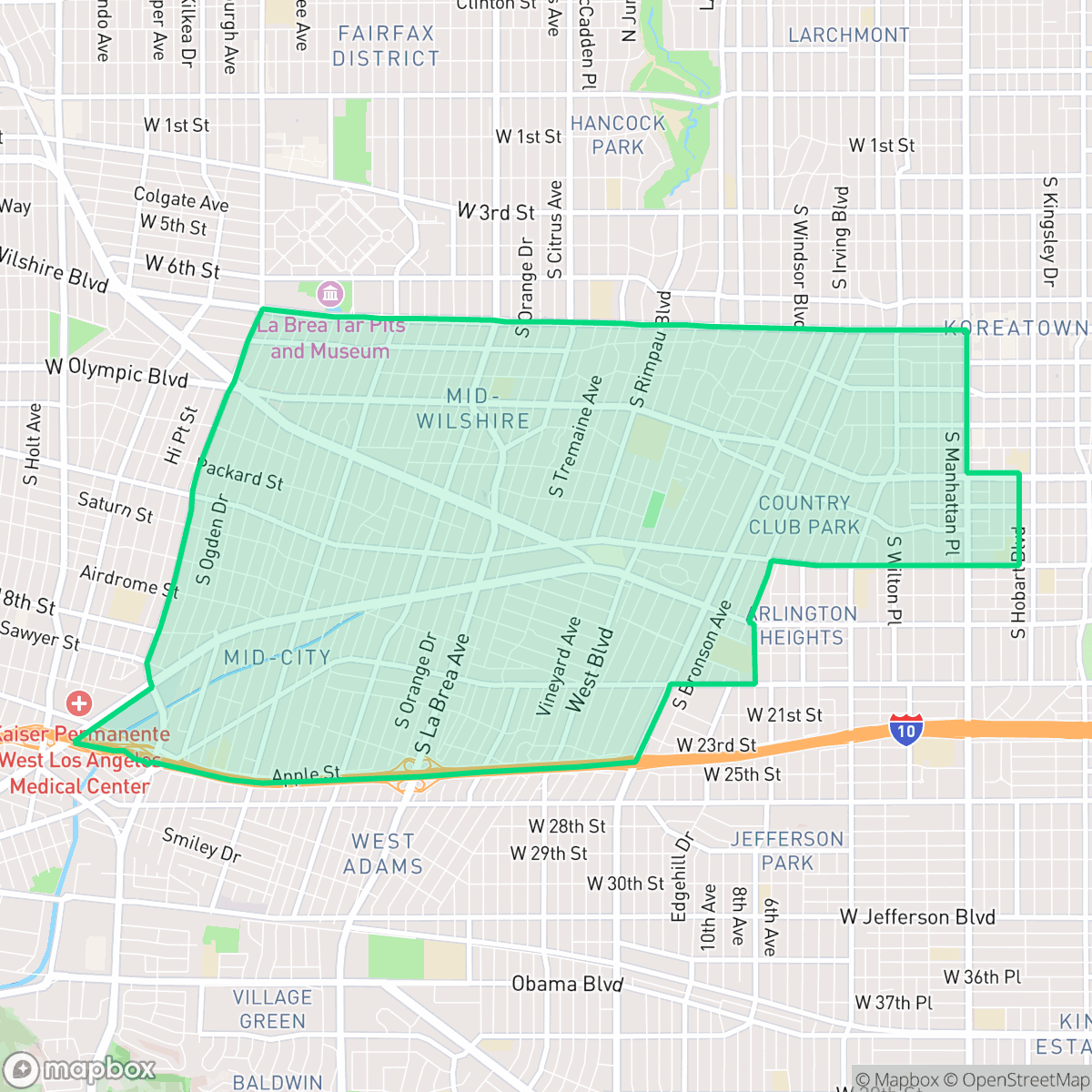
Mid City is a highly walkable, central Los Angeles neighborhood defined by its dense, grid-based layout and rich cultural heritage. Residents benefit from excellent pedestrian access to local services, though the area is characterized by tightly packed housing and significant noise levels from road traffic.
Key Highlights
About Mid City
Mid City, a highly diverse neighborhood in Central Los Angeles, developed in the early 20th century as a vital transit hub. It was home to Vineyard Junction, where Pacific Electric "Red Car" lines converged, and the Rimpau Loop streetcar turnaround. The neighborhood features historic landmarks such as the 1933 West Boulevard Bridge and the Rocha House, Los Angeles Historic-Cultural Monument No. 13. Culturally, Mid City has deep roots in the city's Black and Latino communities. It is anchored by landmarks like the Nate Holden Performing Arts Center (home of the Ebony Repertory Theatre), the historic 1937 music club The Mint, and a local post office named in honor of legendary singer Ray Charles, whose recording studio was located nearby.
This central Los Angeles district functions as a dense, highly accessible urban hub with a continuous grid of sidewalks that makes daily errands convenient for residents. The area features a mix of multi-story apartments and closely packed single-family homes, creating a vibrant, high-density environment that transitions between residential comfort and commercial activity. With its central location, the neighborhood provides easy access to major thoroughfares, though this proximity to high-traffic corridors contributes to elevated noise levels throughout the day.
Living in this area involves certain trade-offs, particularly regarding privacy and outdoor space. Because the residential structures are often built with minimal setbacks and narrow gaps, the neighborhood offers limited privacy for those accustomed to suburban sprawl. Additionally, pet owners may find the environment challenging due to a lack of public green spaces and narrow sidewalk verges. While the area offers a diverse range of educational options through both the Los Angeles Unified and Culver City Unified school districts, prospective residents should be prepared for an urban atmosphere where the energy of the city is always present.
Neighborhood Scores Across 15 Qualities
Residential structures are closely packed with minimal setbacks and narrow gaps between neighboring properties. This density is slightly higher than the Los Angeles average, resulting in limited buffers between homes.
Continuous sidewalks and frequent crosswalks throughout the dense grid make navigating the area on foot exceptionally easy. This level of pedestrian infrastructure sits well above the Los Angeles average, though the nearby major freeway interchange can act as a barrier to movement in certain sections.
Large, well-maintained estates with private pools and manicured grounds coexist with dense, standard urban housing. While some pockets offer high-status amenities, the overall visual variety is slightly below the Los Angeles average.
Walking routes for pets are restricted by narrow sidewalk verges and a lack of accessible public parks. According to iHuus data, the availability of shared green space for dogs is below the city average.
Streetscapes feature a balanced blend of single-family homes and multi-unit apartment blocks. This environment is slightly less dense than the average for Los Angeles, offering a transition between high-density urban cores and traditional suburban sprawl.
A varied mix of energetic urban hubs and quiet suburban pockets defines the area, offering more activity and dining variety than the Los Angeles average. While many blocks feature diverse eateries and social spots, some residential sections remain primarily quiet with limited local shops within walking distance.
Frequent noise from nearby freeways and rail lines contributes to an environment that is noisier than the Los Angeles average. Residents may experience persistent sound disturbances due to the proximity of major transit corridors.
Air quality in this area is consistently good, with rare instances of elevated readings. According to iHuus data, the air quality is on par with the Los Angeles city average.
Residential and light commercial uses dominate the area, with significantly fewer warehouses or heavy industrial hazards than the Los Angeles average. While the neighborhood lacks large-scale manufacturing, residents should be aware of noise and air quality impacts from the major multi-lane freeway bisecting the district.
Health insurance coverage among Mid City residents is lower than the Los Angeles city average. According to iHuus data, a significant portion of the local population lacks employer-sponsored or private coverage.
Voting patterns and census indicators in Mid City reflect a predominantly liberal leaning that is even more pronounced than the Los Angeles city average, according to iHuus data.
Residents live alongside a balanced mix of young professionals, families, and seniors. According to iHuus data, this demographic spread is very similar to the broader Los Angeles area.
Flood vulnerability is significantly higher than the Los Angeles average due to its location in a coastal high-hazard zone. Residents should prepare for the possibility of elevated or prohibitive flood insurance costs.
Address-Level Insights for Mid City


iHuus Neighborhood Intelligence Insights
Get address-level neighborhood insights for Mid City
- Street-level scores — see how individual blocks compare, not just neighborhood averages
- Micro-zone boundaries — identify quiet pockets, flood boundaries, and walkable clusters before you visit
- 15 dimensions in full — walkability, noise, air quality, school quality, insurance coverage, population age profile, urban/rural index, and more
- Boundary risk alerts — know if your address sits near a block boundary where scores drop, the kind of detail no listing will ever mention
- School insights — individual school ratings and insights, not just district-level data
- Compare before you commit — side-by-side data across neighborhoods, down to block precision
No credit card required
Compare with Any Neighborhood
| Dimension | Mid City | Adams-Normandie |
|---|---|---|
| 🚶 Walkabilityavg 8.9 | ||
| 🔊 Acoustic Comfortavg 2.91 | ||
| 🤫 Privacy Indexavg 4.14 | ||
| 🎨 Visual Appealavg 6.58 | ||
| 🐕 Dog Friendlinessavg 5.04 | ||
| 🗺️ Urban-Rural Indexavg 5.96 | ||
| ✨ Neighborhood Vibeavg 5.07 | ||
| 🏥 Health Insurance Coverageavg 6.2 | ||
| 🌿 Air Qualityavg 8.12 | ||
| 🏭 Industrial Proximityavg 8.46 | ||
| 🌊 Flood Safetyavg 2.66 | ||
| 🗳️ Ideological Leanavg 9.56 | ||
| 👥 Population Age Profileavg 4.85 | ||
| 🔥 Fire Safetyavg 0.18 | ||
| 🏫 School Quality |
Mid City Rankings
School Districts Serving Mid City
School Insights for Mid City
Below average outcomes; significant attendance and academic challenges.
School Insights
See what's really behind every school rating near Mid City
- Individual school ratings — each school's own score with outcome context, not just a district average
- Enrollment & class size data — student-to-teacher ratio and how it compares to the state average
- Full demographics breakdown — ethnicity and gender composition for every school in the enrollment zone
- Every school in the district — all schools within the enrollment boundary ranked by rating, not just the closest one
- Grade levels & benchmarks — elementary through high school, with below/above state-average flags
No credit card required