Mid City West, Los Angeles
Updated · 47,874 residents
Mid City West is an exceptionally walkable urban hub defined by its dense residential blocks and proximity to major cultural institutions. Residents benefit from high health insurance coverage and excellent air quality, though the area experiences notable road noise and limited privacy due to its compact housing layout.
Key Highlights
About Mid City West
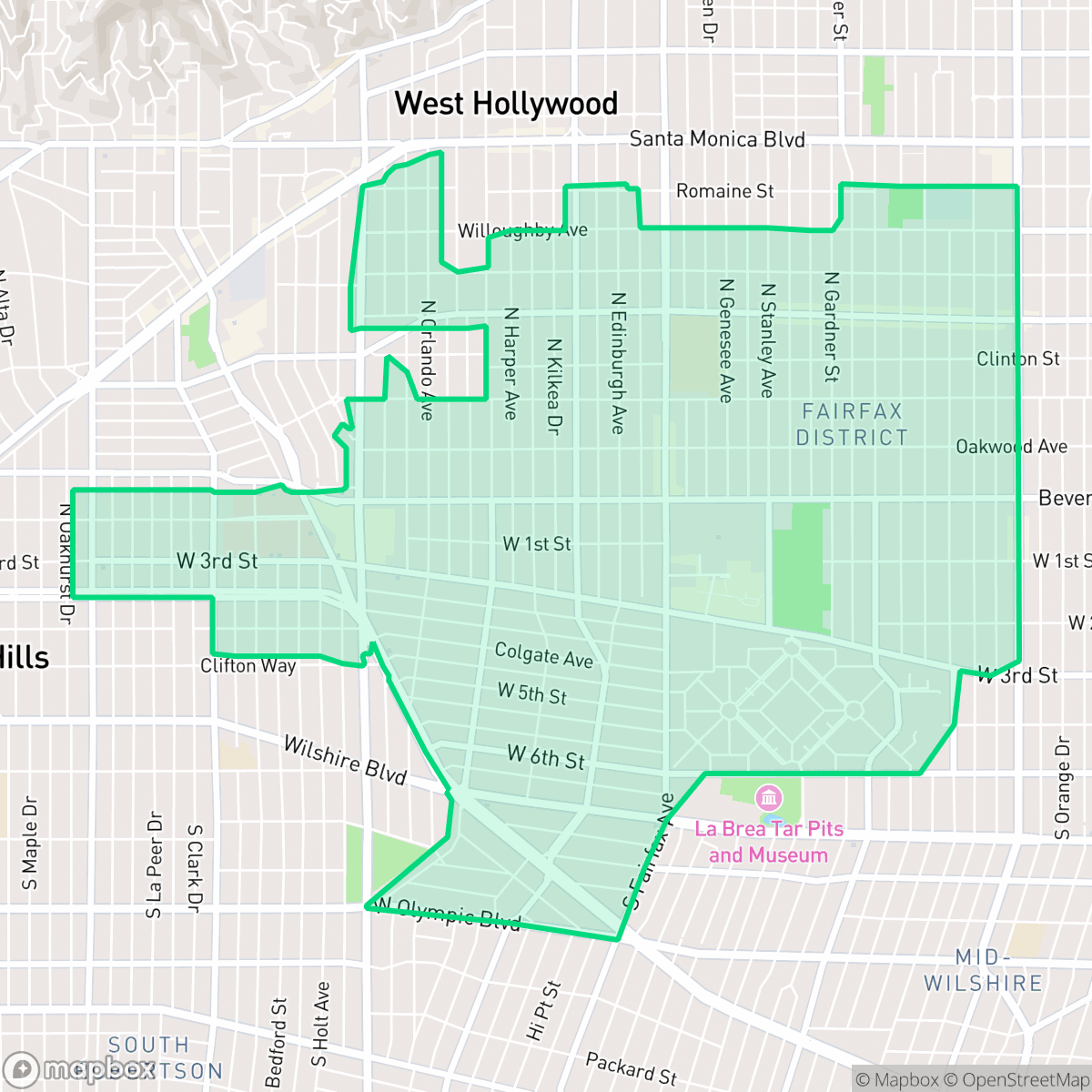
Mid-City West in Los Angeles, California, transitioned in the early 20th century from a landscape of barley fields and oil wells into a vibrant commercial and cultural hub. The neighborhood encompasses historic districts such as Beverly–Fairfax, Melrose, and the Miracle Mile. Developed starting in 1920 by A.W. Ross, the Miracle Mile was designed as one of the nation's first automobile-oriented shopping corridors. Architecturally, the area features a rich mix of Spanish Colonial, Mission Revival, and Mid-Century Modern designs. It is home to world-renowned cultural landmarks, including the La Brea Tar Pits, the Los Angeles County Museum of Art (LACMA), and the Petersen Automotive Museum. Additionally, the historic Original Farmers Market, established in 1934, and the landmark Du-par's restaurant define the neighborhood's enduring cultural identity.
The neighborhood functions as a dense, high-energy urban environment where residents enjoy seamless access to retail, dining, and public transit. With a perfect walkability score, daily errands are easily accomplished on foot, and the area maintains a consistent grid of sidewalks and pedestrian paths. According to iHuus data, the community is characterized by a strong mix of mid-rise residential and commercial structures, fostering a lively atmosphere that remains free from industrial hazards. Living in the area requires adjusting to a high-density lifestyle where structures are closely packed, resulting in limited privacy and elevated noise levels from road traffic. It is best suited for professionals and active individuals who prioritize proximity to cultural amenities and a car-free lifestyle over suburban seclusion. While the neighborhood faces challenges regarding fire safety, it offers high-quality air and widespread health insurance coverage, making it a stable choice for those who thrive in a bustling, central Los Angeles setting.
Neighborhood Scores Across 15 Qualities
Residential structures feature mixed spacing with some buildings closely packed and others separated by small buffers. This level of density is roughly in line with the average for Los Angeles.
Extensive sidewalk networks and frequent, marked crosswalks make navigating the area on foot easy. This dense grid offers superior connectivity for pedestrians compared to the Los Angeles average.
Large custom estates, private pools, and manicured landscaping are frequently visible, making the visual environment more polished than the Los Angeles average. High-status urban features like rooftop pools and well-maintained greenery are common throughout much of the area.
Access to large public parks and consistent green verges along many sidewalks provides more opportunities for pet walking than the city average. While some high-density blocks lack significant greenery, the presence of nearby parklands and grassy street parkways supports an active lifestyle for dog owners.
Residential blocks and commercial structures exist in roughly equal measure with greenery, creating a transitional environment that is slightly less dense than the Los Angeles average.
Frequent movement and a high concentration of social hubs create an atmosphere significantly more active than the Los Angeles average. Residents can access a wide variety of dining, galleries, and coffee shops within a dense, mid-rise urban landscape.
Persistent noise from nearby freeways and railroad tracks is a common feature here. According to iHuus data, acoustic levels in this area are consistent with the city average for Los Angeles.
Air quality remains consistently high with minimal health concerns. According to iHuus data, levels are notably better than the Los Angeles city average.
Industrial activity is almost nonexistent here, as the area consists primarily of residential, commercial, and institutional uses. This lack of heavy manufacturing and warehouses makes the neighborhood significantly cleaner of industrial hazards than the Los Angeles average.
Health insurance accessibility is notably higher than the Los Angeles average, according to iHuus data. Residents in this area benefit from a significantly greater proportion of covered individuals compared to most of the city.
Voting patterns and census indicators show a deeply liberal political leaning that is consistent with the broader Los Angeles area.
Residents live alongside a balanced variety of young professionals, families, and older adults. According to iHuus data, this demographic spread is slightly more varied than the typical Los Angeles profile.
Flood risk in this area is notably higher than the Los Angeles average. According to iHuus data, official FEMA flood studies for this specific zone remain incomplete.
Address-Level Insights for Mid City West


iHuus Neighborhood Intelligence Insights
Get address-level neighborhood insights for Mid City West
- Street-level scores — see how individual blocks compare, not just neighborhood averages
- Micro-zone boundaries — identify quiet pockets, flood boundaries, and walkable clusters before you visit
- 15 dimensions in full — walkability, noise, air quality, school quality, insurance coverage, population age profile, urban/rural index, and more
- Boundary risk alerts — know if your address sits near a block boundary where scores drop, the kind of detail no listing will ever mention
- School insights — individual school ratings and insights, not just district-level data
- Compare before you commit — side-by-side data across neighborhoods, down to block precision
No credit card required
Compare with Any Neighborhood
| Dimension | Mid City West | Adams-Normandie |
|---|---|---|
| 🚶 Walkabilityavg 8.9 | ||
| 🔊 Acoustic Comfortavg 2.91 | ||
| 🤫 Privacy Indexavg 4.14 | ||
| 🎨 Visual Appealavg 6.58 | ||
| 🐕 Dog Friendlinessavg 5.04 | ||
| 🗺️ Urban-Rural Indexavg 5.96 | ||
| ✨ Neighborhood Vibeavg 5.07 | ||
| 🏥 Health Insurance Coverageavg 6.2 | ||
| 🌿 Air Qualityavg 8.12 | ||
| 🏭 Industrial Proximityavg 8.46 | ||
| 🌊 Flood Safetyavg 2.66 | ||
| 🗳️ Ideological Leanavg 9.56 | ||
| 👥 Population Age Profileavg 4.85 | ||
| 🔥 Fire Safetyavg 0.18 | ||
| 🏫 School Quality |
Mid City West Rankings
School Districts Serving Mid City West
School Insights for Mid City West
Below average outcomes; significant attendance and academic challenges.
School Insights
See what's really behind every school rating near Mid City West
- Individual school ratings — each school's own score with outcome context, not just a district average
- Enrollment & class size data — student-to-teacher ratio and how it compares to the state average
- Full demographics breakdown — ethnicity and gender composition for every school in the enrollment zone
- Every school in the district — all schools within the enrollment boundary ranked by rating, not just the closest one
- Grade levels & benchmarks — elementary through high school, with below/above state-average flags
No credit card required