Melrose Hill Historic Preservation Overlay Zone, Los Angeles
Updated · 487 residents
Melrose Hill is a highly walkable residential enclave in East Hollywood defined by its dense grid and historic architecture. While the area offers convenient access to local dining and parks, residents experience significant noise from nearby road traffic and limited privacy due to the close proximity of homes.
Key Highlights
About Melrose Hill Historic Preservation Overlay Zone
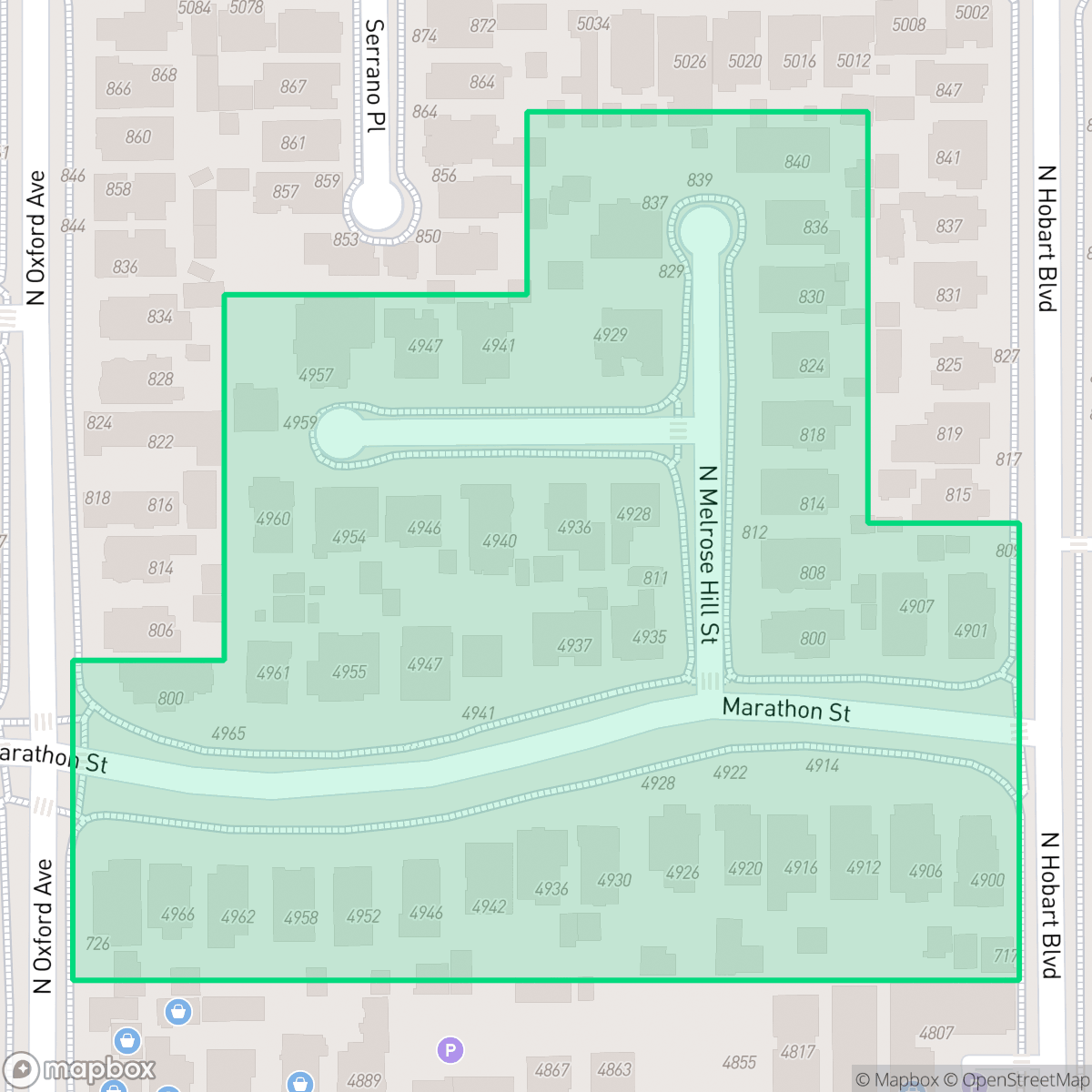
First developed in 1906 by Sidney L. Briggs and M. P. Gilbert, Melrose Hill is a secluded residential enclave in East Hollywood. Bounded by Melrose Avenue, Western Avenue, and the Hollywood Freeway, this historic neighborhood is celebrated as a prime example of the early 20th-century "bungalow capital" movement. Designated as one of Los Angeles's earliest Historic Preservation Overlay Zones (HPOZ) in 1988, the district contains just over 40 modest Craftsman and Colonial Revival bungalows built between 1911 and 1926. Nearly half of these homes were built by the Briggs Company. Melrose Hill is defined by its quiet cul-de-sacs, jacaranda-lined streets, and distinctive antique streetlights cast from a 1910 mold originally used in New York's Central Park, which neighbors installed in 1980 to spark the area's preservation movement.
The neighborhood functions as a dense, transit-accessible pocket within the broader East Hollywood landscape. Its grid-based layout ensures high walkability, allowing residents to easily reach a variety of local dining options, including popular spots like Dave's Hot Chicken and Mesa Thai. The environment remains lively and connected, blending residential blocks with nearby light industrial zones and commercial corridors.
Prospective residents should be aware of the acoustic environment, as the proximity to major thoroughfares results in elevated noise levels from road traffic. The area also features high-density housing configurations, which contributes to a limited sense of private space between structures. While the community benefits from good air quality and access to local green spaces for recreation, it is important to note that the neighborhood carries significant risks regarding fire and flood safety. This area is best suited for individuals who prioritize walkability and a central location over quietude or expansive private property.
Neighborhood Scores Across 15 Qualities
Residential structures are positioned in close proximity with minimal separation between buildings. This level of density is notably higher than the Los Angeles average, according to iHuus data.
Pedestrian movement is supported by a dense grid system, wide sidewalks, and frequent crosswalks. This level of connectivity and ease of navigation is notably higher than the average for Los Angeles.
Residential views consist primarily of high-density housing with simple rooflines and minimal private greenery. According to iHuus data, the visual variety in this area is slightly below the city average.
Access to pet exercise areas is slightly above the city average due to the presence of a central public park with green fields. Some residents may find limited options for walking pets on wider green verges throughout the entire zone.
A low density urban grid characterizes the area, featuring a mix of multi-unit residential and commercial structures. This setting is slightly more developed than the Los Angeles average, according to iHuus data.
Lively dining options and diverse amenities provide a more active atmosphere than the Los Angeles average. Certain blocks feature a mix of suburban-style green spaces and active commercial strips near light industrial areas.
Frequent noise from nearby freeways and transit corridors impacts the area. According to iHuus data, acoustic comfort in this neighborhood is lower than the Los Angeles average.
Air quality remains consistently high with infrequent instances of elevated readings. This level of cleanliness is nearly identical to the average found across Los Angeles.
Light industrial and commercial zones exist alongside residential streets, resulting in lower industrial density than the Los Angeles average. Large warehouses near the highway may introduce localized noise and pollution potential, according to iHuus data.
Health insurance accessibility is lower in this area than the broader Los Angeles average, according to iHuus data.
Voting patterns and census indicators reflect a predominantly liberal political leaning that is slightly more pronounced than the Los Angeles average. According to iHuus data, this area demonstrates highly consistent progressive social and political trends.
Residents experience a balanced demographic spread of young adults, families, and older populations. According to iHuus data, this age distribution is slightly more varied than the average found across Los Angeles.
Address-Level Insights for Melrose Hill Historic Preservation Overlay Zone


iHuus Neighborhood Intelligence Insights
Get address-level neighborhood insights for Melrose Hill Historic Preservation Overlay Zone
- Street-level scores — see how individual blocks compare, not just neighborhood averages
- Micro-zone boundaries — identify quiet pockets, flood boundaries, and walkable clusters before you visit
- 15 dimensions in full — walkability, noise, air quality, school quality, insurance coverage, population age profile, urban/rural index, and more
- Boundary risk alerts — know if your address sits near a block boundary where scores drop, the kind of detail no listing will ever mention
- School insights — individual school ratings and insights, not just district-level data
- Compare before you commit — side-by-side data across neighborhoods, down to block precision
No credit card required
Compare with Any Neighborhood
| Dimension | Melrose Hill Historic Preservation Overlay Zone | Adams-Normandie |
|---|---|---|
| 🚶 Walkabilityavg 8.9 | ||
| 🔊 Acoustic Comfortavg 2.91 | ||
| 🤫 Privacy Indexavg 4.14 | ||
| 🎨 Visual Appealavg 6.58 | ||
| 🐕 Dog Friendlinessavg 5.04 | ||
| 🗺️ Urban-Rural Indexavg 5.96 | ||
| ✨ Neighborhood Vibeavg 5.07 | ||
| 🏥 Health Insurance Coverageavg 6.2 | ||
| 🌿 Air Qualityavg 8.12 | ||
| 🏭 Industrial Proximityavg 8.46 | ||
| 🌊 Flood Safetyavg 2.66 | ||
| 🗳️ Ideological Leanavg 9.56 | ||
| 👥 Population Age Profileavg 4.85 | ||
| 🔥 Fire Safetyavg 0.18 | ||
| 🏫 School Quality |
Melrose Hill Historic Preservation Overlay Zone Rankings
School Districts Serving Melrose Hill Historic Preservation Overlay Zone
School Insights for Melrose Hill Historic Preservation Overlay Zone
Below average outcomes; significant attendance and academic challenges.
School Insights
See what's really behind every school rating near Melrose Hill Historic Preservation Overlay Zone
- Individual school ratings — each school's own score with outcome context, not just a district average
- Enrollment & class size data — student-to-teacher ratio and how it compares to the state average
- Full demographics breakdown — ethnicity and gender composition for every school in the enrollment zone
- Every school in the district — all schools within the enrollment boundary ranked by rating, not just the closest one
- Grade levels & benchmarks — elementary through high school, with below/above state-average flags
No credit card required