Los Feliz, Los Angeles
Updated · 28,785 residents
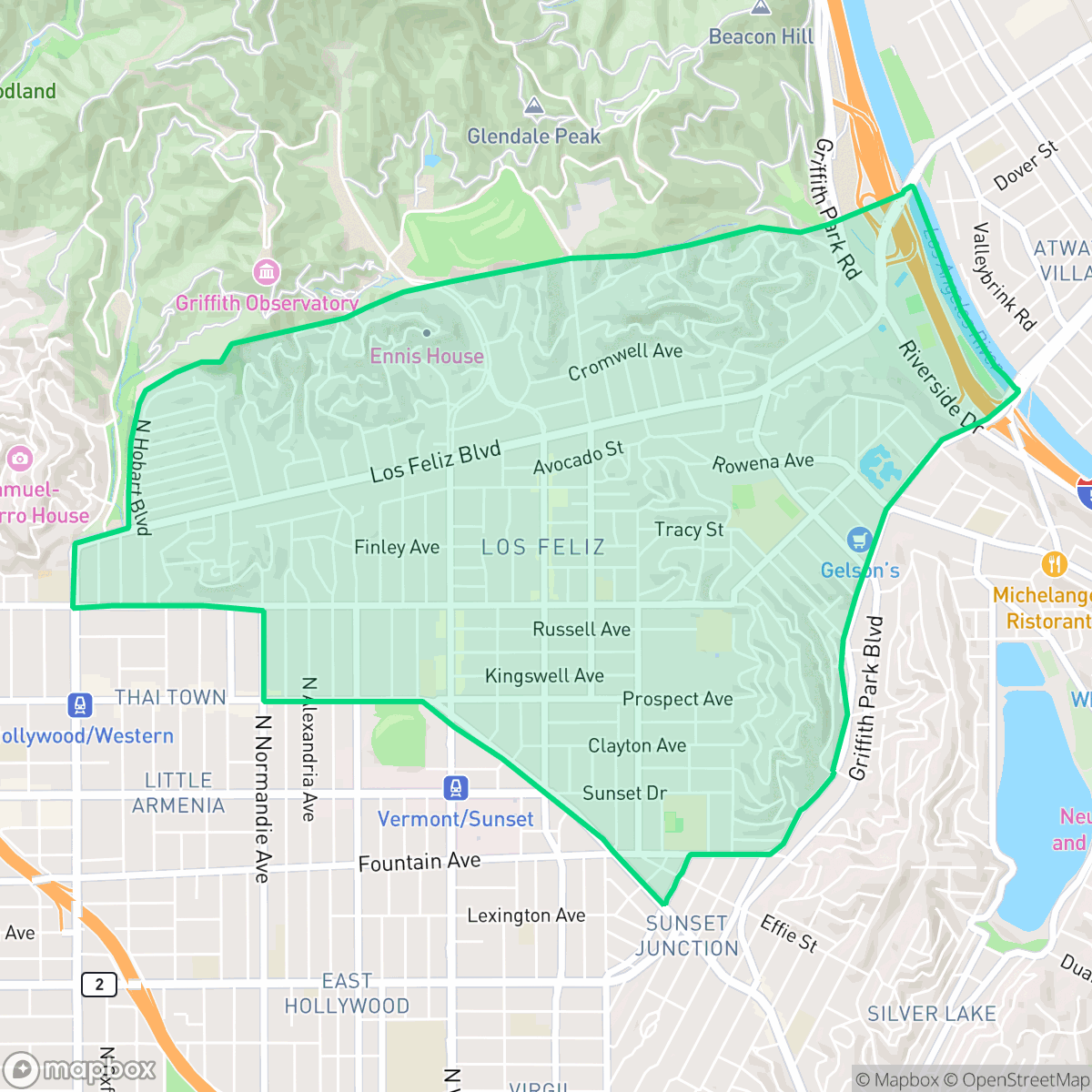
Los Feliz is a hillside neighborhood in Los Angeles defined by its architectural significance and proximity to Griffith Park. With a high level of walkability and access to top-rated local schools, the area offers a blend of urban convenience and quiet residential character. According to iHuus data, residents benefit from excellent air quality and a strong sense of community, though they should be prepared for typical urban noise levels and higher density in certain pockets.
Key Highlights
About Los Feliz
Nestled in the hills of Los Angeles, Los Feliz originated from the 1795 Spanish land grant Rancho Los Feliz, awarded to Corporal José Vicente Feliz. The neighborhood is renowned for its exceptional architectural heritage, featuring Frank Lloyd Wright’s Mayan Revival Ennis House (1924) and the UNESCO-listed Hollyhock House, alongside Richard Neutra’s pioneering modernist Lovell Health House. Local landmarks include the 1926 Gothic-style Shakespeare Bridge, the historic Vista Theatre, and the adjacent Griffith Observatory. At the heart of the community is Los Feliz Village, a vibrant commercial district centered on Vermont and Hillhurst avenues, home to legendary local institutions like the 1954 retro lounge, The Dresden Room. This blend of historic estates, mid-century modernism, and pedestrian-friendly commercial hubs defines the neighborhood's artistic and affluent character.
The neighborhood maintains a distinct identity through its mix of hillside estates and the bustling commercial corridors of Vermont and Hillhurst avenues. Residents enjoy a high degree of walkability, allowing for easy access to local dining, boutique retail, and community services. The area is particularly well-regarded for its educational landscape, featuring high-performing institutions like Franklin Avenue Elementary and John Marshall Senior High. These schools contribute to a stable environment for families, while the proximity to large-scale recreational spaces provides a necessary balance to the dense urban layout.
Prospective residents should note that while the area offers high visual appeal and well-maintained properties, it does present specific trade-offs regarding acoustic comfort and privacy. The neighborhood experiences moderate road traffic noise, and the density of housing means that some residents may find less separation between properties than in more suburban settings. According to iHuus data, the combination of high health insurance coverage and a strong, consistent ideological lean creates a cohesive community. It is an ideal location for those who value architectural history, academic access, and a pedestrian-friendly lifestyle in the heart of Los Angeles.
Neighborhood Scores Across 15 Qualities
Residential spacing varies from dense apartment complexes to secluded hillside estates, providing slightly more buffer between neighbors than the city average. According to iHuus data, many homes feature narrow setbacks or shared walls, though dense perimeter vegetation often helps maintain separation.
Extensive sidewalk networks and clearly marked crosswalks make navigating the neighborhood on foot easy. This level of pedestrian connectivity is nearly identical to the average found throughout Los Angeles.
Manicured landscaping, large estates, and frequent private pools create a visually pleasing environment that is more aesthetically pleasing than the Los Angeles average. Many properties in the eastern and hillside sectors feature high-end amenities such as tennis courts and custom architecture, according to iHuus data.
Access to public green space and wide sidewalk verges is slightly above the city average. While some dense areas have limited public greenery, proximity to large trails and riverside parks provides reliable walking options for dogs.
Tree-lined streets and single-family homes exist alongside dense low-rise apartment blocks. This balance of greenery and urban density is slightly higher than the Los Angeles average, according to iHuus data.
A mix of lively dining corridors and quiet, green residential pockets creates an atmosphere slightly more active than the Los Angeles average. While some blocks offer dense clusters of cafes and restaurants, many areas remain suburban and serene with limited walking access to amenities.
Persistent noise from nearby freeway corridors and transit routes is common here. According to iHuus data, acoustic levels are slightly higher than the Los Angeles average.
Air quality remains consistently good with infrequent periods of elevated readings. According to iHuus data, the air quality in this area is comparable to the Los Angeles city average.
Industrial hazards and large-scale warehouses are absent from this area, making it significantly cleaner than the Los Angeles average. The landscape consists strictly of residential, recreational, and light commercial structures.
Health insurance coverage among residents is higher than the Los Angeles average, according to iHuus data. This level of coverage suggests greater access to medical services and reduced out-of-pocket healthcare costs for the community.
Voting patterns and census indicators show a very high concentration of liberal-leaning residents, even surpassing the average seen across Los Angeles.
Residents live alongside a relatively even mix of young professionals, families, and seniors. This demographic spread is slightly more varied than the average found across Los Angeles.
Properties in certain parts of Los Feliz are located within a designated floodplain, which represents a higher risk of flooding than the Los Angeles average. According to iHuus data, residents in these zones should anticipate a greater likelihood of needing flood insurance.
Wildfire vulnerability is exceptionally high in this area; according to iHuus data, the risk level is slightly above the Los Angeles average. Residents should prioritize maximum fire protection measures and remain vigilant regarding local seasonal hazards.
Address-Level Insights for Los Feliz


iHuus Neighborhood Intelligence Insights
Get address-level neighborhood insights for Los Feliz
- Street-level scores — see how individual blocks compare, not just neighborhood averages
- Micro-zone boundaries — identify quiet pockets, flood boundaries, and walkable clusters before you visit
- 15 dimensions in full — walkability, noise, air quality, school quality, insurance coverage, population age profile, urban/rural index, and more
- Boundary risk alerts — know if your address sits near a block boundary where scores drop, the kind of detail no listing will ever mention
- School insights — individual school ratings and insights, not just district-level data
- Compare before you commit — side-by-side data across neighborhoods, down to block precision
No credit card required
Compare with Any Neighborhood
| Dimension | Los Feliz | Adams-Normandie |
|---|---|---|
| 🚶 Walkabilityavg 8.9 | ||
| 🔊 Acoustic Comfortavg 2.91 | ||
| 🤫 Privacy Indexavg 4.14 | ||
| 🎨 Visual Appealavg 6.58 | ||
| 🐕 Dog Friendlinessavg 5.04 | ||
| 🗺️ Urban-Rural Indexavg 5.96 | ||
| ✨ Neighborhood Vibeavg 5.07 | ||
| 🏥 Health Insurance Coverageavg 6.2 | ||
| 🌿 Air Qualityavg 8.12 | ||
| 🏭 Industrial Proximityavg 8.46 | ||
| 🌊 Flood Safetyavg 2.66 | ||
| 🗳️ Ideological Leanavg 9.56 | ||
| 👥 Population Age Profileavg 4.85 | ||
| 🔥 Fire Safetyavg 0.18 | ||
| 🏫 School Quality |
Los Feliz Rankings
School Districts Serving Los Feliz
School Insights for Los Feliz
Below average outcomes; significant attendance and academic challenges.
School Insights
See what's really behind every school rating near Los Feliz
- Individual school ratings — each school's own score with outcome context, not just a district average
- Enrollment & class size data — student-to-teacher ratio and how it compares to the state average
- Full demographics breakdown — ethnicity and gender composition for every school in the enrollment zone
- Every school in the district — all schools within the enrollment boundary ranked by rating, not just the closest one
- Grade levels & benchmarks — elementary through high school, with below/above state-average flags
No credit card required