Little Ethiopia, Los Angeles
Updated · 116 residents
Little Ethiopia is a high-energy, exceptionally walkable neighborhood centered along South Fairfax Avenue. Residents enjoy immediate access to a diverse array of dining and social venues, though the area is characterized by significant road traffic noise and dense residential living.
Key Highlights
About Little Ethiopia
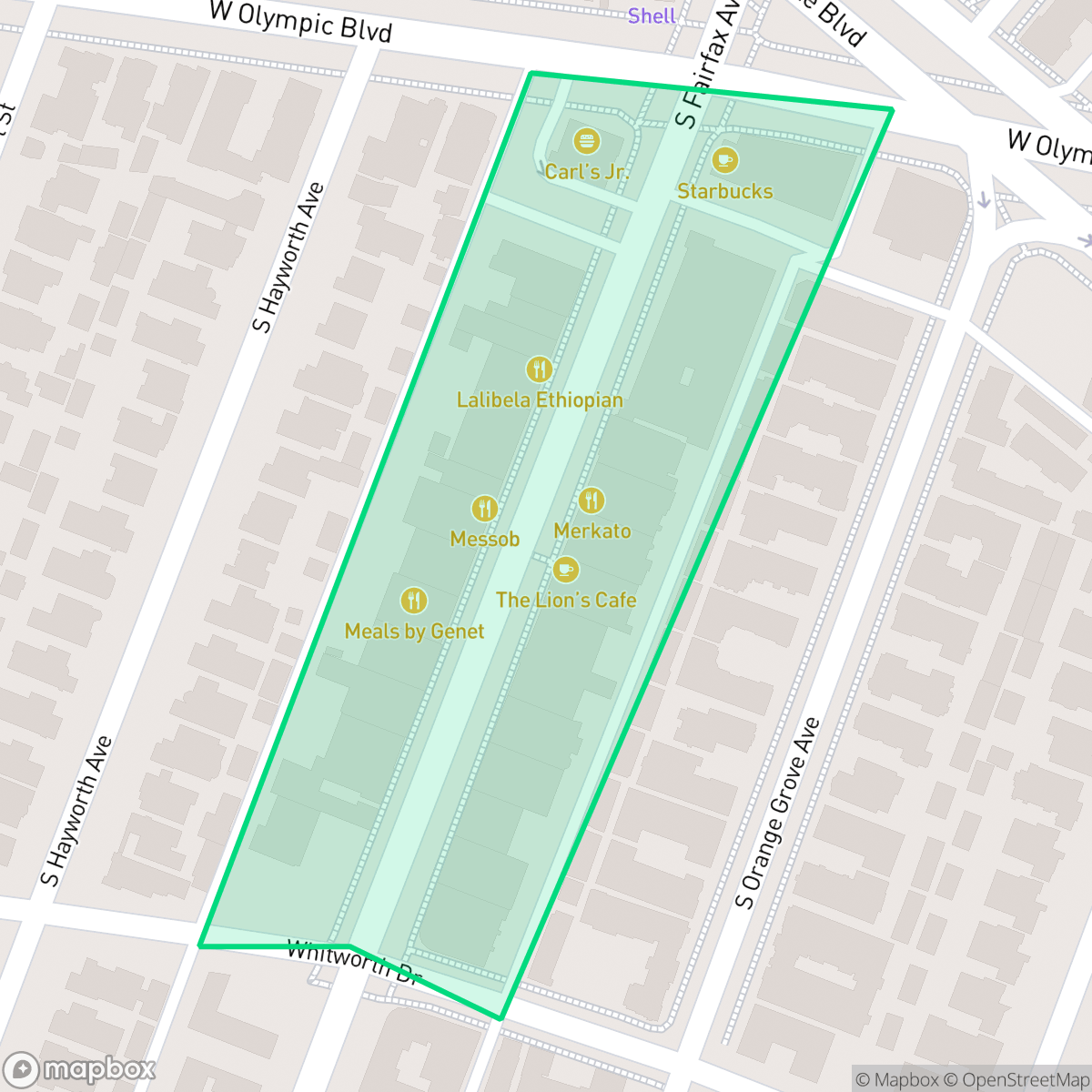
Located in the Carthay district of Los Angeles, Little Ethiopia is a vibrant cultural enclave concentrated along a three-block stretch of South Fairfax Avenue between Olympic and Pico Boulevards. Originally part of a prominent Jewish commercial district nicknamed "SoFax", the area underwent a demographic shift in the late 1980s and 1990s. Following political upheaval in East Africa, thousands of Ethiopian immigrants settled in Los Angeles. In 1988, businessman Fekere Gebre-Mariam relocated his restaurant, Rosalind’s, to Fairfax Avenue, envisioning a dedicated cultural hub. Other pioneering businesses like Messob and Merkato soon followed. Initially referred to as "Little Addis," the neighborhood was officially designated "Little Ethiopia" by the Los Angeles City Council in November 2002. It is celebrated as the first official U.S. neighborhood named for an African nation.
The neighborhood functions as a dense, urban corridor that blends mid-rise commercial activity with high-density residential housing. It is a highly active area, featuring popular local spots such as Hiho Cheeseburger, Kazunori, and various coffee shops like Paradocs Coffee and Tea. According to iHuus data, the area maintains a perfect walkability score, making it an ideal location for those who prioritize pedestrian access to amenities over the quiet of a suburban environment. The visual landscape is well-maintained, characterized by affluent residential structures and private greenery, despite the compact nature of the housing plots.
Prospective residents should consider the trade-offs of living in such a central, high-traffic zone. The acoustic environment is notably loud, with road traffic contributing to a consistent ambient noise level of 63 decibels. Additionally, the high density of the area results in limited privacy, as homes are closely packed with small setbacks. While the neighborhood is free from industrial activity, it faces specific challenges regarding fire safety and the broader administrative complexities of the Los Angeles Unified School District. It remains best suited for individuals who value a vibrant, walkable lifestyle in the heart of the city and are comfortable with the inherent noise and density of an urban environment.
Neighborhood Scores Across 15 Qualities
Homes are situated in close quarters with minimal separation between properties. This level of density is notably higher than the average for Los Angeles.
A dense street grid with wide sidewalks and frequent marked crosswalks makes navigating the area on foot easy. According to iHuus data, the pedestrian infrastructure in Little Ethiopia is superior to the Los Angeles average.
Residential structures and yards exhibit standard urban density, appearing slightly more uniform than the average for Los Angeles. Some pockets contain larger homes with private pools, but most of the area features typical middle-class housing layouts.
Access to public parks is inconsistent, with some residential blocks lacking significant green space or wide sidewalk verges. According to iHuus data, pet-friendly amenities in this area are slightly below the city average.
Residential streets and green spaces are distributed in roughly equal measure, though the area feels slightly less dense than the Los Angeles average. This transitional zone features a mix of low-rise multi-family housing and commercial corridors according to iHuus data.
Dense concentrations of diverse dining and social destinations create an energy level significantly higher than the Los Angeles average. According to iHuus data, the area functions as a lively district with a rich infrastructure of local eateries and community gathering spots.
Frequent noise from nearby transit infrastructure and heavy traffic makes this area significantly louder than most of Los Angeles. According to iHuus data, residents can expect very low acoustic comfort due to its proximity to major transportation corridors.
Air quality remains consistently high with rare instances of elevated readings. According to iHuus data, the atmosphere in this area is slightly cleaner than the Los Angeles average.
Industrial zones and warehouses are entirely absent from this area, making it significantly cleaner of heavy industrial hazards than most of Los Angeles. According to iHuus data, the neighborhood consists strictly of residential and light commercial uses.
Health insurance accessibility is notably higher than the Los Angeles average, according to iHuus data.
Voting patterns and census indicators show a highly liberal leaning that is even more pronounced than the Los Angeles city average, according to iHuus data.
A diverse age range of young professionals, families, and seniors creates a balanced demographic profile. This distribution is notably more varied than the typical age spread found across Los Angeles.
Flood vulnerability is higher than the Los Angeles average due to the area's location within a designated floodplain. Residents may find that flood insurance is a standard requirement for properties here, according to iHuus data.
Address-Level Insights for Little Ethiopia


iHuus Neighborhood Intelligence Insights
Get address-level neighborhood insights for Little Ethiopia
- Street-level scores — see how individual blocks compare, not just neighborhood averages
- Micro-zone boundaries — identify quiet pockets, flood boundaries, and walkable clusters before you visit
- 15 dimensions in full — walkability, noise, air quality, school quality, insurance coverage, population age profile, urban/rural index, and more
- Boundary risk alerts — know if your address sits near a block boundary where scores drop, the kind of detail no listing will ever mention
- School insights — individual school ratings and insights, not just district-level data
- Compare before you commit — side-by-side data across neighborhoods, down to block precision
No credit card required
Compare with Any Neighborhood
| Dimension | Little Ethiopia | Adams-Normandie |
|---|---|---|
| 🚶 Walkabilityavg 8.9 | ||
| 🔊 Acoustic Comfortavg 2.91 | ||
| 🤫 Privacy Indexavg 4.14 | ||
| 🎨 Visual Appealavg 6.58 | ||
| 🐕 Dog Friendlinessavg 5.04 | ||
| 🗺️ Urban-Rural Indexavg 5.96 | ||
| ✨ Neighborhood Vibeavg 5.07 | ||
| 🏥 Health Insurance Coverageavg 6.2 | ||
| 🌿 Air Qualityavg 8.12 | ||
| 🏭 Industrial Proximityavg 8.46 | ||
| 🌊 Flood Safetyavg 2.66 | ||
| 🗳️ Ideological Leanavg 9.56 | ||
| 👥 Population Age Profileavg 4.85 | ||
| 🔥 Fire Safetyavg 0.18 | ||
| 🏫 School Quality |
Little Ethiopia Rankings
School Districts Serving Little Ethiopia
School Insights for Little Ethiopia
Below average outcomes; significant attendance and academic challenges.
School Insights
See what's really behind every school rating near Little Ethiopia
- Individual school ratings — each school's own score with outcome context, not just a district average
- Enrollment & class size data — student-to-teacher ratio and how it compares to the state average
- Full demographics breakdown — ethnicity and gender composition for every school in the enrollment zone
- Every school in the district — all schools within the enrollment boundary ranked by rating, not just the closest one
- Grade levels & benchmarks — elementary through high school, with below/above state-average flags
No credit card required