Lincoln Heights, Los Angeles
Updated · 38,572 residents
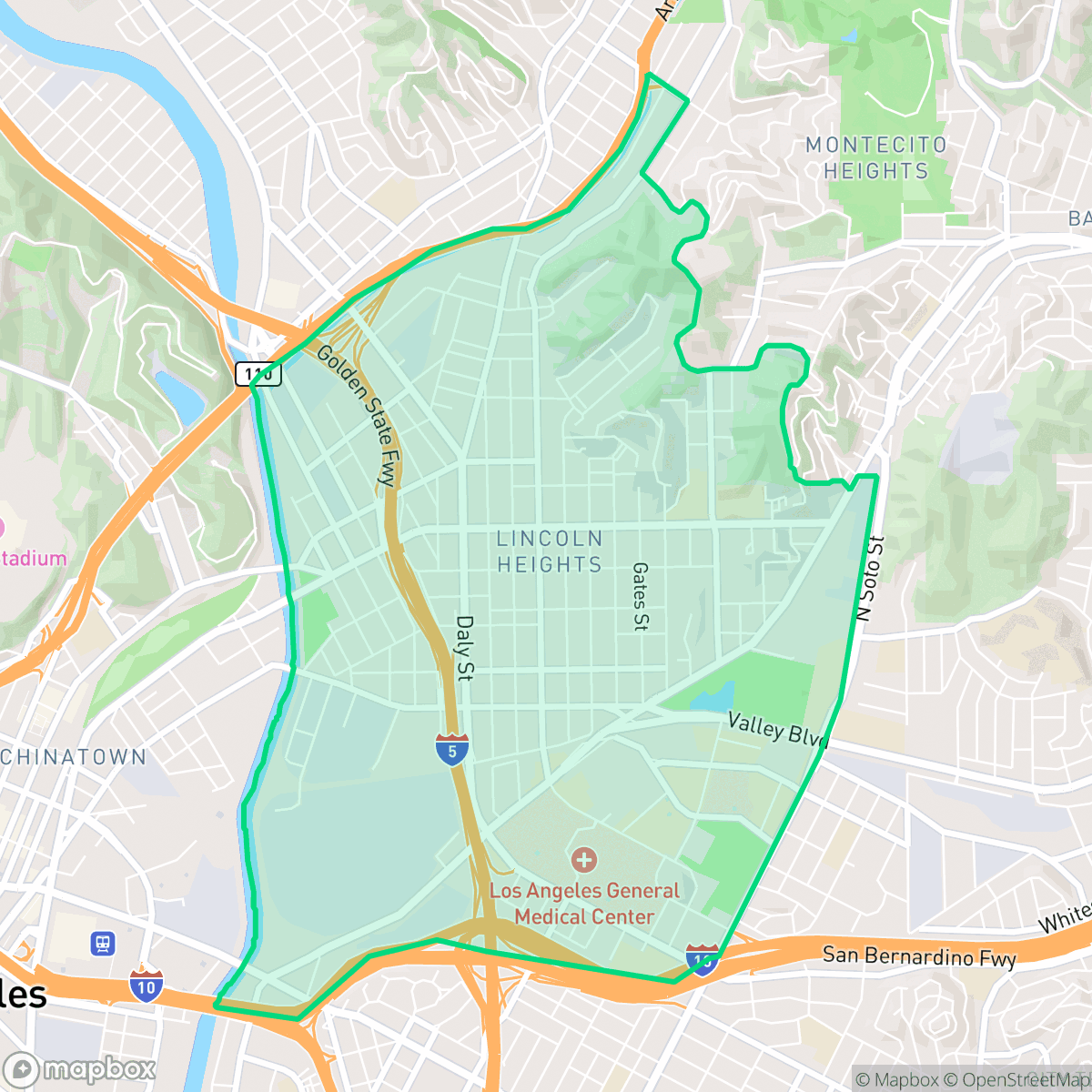
Lincoln Heights is a dense, historic neighborhood known for its diverse culinary scene and proximity to major transit infrastructure. While residents benefit from high walkability and good air quality, the area is characterized by tightly packed housing and significant noise from road traffic.
Key Highlights
About Lincoln Heights
Subdivided in 1873 as "East Los Angeles" by Dr. John Strother Griffin, Lincoln Heights is recognized as Los Angeles’s oldest suburb. Renamed in 1917 after Abraham Lincoln High School, the neighborhood evolved from a middle-class commuter hub into a diverse enclave often called the "Ellis Island of Los Angeles" due to successive waves of Italian, Chinese, and Mexican immigrants. Its rich architectural heritage features Queen Anne, Folk Victorian, and Arts and Crafts homes protected under a Historic Preservation Overlay Zone. Key local landmarks include the 1931 Art Deco Lincoln Heights Jail, the historic San Antonio Winery, and the Brewery Art Colony—once home to the city's early brewing industry. Today, the neighborhood's vibrant cultural identity is anchored along the North Broadway corridor, celebrated for its Chicano movement murals.
The neighborhood functions as a dense urban hub where residential streets intersect with heavy industrial and logistics infrastructure. It maintains a consistent grid layout that supports high walkability, allowing residents to easily access local transit and neighborhood services. The local dining scene is particularly notable, offering a range of options that reflect the community's cultural diversity. According to iHuus data, the area provides a central location within Los Angeles, though it is marked by a high density of housing, resulting in limited personal space and minimal privacy between properties.
Prospective residents should be aware of the acoustic environment, as the proximity to major freeways and industrial zones results in elevated noise levels. The area presents a complex mix of urban challenges and benefits, including higher-than-average fire and flood risks alongside strong air quality metrics. It is best suited for individuals who prioritize central accessibility and a vibrant, unpretentious urban atmosphere over the quietude or spaciousness of traditional suburban living.
Neighborhood Scores Across 15 Qualities
Residential structures and multi-unit complexes are tightly packed with minimal separation between buildings. This level of density and proximity to neighbors is slightly higher than the average for Los Angeles.
Sidewalks and crosswalks are consistent throughout residential pockets and parks, but heavy freeway interchanges and industrial rail corridors create significant barriers for pedestrians. This fragmented network makes walking less seamless than in many other parts of Los Angeles.
Residential views consist primarily of dense, standard tract housing and apartment complexes with modest yards. The area lacks the expansive greenery or luxury amenities found in more visually lush parts of Los Angeles, according to iHuus data.
Access to green space for pets varies significantly across the area, ranging from large parks with lakes and walking paths to highly industrial zones with minimal public greenery. While some residents benefit from proximity to hilly parkland, other parts of the neighborhood feature dense pavement and limited sidewalk verges, making the area's dog friendliness comparable to the city average.
Residential streets and green spaces exist in roughly equal measure with industrial zones and transit infrastructure. This balance of built environment and open space is slightly less dense than the Los Angeles average.
Predominantly industrial and suburban in character, this area offers a calm atmosphere with limited walking options for daily errands. While diverse dining and local services are available, most locations require a vehicle due to the low density of pedestrian-friendly business hubs.
Persistent noise from nearby freeways and railroad tracks makes this area significantly louder than the Los Angeles average. Residents should expect frequent auditory disruptions from heavy transit traffic.
Air quality remains largely clear with infrequent periods of higher pollution levels, performing closely to the Los Angeles average according to iHuus data.
Heavy industrial activity and large-scale rail infrastructure are concentrated near the southern and southeastern edges of the neighborhood. This proximity to warehouses and major transit corridors results in higher levels of noise and traffic than is typically found across the rest of Los Angeles.
Health insurance coverage among residents is lower than the average for Los Angeles. This gap in coverage may impact ease of access to medical services for those living in the area.
Voting patterns and census indicators show a highly liberal political leaning that is slightly more pronounced than the Los Angeles average, according to iHuus data.
A varied demographic of young adults, families, and seniors resides here, representing a population age distribution that is very similar to the city average.
Significant flood risk exists here because portions of the area fall within a designated floodplain. According to iHuus data, the vulnerability to flooding is higher than the average for Los Angeles.
Fire hazards in this area are severe and represent an extreme risk to residents. This level of danger is consistent with the current average found across Los Angeles.
Address-Level Insights for Lincoln Heights


iHuus Neighborhood Intelligence Insights
Get address-level neighborhood insights for Lincoln Heights
- Street-level scores — see how individual blocks compare, not just neighborhood averages
- Micro-zone boundaries — identify quiet pockets, flood boundaries, and walkable clusters before you visit
- 15 dimensions in full — walkability, noise, air quality, school quality, insurance coverage, population age profile, urban/rural index, and more
- Boundary risk alerts — know if your address sits near a block boundary where scores drop, the kind of detail no listing will ever mention
- School insights — individual school ratings and insights, not just district-level data
- Compare before you commit — side-by-side data across neighborhoods, down to block precision
No credit card required
Compare with Any Neighborhood
| Dimension | Lincoln Heights | Adams-Normandie |
|---|---|---|
| 🚶 Walkabilityavg 8.9 | ||
| 🔊 Acoustic Comfortavg 2.91 | ||
| 🤫 Privacy Indexavg 4.14 | ||
| 🎨 Visual Appealavg 6.58 | ||
| 🐕 Dog Friendlinessavg 5.04 | ||
| 🗺️ Urban-Rural Indexavg 5.96 | ||
| ✨ Neighborhood Vibeavg 5.07 | ||
| 🏥 Health Insurance Coverageavg 6.2 | ||
| 🌿 Air Qualityavg 8.12 | ||
| 🏭 Industrial Proximityavg 8.46 | ||
| 🌊 Flood Safetyavg 2.66 | ||
| 🗳️ Ideological Leanavg 9.56 | ||
| 👥 Population Age Profileavg 4.85 | ||
| 🔥 Fire Safetyavg 0.18 | ||
| 🏫 School Quality |
Lincoln Heights Rankings
School Districts Serving Lincoln Heights
School Insights for Lincoln Heights
Below average outcomes; significant attendance and academic challenges.
School Insights
See what's really behind every school rating near Lincoln Heights
- Individual school ratings — each school's own score with outcome context, not just a district average
- Enrollment & class size data — student-to-teacher ratio and how it compares to the state average
- Full demographics breakdown — ethnicity and gender composition for every school in the enrollment zone
- Every school in the district — all schools within the enrollment boundary ranked by rating, not just the closest one
- Grade levels & benchmarks — elementary through high school, with below/above state-average flags
No credit card required