Leimert Park, Los Angeles
Updated · 10,516 residents
Leimert Park is a highly walkable neighborhood characterized by its dense residential grid and strong community identity. Residents benefit from a consistent sidewalk network and proximity to local retail, though the area experiences elevated noise levels from road traffic and limited access to public green spaces.
Key Highlights
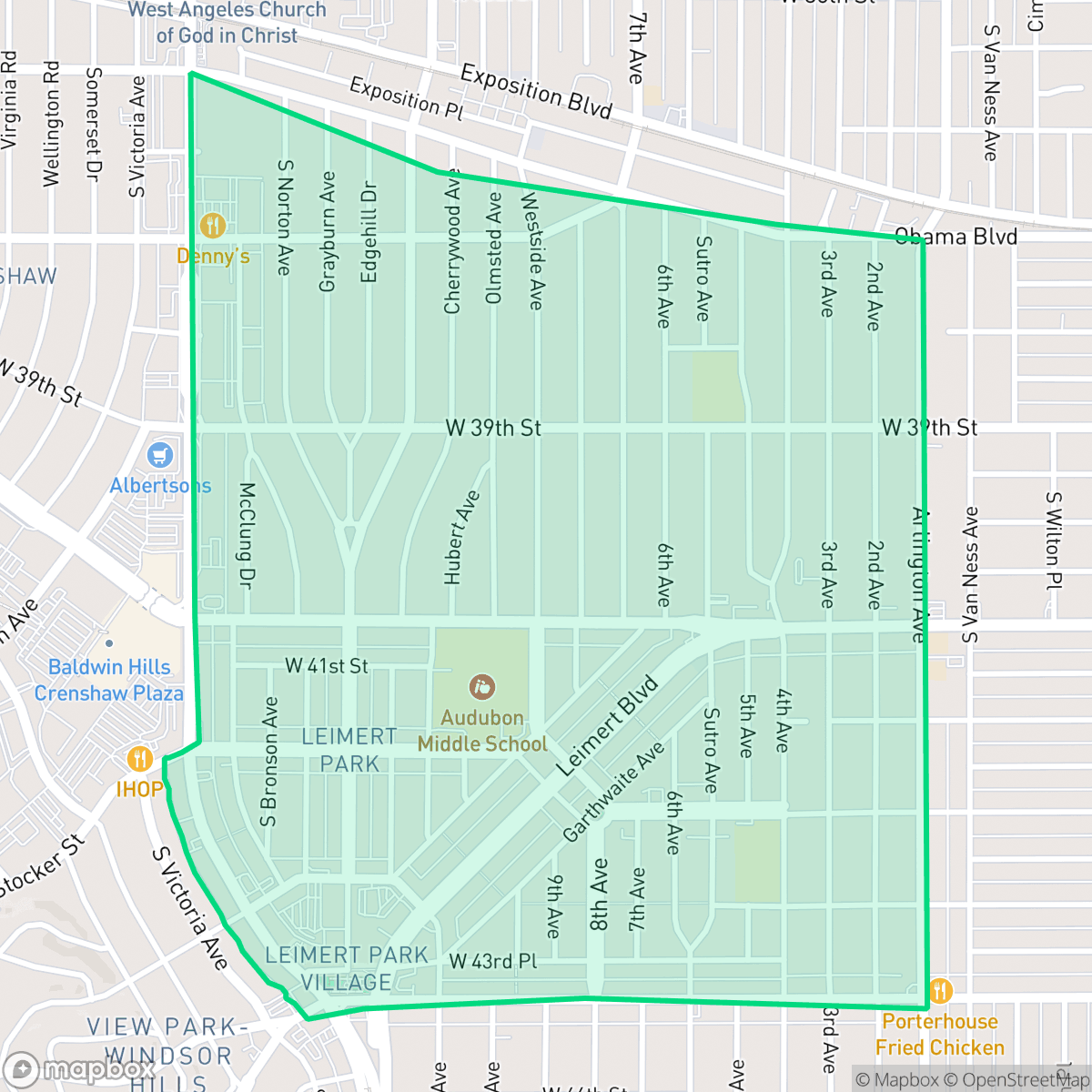
About Leimert Park
Developed in 1927 by Walter H. Leimert and master-planned by the Olmsted Brothers, Leimert Park was designed as a model community featuring Spanish Colonial Revival homes, hidden utility wires, and tree-lined streets. Initially restricted to white residents, the neighborhood integrated after restrictive covenants were struck down in 1948. It transitioned into a premier middle-class Black community by the 1960s, earning the moniker the "Black Greenwich Village". At its core is Leimert Park Village, a cultural hub anchored by Degnan Boulevard, the historic Vision Theatre (originally built in 1932 by Morgan, Walls & Clements), and Leimert Plaza Park. The neighborhood's artistic legacy was catalyzed by the Brockman Gallery in 1967 and continues to thrive through local landmarks like The World Stage, weekly drum circles, and historic residences of icons like Ella Fitzgerald and Ray Charles.
This neighborhood functions as a dense urban and suburban mix, defined by a grid-based layout that prioritizes pedestrian access. According to iHuus data, the area maintains a high walkability score, supported by a comprehensive system of sidewalks and crosswalks throughout its residential and commercial corridors. While the architectural landscape consists primarily of tightly packed single-family homes, the community remains a focal point for local commerce and social engagement, balancing its quiet residential streets with active cultural hubs along its primary thoroughfares.
Prospective residents should consider that the high density of housing results in limited private outdoor space and lower privacy levels compared to other parts of the city. The area is subject to consistent road traffic noise, and public green space is relatively scarce, which may impact pet owners. However, the neighborhood offers strong access to health insurance coverage and a selection of high-performing educational institutions, including the Iovine and Young Center and Catch Prep Charter High. It is best suited for individuals who prioritize walkability and cultural connectivity over expansive private yards or total acoustic seclusion.
Neighborhood Scores Across 15 Qualities
Homes are closely packed with minimal setbacks and limited separation between structures. This density is notably higher than the Los Angeles average, with many properties sharing narrow side yards or property lines.
A comprehensive network of sidewalks and clearly marked crosswalks makes navigating the area on foot easy. This sidewalk connectivity is even more robust than the average found across Los Angeles.
Standard tract housing and dense residential layouts define the area, which offers less visual variety than the Los Angeles average. According to iHuus data, the landscape consists primarily of uniform rooflines and small yards with limited greenery.
Public green space and accessible parks for pets are scarce within the immediate residential blocks. Most greenery is confined to private fenced yards, making this area less dog-friendly than the Los Angeles average.
Residential streets and commercial corridors exist in roughly equal measure. This layout presents a blend of single-family homes and low-rise density that is nearly identical to the broader Los Angeles average.
A blend of lively social hubs and quiet residential pockets provides a variety of dining and green spaces. This mix of activity and suburban calm is slightly higher than the typical experience found elsewhere in Los Angeles.
Frequent noise from nearby freeways and transit corridors makes this area louder than much of Los Angeles. Residents should expect consistent ambient sound levels from heavy vehicle traffic and rail proximity.
Air quality in this area is generally good, remaining consistent with the broader Los Angeles average. According to iHuus data, residents can expect rare instances of elevated readings but otherwise stable conditions.
Industrial activity and large warehouses are absent from the neighborhood, providing a setting that is even more residential than the Los Angeles average. According to iHuus data, the area consists exclusively of residential and light commercial uses with no visible heavy industrial hazards.
Health insurance accessibility in Leimert Park is slightly below the Los Angeles city average. Residents may find fewer options for covered care within the immediate area according to iHuus data.
Voting patterns and census indicators show a deeply liberal political leaning that is even more pronounced than the Los Angeles average. This reflects a community with a very high concentration of progressive-aligned residents according to iHuus data.
Residents live alongside a balanced mix of young adults, families, and older populations. This demographic spread is slightly more varied than the typical Los Angeles profile, according to iHuus data.
Significant flood risk exists because parts of the area fall within a designated floodplain; according to iHuus data, this risk is higher than the Los Angeles average and may necessitate flood insurance.
Address-Level Insights for Leimert Park


iHuus Neighborhood Intelligence Insights
Get address-level neighborhood insights for Leimert Park
- Street-level scores — see how individual blocks compare, not just neighborhood averages
- Micro-zone boundaries — identify quiet pockets, flood boundaries, and walkable clusters before you visit
- 15 dimensions in full — walkability, noise, air quality, school quality, insurance coverage, population age profile, urban/rural index, and more
- Boundary risk alerts — know if your address sits near a block boundary where scores drop, the kind of detail no listing will ever mention
- School insights — individual school ratings and insights, not just district-level data
- Compare before you commit — side-by-side data across neighborhoods, down to block precision
No credit card required
Compare with Any Neighborhood
| Dimension | Leimert Park | Adams-Normandie |
|---|---|---|
| 🚶 Walkabilityavg 8.9 | ||
| 🔊 Acoustic Comfortavg 2.91 | ||
| 🤫 Privacy Indexavg 4.14 | ||
| 🎨 Visual Appealavg 6.58 | ||
| 🐕 Dog Friendlinessavg 5.04 | ||
| 🗺️ Urban-Rural Indexavg 5.96 | ||
| ✨ Neighborhood Vibeavg 5.07 | ||
| 🏥 Health Insurance Coverageavg 6.2 | ||
| 🌿 Air Qualityavg 8.12 | ||
| 🏭 Industrial Proximityavg 8.46 | ||
| 🌊 Flood Safetyavg 2.66 | ||
| 🗳️ Ideological Leanavg 9.56 | ||
| 👥 Population Age Profileavg 4.85 | ||
| 🔥 Fire Safetyavg 0.18 | ||
| 🏫 School Quality |
Leimert Park Rankings
School Districts Serving Leimert Park
School Insights for Leimert Park
Below average outcomes; significant attendance and academic challenges.
School Insights
See what's really behind every school rating near Leimert Park
- Individual school ratings — each school's own score with outcome context, not just a district average
- Enrollment & class size data — student-to-teacher ratio and how it compares to the state average
- Full demographics breakdown — ethnicity and gender composition for every school in the enrollment zone
- Every school in the district — all schools within the enrollment boundary ranked by rating, not just the closest one
- Grade levels & benchmarks — elementary through high school, with below/above state-average flags
No credit card required