Lake Balboa, Los Angeles
Updated · 23,698 residents
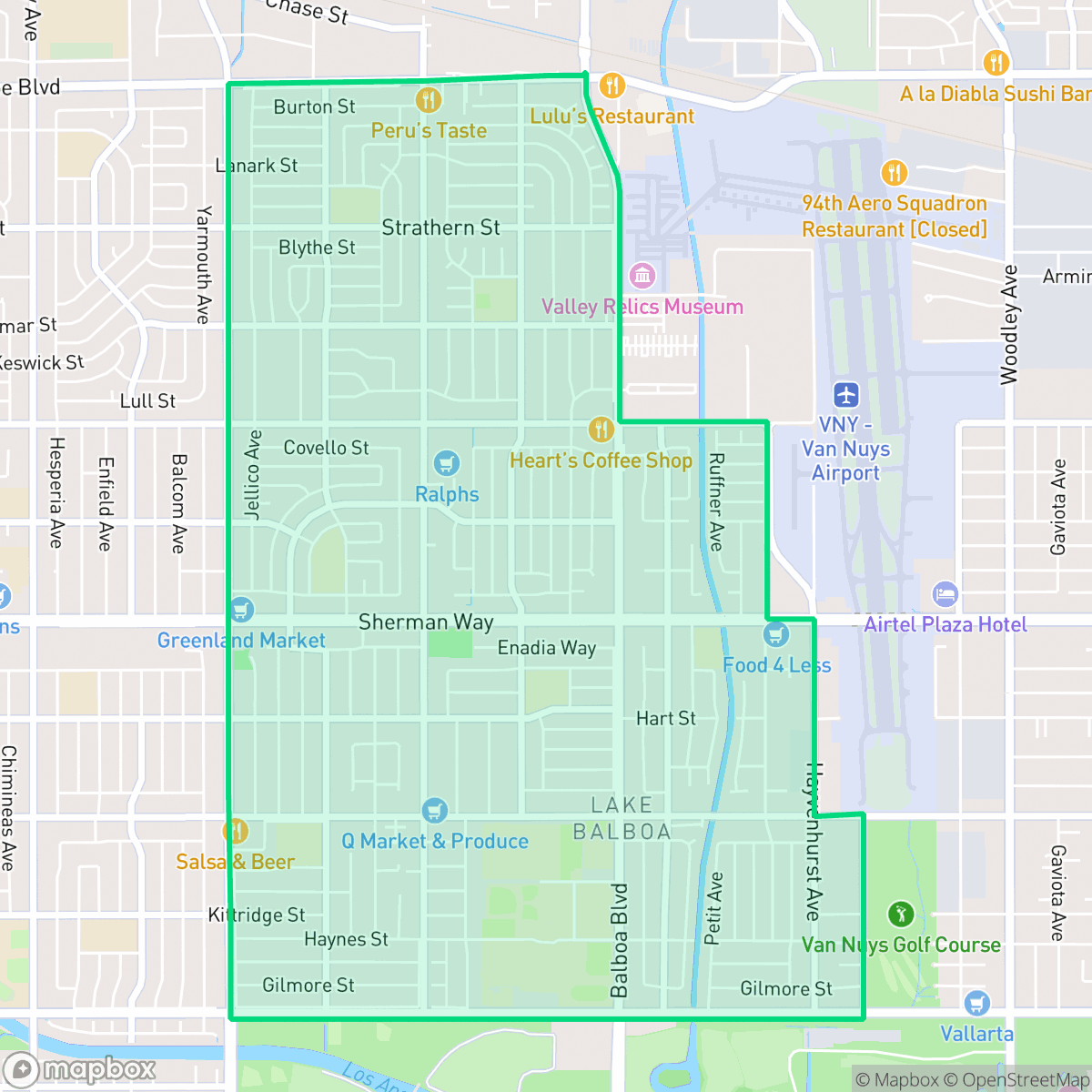
Lake Balboa is a quiet, suburban neighborhood in the San Fernando Valley characterized by its high walkability and proximity to the expansive Sepulveda Basin recreation area. Residents benefit from a well-connected grid of sidewalks and a peaceful atmosphere, though the area experiences moderate noise levels primarily driven by road traffic.
Key Highlights
About Lake Balboa
Originally part of Van Nuys, the San Fernando Valley neighborhood of Lake Balboa was officially recognized by the Los Angeles City Council in 2007. Historically, the area was part of Isaac Newton Van Nuys's 19th-century wheat farming empire. One of its signature streets, Sherman Way, was constructed as a grand boulevard modeled after Mexico City's Paseo de la Reforma. The neighborhood’s modern landscape is defined by the Sepulveda Basin, established as a flood control area by the U.S. Army Corps of Engineers after the devastating 1938 Los Angeles River floods. This basin now hosts the 80-acre Anthony C. Beilenson Park, which features the neighborhood's namesake 27-acre man-made lake, vibrant Japanese cherry blossom trees, and the nearby Japanese Garden.
The neighborhood functions as a dense suburban enclave defined by its mix of detached single-family homes and mid-sized apartment complexes. It features a consistent grid layout with high walkability, allowing residents to easily navigate between residential blocks and local commercial nodes. While the area maintains a serene residential feel, it is situated near major transit corridors, which contributes to an acoustic environment that is notably louder than the city average.
For prospective residents, the area offers a stable middle-class environment with high access to public green spaces and educational opportunities, including several top-rated charter schools. According to iHuus data, the neighborhood provides a balanced living experience, though those sensitive to noise or specific flood and fire safety risks should evaluate local conditions carefully. It is best suited for families and individuals seeking a walkable, established community with strong ties to the wider San Fernando Valley.
Neighborhood Scores Across 15 Qualities
Housing density provides a greater sense of separation between neighbors than is typically found across Los Angeles. Most residences feature detached structures and private yards, though spacing between homes varies from narrow side yards to more generous suburban lots.
Pedestrians benefit from a continuous sidewalk network and clearly marked crosswalks throughout the residential and arterial streets. This level of connectivity is even more robust than the average found across Los Angeles.
Well-maintained properties and a high density of private backyard pools create a visually pleasant environment that is more upscale than the Los Angeles average. Large lots and manicured greenery are common features throughout the area, according to iHuus data.
Wide green parkway verges and proximity to large athletic fields and golf courses provide more ample walking space than the city average. According to iHuus data, the presence of continuous sidewalks and accessible public parkland makes this an easier area for pet owners to navigate.
Open land and scattered greenery are more frequent here than in most of Los Angeles. The landscape features a blend of single-family homes, industrial warehouses, and proximity to airport infrastructure.
A low-key, car-oriented environment prevails, featuring a sparse collection of dining and essential services. This area offers a more subdued rhythm than the Los Angeles average, characterized by quiet residential streets and limited walkable commercial density.
Frequent noise from nearby freeways and transit corridors is a common feature of this area. According to iHuus data, acoustic levels are higher than the average for Los Angeles.
Air quality in this area is consistently good, remaining nearly identical to the Los Angeles average. According to iHuus data, residents can expect mostly clean air with only rare instances of elevated readings.
Residential and light commercial uses dominate the area, with very few heavy industrial hazards or large warehouses found near the core. According to iHuus data, this lack of heavy industry is slightly better than the Los Angeles average.
Health insurance access is consistent with the average found across Los Angeles. According to iHuus data, a notable portion of the resident population remains uninsured.
Voting patterns and census indicators show a highly liberal political leaning that is nearly identical to the broader Los Angeles average.
Residents live alongside a diverse mix of young adults, families, and seniors. This age distribution is largely consistent with the broader Los Angeles area, according to iHuus data.
Properties within this area are situated inside a designated floodplain, which may necessitate flood insurance. According to iHuus data, this level of flood risk is higher than the average found throughout Los Angeles.
Address-Level Insights for Lake Balboa


iHuus Neighborhood Intelligence Insights
Get address-level neighborhood insights for Lake Balboa
- Street-level scores — see how individual blocks compare, not just neighborhood averages
- Micro-zone boundaries — identify quiet pockets, flood boundaries, and walkable clusters before you visit
- 15 dimensions in full — walkability, noise, air quality, school quality, insurance coverage, population age profile, urban/rural index, and more
- Boundary risk alerts — know if your address sits near a block boundary where scores drop, the kind of detail no listing will ever mention
- School insights — individual school ratings and insights, not just district-level data
- Compare before you commit — side-by-side data across neighborhoods, down to block precision
No credit card required
Compare with Any Neighborhood
| Dimension | Lake Balboa | Adams-Normandie |
|---|---|---|
| 🚶 Walkabilityavg 8.9 | ||
| 🔊 Acoustic Comfortavg 2.91 | ||
| 🤫 Privacy Indexavg 4.14 | ||
| 🎨 Visual Appealavg 6.58 | ||
| 🐕 Dog Friendlinessavg 5.04 | ||
| 🗺️ Urban-Rural Indexavg 5.96 | ||
| ✨ Neighborhood Vibeavg 5.07 | ||
| 🏥 Health Insurance Coverageavg 6.2 | ||
| 🌿 Air Qualityavg 8.12 | ||
| 🏭 Industrial Proximityavg 8.46 | ||
| 🌊 Flood Safetyavg 2.66 | ||
| 🗳️ Ideological Leanavg 9.56 | ||
| 👥 Population Age Profileavg 4.85 | ||
| 🔥 Fire Safetyavg 0.18 | ||
| 🏫 School Quality |
Lake Balboa Rankings
School Districts Serving Lake Balboa
School Insights for Lake Balboa
Below average outcomes; significant attendance and academic challenges.
School Insights
See what's really behind every school rating near Lake Balboa
- Individual school ratings — each school's own score with outcome context, not just a district average
- Enrollment & class size data — student-to-teacher ratio and how it compares to the state average
- Full demographics breakdown — ethnicity and gender composition for every school in the enrollment zone
- Every school in the district — all schools within the enrollment boundary ranked by rating, not just the closest one
- Grade levels & benchmarks — elementary through high school, with below/above state-average flags
No credit card required