Koreatown, Los Angeles
Updated · 89,073 residents
Koreatown is a high-energy urban hub in Los Angeles known for its dense, bustling commercial corridors and diverse international dining scene. The neighborhood offers exceptional walkability and a vibrant atmosphere, though residents experience limited privacy due to the tightly packed urban density.
Key Highlights
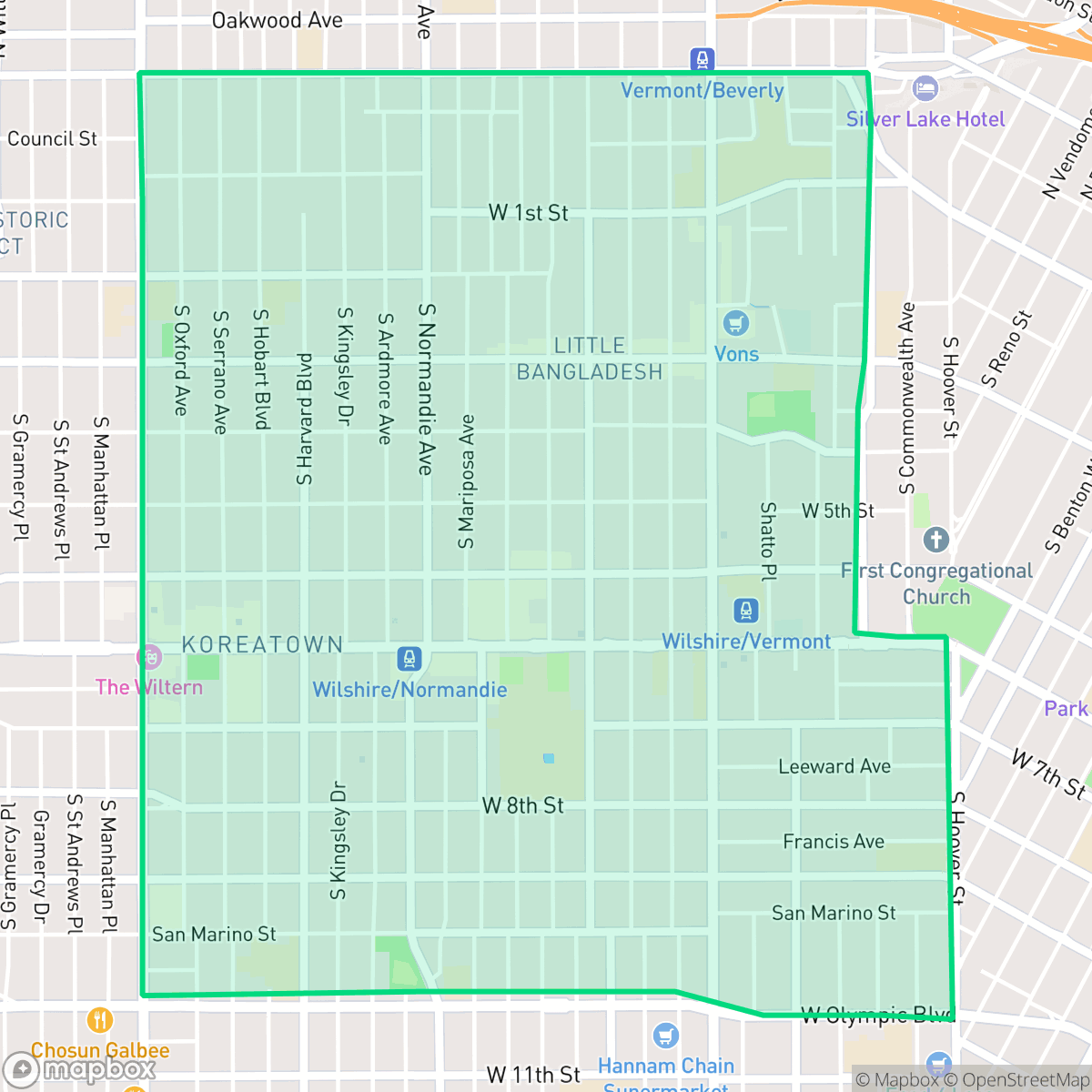
About Koreatown
Los Angeles’s Koreatown traces its roots to the early 20th century, when Korean immigrants, including independence activist Dosan Ahn Chang Ho, initially settled in Bunker Hill and Jefferson Boulevard. Following the Hart-Celler Act of 1965, the community shifted to the Mid-Wilshire district. In the 1970s, visionary businessman Hi Duk Lee established the "Korean Village" near Olympic Boulevard and Normandie Avenue, opening the Olympic Market and the palace-style VIP Plaza to anchor the growing enclave. Officially designated by the city in 1980, the neighborhood is architecturally diverse, blending historic 1920s Art Deco buildings and grand cathedrals with traditional Korean structures, such as the hand-carved Da Wool Jung pavilion. Today, Koreatown is a densely populated cultural hub defined by its vibrant commercial corridors, historic preservation, and multiethnic heritage.
The area functions as a dense, high-energy core characterized by its mid-to-high-rise architecture and continuous urban grid. It serves as a major cultural destination, featuring a wide array of international restaurants, bakeries, and historic landmarks along its primary boulevards. The streetscape is defined by a lack of traditional green verges, creating a concrete-dominant environment that prioritizes commercial accessibility and high-density residential living. Prospective residents should note that the neighborhood is best suited for those who prioritize proximity to amenities and a fast-paced lifestyle over quiet, suburban-style privacy. While the infrastructure supports excellent pedestrian connectivity, the environment is notably loud due to road traffic and offers minimal private outdoor space. The area remains a central, well-connected choice for those seeking a truly urban experience in the heart of Los Angeles.
Neighborhood Scores Across 15 Qualities
Buildings and multi-unit structures are tightly packed with minimal separation or shared walls. This high density results in much lower privacy levels compared to the city average.
Extensive sidewalk networks and frequent crosswalks make navigating the area on foot very efficient. This level of pedestrian connectivity and infrastructure is significantly higher than the Los Angeles average.
Characterized by high-density apartment blocks and functional rooftop amenities, the area features repetitive rooflines and minimal private yard space. This urban landscape offers slightly less visual variety than the Los Angeles average.
Dense concrete surfaces and narrow sidewalks make finding grassy areas difficult. Most public space is paved, though proximity to MacArthur Park offers some accessible greenery for pet owners.
Highly developed urban blocks feature multi-story buildings and significant pavement with very little natural land cover. This environment is considerably more built-up than the average Los Angeles neighborhood, according to iHuus data.
Dense urban blocks and a concentrated mix of international dining and social hubs create a level of activity much higher than the Los Angeles average. According to iHuus data, this landscape of high-rise buildings and diverse eateries provides a vibrant, bustling atmosphere for residents.
Constant noise from nearby freeways and transit corridors is present. While levels are higher than the Los Angeles average, the area remains more acoustically stable than the most heavily impacted parts of the city according to iHuus data.
Air quality remains consistently high with infrequent periods of poor circulation. According to iHuus data, the atmosphere in this area is notably cleaner than the Los Angeles average.
The area consists almost entirely of residential and commercial buildings with no visible heavy industrial chimneys or hazardous warehouses. This lack of industrial presence is significantly higher than the city average, according to iHuus data.
Health insurance access is notably lower than the Los Angeles average. According to iHuus data, a significant portion of the resident population lacks coverage.
Voting patterns and census indicators show a predominantly liberal political leaning, which is slightly more pronounced than the Los Angeles city average.
A diverse range of age groups resides here, mirroring the broader demographic distribution found across Los Angeles. According to iHuus data, the area maintains a balanced presence of young professionals, families, and older adults.
Significant flood hazards exist in this area, with risk levels much higher than the Los Angeles average. Residents should anticipate elevated or potentially prohibitive flood insurance costs according to iHuus data.
Address-Level Insights for Koreatown


iHuus Neighborhood Intelligence Insights
Get address-level neighborhood insights for Koreatown
- Street-level scores — see how individual blocks compare, not just neighborhood averages
- Micro-zone boundaries — identify quiet pockets, flood boundaries, and walkable clusters before you visit
- 15 dimensions in full — walkability, noise, air quality, school quality, insurance coverage, population age profile, urban/rural index, and more
- Boundary risk alerts — know if your address sits near a block boundary where scores drop, the kind of detail no listing will ever mention
- School insights — individual school ratings and insights, not just district-level data
- Compare before you commit — side-by-side data across neighborhoods, down to block precision
No credit card required
Compare with Any Neighborhood
| Dimension | Koreatown | Adams-Normandie |
|---|---|---|
| 🚶 Walkabilityavg 8.9 | ||
| 🔊 Acoustic Comfortavg 2.91 | ||
| 🤫 Privacy Indexavg 4.14 | ||
| 🎨 Visual Appealavg 6.58 | ||
| 🐕 Dog Friendlinessavg 5.04 | ||
| 🗺️ Urban-Rural Indexavg 5.96 | ||
| ✨ Neighborhood Vibeavg 5.07 | ||
| 🏥 Health Insurance Coverageavg 6.2 | ||
| 🌿 Air Qualityavg 8.12 | ||
| 🏭 Industrial Proximityavg 8.46 | ||
| 🌊 Flood Safetyavg 2.66 | ||
| 🗳️ Ideological Leanavg 9.56 | ||
| 👥 Population Age Profileavg 4.85 | ||
| 🔥 Fire Safetyavg 0.18 | ||
| 🏫 School Quality |
Koreatown Rankings
School Districts Serving Koreatown
School Insights for Koreatown
Below average outcomes; significant attendance and academic challenges.
School Insights
See what's really behind every school rating near Koreatown
- Individual school ratings — each school's own score with outcome context, not just a district average
- Enrollment & class size data — student-to-teacher ratio and how it compares to the state average
- Full demographics breakdown — ethnicity and gender composition for every school in the enrollment zone
- Every school in the district — all schools within the enrollment boundary ranked by rating, not just the closest one
- Grade levels & benchmarks — elementary through high school, with below/above state-average flags
No credit card required