Jefferson Park, Los Angeles
Updated · 30,195 residents
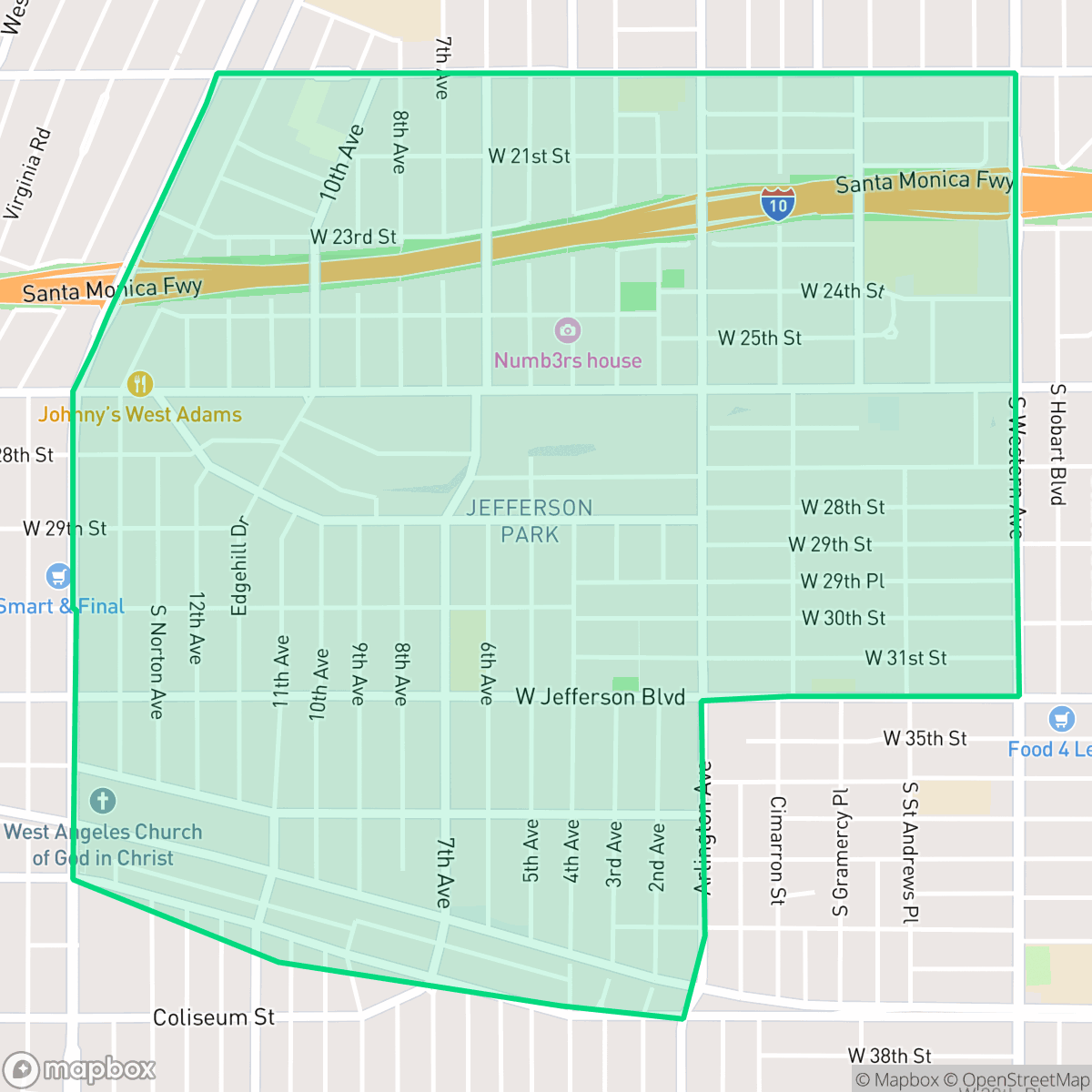
Jefferson Park is a highly walkable urban neighborhood in Los Angeles characterized by a dense grid of historic architecture and residential streets. Residents experience a quiet, suburban atmosphere, though the area is notably noisy due to consistent road traffic and features limited public green space.
Key Highlights
About Jefferson Park
Originally part of the swampy Rancho Las Cienegas, Jefferson Park remained farmland until streetcar lines on Adams and Jefferson Boulevards sparked residential subdivision in the early 1900s. Developed primarily between 1905 and 1920, it grew into a prominent streetcar suburb. Today, the neighborhood boasts one of the nation's largest collections of Arts and Crafts bungalows, many built from Sears and Pacific Ready-Cut kit plans, and is protected as a Historic Preservation Overlay Zone. Landmarks like the 1887 Starr Dairy Farmhouse recall its agricultural past, while the 1923 Spanish Colonial Revival Jefferson Branch Library is listed on the National Register of Historic Places. Following the lifting of racially restrictive covenants in the 1940s, Jefferson Park became a diverse, thriving enclave for African American and Japanese American families, a heritage reflected in local institutions like the historic Westminster Presbyterian Church.
The area functions as a dense, low-rise urban grid, blending historic single-family homes with small apartment complexes. While the neighborhood maintains a quiet, residential vibe, it is well-connected for pedestrians, offering a high level of walkability across its complete sidewalk network. Local dining options are scattered throughout the community, providing diverse culinary choices within a short distance of many homes. Prospective residents should note that the neighborhood presents specific trade-offs regarding privacy and noise. Homes are situated closely together with minimal setbacks, and the proximity to major transit corridors contributes to a higher ambient noise level from road traffic. While the area offers high air quality, it lacks significant public parks, making it less ideal for pet owners seeking expansive outdoor space. According to iHuus data, families may find value in the proximity to several high-performing schools, though the overall environment is best suited for those who prioritize neighborhood connectivity and central access over expansive private grounds.
Neighborhood Scores Across 15 Qualities
Residential structures often feature narrow setbacks and shared property lines with very little separation between buildings. This high-density spacing results in lower levels of privacy compared to the city average.
A dense grid of sidewalks and clearly marked crosswalks ensures easy pedestrian movement throughout the area. According to iHuus data, this level of connectivity and sidewalk continuity is significantly higher than the Los Angeles average.
Uniform tract housing and mid-density apartments characterize the area, offering a functional but modest aesthetic that sits slightly below the city average. According to iHuus data, the neighborhood features small yards and boxy rooflines with very few private pools or luxury amenities visible.
Public parks and grassy verges are scarce throughout the neighborhood, with most greenery restricted to private, fenced backyards. According to iHuus data, this lack of accessible outdoor space is below the Los Angeles average.
Residential streets and green spaces exist in roughly equal measure. This layout offers a suburban density that is slightly higher than the typical Los Angeles average.
Suburban streets and light industrial zones create a subdued atmosphere that is less active than the Los Angeles average. While various dining options exist, most essential services and social spots require a vehicle as they are not easily reachable on foot.
Frequent acoustic disturbances from nearby railroad tracks and heavy freeway traffic are common in this area. According to iHuus data, these noise levels are slightly higher than the city average.
Air quality remains consistently high with rare instances of elevated readings. This level of air cleanliness is roughly in line with the average found throughout Los Angeles.
Heavy industrial activity is largely absent from the neighborhood, though some areas near the central rail corridor and highway feature warehouses and commercial structures. According to iHuus data, the area remains primarily residential with a lower presence of industrial hazards than the Los Angeles average.
Health insurance access is notably lower than the average found across Los Angeles. According to iHuus data, a minority of the local population maintains active health coverage.
Voting patterns and census indicators reflect a highly progressive community, slightly more liberal than the broader Los Angeles average.
Residents live alongside a balanced distribution of young adults, families, and older populations. This demographic spread is largely consistent with the broader Los Angeles area, according to iHuus data.
Significant flood hazards exist here due to coastal wave action, which is much higher than the Los Angeles average. Residents should anticipate elevated or potentially prohibitive flood insurance costs according to iHuus data.
Address-Level Insights for Jefferson Park


iHuus Neighborhood Intelligence Insights
Get address-level neighborhood insights for Jefferson Park
- Street-level scores — see how individual blocks compare, not just neighborhood averages
- Micro-zone boundaries — identify quiet pockets, flood boundaries, and walkable clusters before you visit
- 15 dimensions in full — walkability, noise, air quality, school quality, insurance coverage, population age profile, urban/rural index, and more
- Boundary risk alerts — know if your address sits near a block boundary where scores drop, the kind of detail no listing will ever mention
- School insights — individual school ratings and insights, not just district-level data
- Compare before you commit — side-by-side data across neighborhoods, down to block precision
No credit card required
Compare with Any Neighborhood
| Dimension | Jefferson Park | Adams-Normandie |
|---|---|---|
| 🚶 Walkabilityavg 8.9 | ||
| 🔊 Acoustic Comfortavg 2.91 | ||
| 🤫 Privacy Indexavg 4.14 | ||
| 🎨 Visual Appealavg 6.58 | ||
| 🐕 Dog Friendlinessavg 5.04 | ||
| 🗺️ Urban-Rural Indexavg 5.96 | ||
| ✨ Neighborhood Vibeavg 5.07 | ||
| 🏥 Health Insurance Coverageavg 6.2 | ||
| 🌿 Air Qualityavg 8.12 | ||
| 🏭 Industrial Proximityavg 8.46 | ||
| 🌊 Flood Safetyavg 2.66 | ||
| 🗳️ Ideological Leanavg 9.56 | ||
| 👥 Population Age Profileavg 4.85 | ||
| 🔥 Fire Safetyavg 0.18 | ||
| 🏫 School Quality |
Jefferson Park Rankings
School Districts Serving Jefferson Park
School Insights for Jefferson Park
Below average outcomes; significant attendance and academic challenges.
School Insights
See what's really behind every school rating near Jefferson Park
- Individual school ratings — each school's own score with outcome context, not just a district average
- Enrollment & class size data — student-to-teacher ratio and how it compares to the state average
- Full demographics breakdown — ethnicity and gender composition for every school in the enrollment zone
- Every school in the district — all schools within the enrollment boundary ranked by rating, not just the closest one
- Grade levels & benchmarks — elementary through high school, with below/above state-average flags
No credit card required