Hyde Park, Los Angeles
Updated · 35,691 residents
Hyde Park is a highly walkable neighborhood in Los Angeles defined by its dense grid of historic homes and a vibrant corridor along Crenshaw Boulevard. Residents benefit from excellent pedestrian access to local services, though the area features limited green space and high-density residential layouts with minimal privacy.
Key Highlights
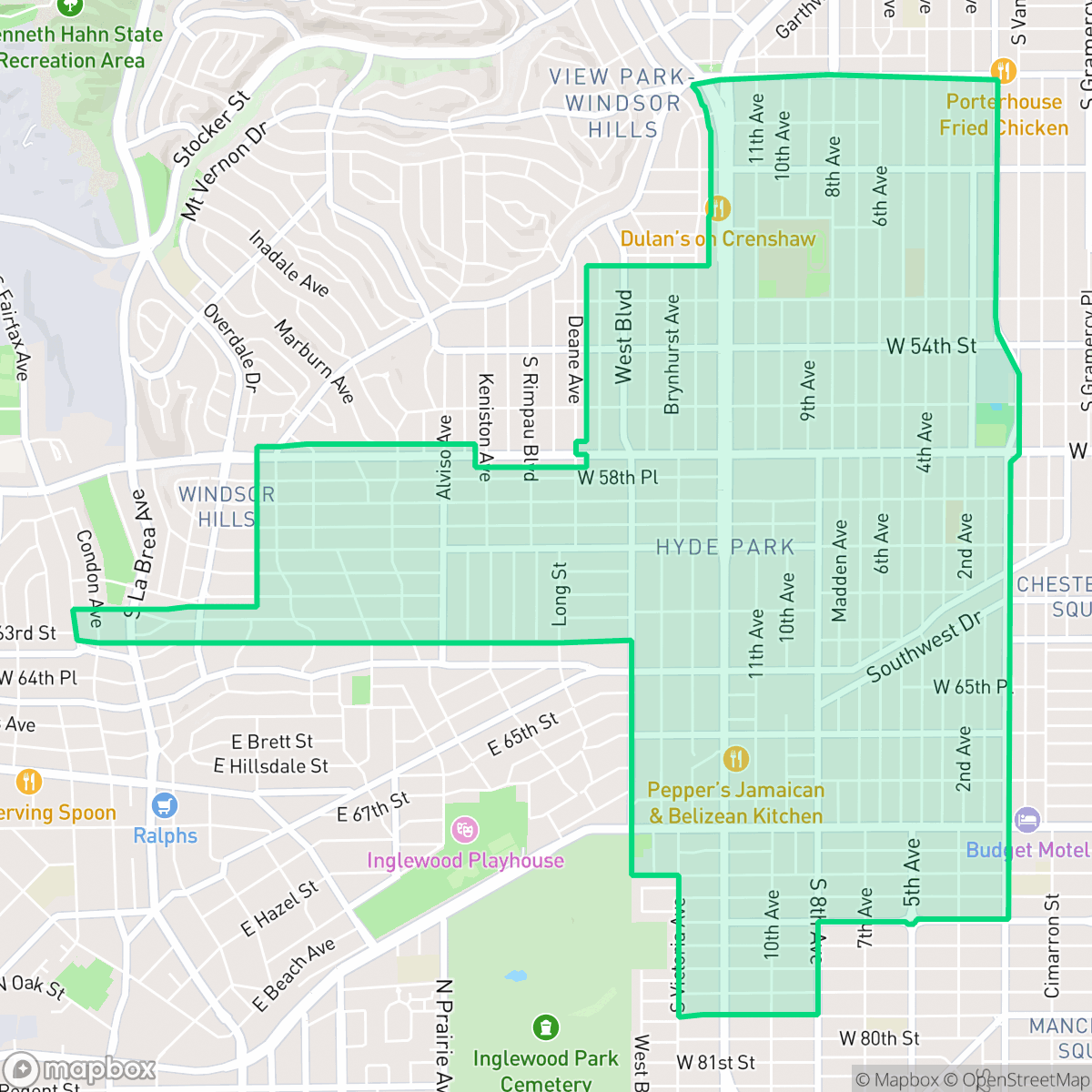
About Hyde Park
Platted in 1887 as a stop on the Atchison, Topeka and Santa Fe Railway, Hyde Park is one of Los Angeles’s oldest neighborhoods. Originally an agricultural shipping hub, the community incorporated as an independent city in 1921 to resist annexation, only to consolidate with Los Angeles in 1923 to secure municipal water and power. In the post-World War II era, Hyde Park transformed into a thriving residential haven for African American families seeking homeownership amid restrictive covenants elsewhere. Today, the neighborhood is characterized by its historic Craftsman bungalows and Spanish Colonial Revival homes. Its primary commercial corridor along Crenshaw Boulevard serves as a historic hub of Black commerce and is home to Destination Crenshaw, an open-air museum celebrating African American history and culture.
The neighborhood functions as a dense, low-rise urban grid characterized by its consistent sidewalk network and proximity to major transit lines. While the area lacks significant public parks and green verges, it offers a steady rhythm of life with diverse local dining options. The community is anchored by various institutional and religious landmarks that support the daily lives of residents, maintaining a cohesive urban fabric that is well-connected to the broader city. Prospective residents should note that the area is characterized by tightly packed housing, which results in limited privacy between neighbors. The neighborhood also faces challenges regarding noise levels, which are primarily driven by road traffic, and a lack of dedicated dog-friendly public amenities. Despite these constraints, the high walkability and strong ideological alignment of the community make it a distinct choice for those seeking a connected, urban lifestyle in Los Angeles.
Neighborhood Scores Across 15 Qualities
Residential structures are densely packed with very narrow gaps between properties. This level of proximity is notably lower than the Los Angeles average, as many homes feature minimal side yards or shared property lines.
Continuous sidewalks on both sides of nearly every street and clearly marked crosswalks ensure safe, easy movement throughout the neighborhood. This level of connectivity and infrastructure is notably higher than the Los Angeles average.
Residential scenery ranges from affluent estates with manicured yards and private pools to denser, uniform tract housing. This visual variety is slightly below the Los Angeles average.
Public parks and wide grassy verges are scarce in most parts of the area, making it slightly less dog friendly than the Los Angeles average. Most greenery is found within private fenced backyards or in specific pockets near the neighborhood edges.
Residential streets and commercial corridors exist in roughly equal measure, providing a suburban feel that is very similar to the broader Los Angeles area. This layout features a dense grid of single-family homes and low-rise apartments interspersed with organized commercial sectors.
Local streets offer a calm, suburban feel with a balanced mix of green space and light commercial units. While various dining options and community landmarks are accessible, the level of activity is slightly below the city average for urban liveliness.
Steady sounds from nearby busy streets are present. According to iHuus data, acoustic levels in this area are higher than the average for Los Angeles.
Air quality remains consistently high with rare instances of elevated readings. This level of air purity is nearly identical to the average found throughout Los Angeles.
Industrial presence is minimal throughout the neighborhood, with land use consisting almost entirely of residential and light commercial properties. According to iHuus data, the area contains significantly fewer warehouses and heavy industrial hazards than the Los Angeles average.
Health insurance accessibility is relatively high in this area, sitting slightly above the Los Angeles city average according to iHuus data.
Voting patterns and census indicators show a very strong liberal lean that is even more pronounced than the Los Angeles average. According to iHuus data, the area's political landscape is characterized by highly progressive-leaning demographics.
Residents encounter a balanced demographic spread ranging from young professionals to older adults and families. According to iHuus data, this age distribution is largely consistent with the broader Los Angeles area.
Property locations within Hyde Park fall within a designated floodplain, which implies a higher risk of flooding and a likely requirement for flood insurance. This level of risk is notably higher than the average found across Los Angeles.
Address-Level Insights for Hyde Park


iHuus Neighborhood Intelligence Insights
Get address-level neighborhood insights for Hyde Park
- Street-level scores — see how individual blocks compare, not just neighborhood averages
- Micro-zone boundaries — identify quiet pockets, flood boundaries, and walkable clusters before you visit
- 15 dimensions in full — walkability, noise, air quality, school quality, insurance coverage, population age profile, urban/rural index, and more
- Boundary risk alerts — know if your address sits near a block boundary where scores drop, the kind of detail no listing will ever mention
- School insights — individual school ratings and insights, not just district-level data
- Compare before you commit — side-by-side data across neighborhoods, down to block precision
No credit card required
Compare with Any Neighborhood
| Dimension | Hyde Park | Adams-Normandie |
|---|---|---|
| 🚶 Walkabilityavg 8.9 | ||
| 🔊 Acoustic Comfortavg 2.91 | ||
| 🤫 Privacy Indexavg 4.14 | ||
| 🎨 Visual Appealavg 6.58 | ||
| 🐕 Dog Friendlinessavg 5.04 | ||
| 🗺️ Urban-Rural Indexavg 5.96 | ||
| ✨ Neighborhood Vibeavg 5.07 | ||
| 🏥 Health Insurance Coverageavg 6.2 | ||
| 🌿 Air Qualityavg 8.12 | ||
| 🏭 Industrial Proximityavg 8.46 | ||
| 🌊 Flood Safetyavg 2.66 | ||
| 🗳️ Ideological Leanavg 9.56 | ||
| 👥 Population Age Profileavg 4.85 | ||
| 🔥 Fire Safetyavg 0.18 | ||
| 🏫 School Quality |
Hyde Park Rankings
School Districts Serving Hyde Park
School Insights for Hyde Park
Below average outcomes; significant attendance and academic challenges.
School Insights
See what's really behind every school rating near Hyde Park
- Individual school ratings — each school's own score with outcome context, not just a district average
- Enrollment & class size data — student-to-teacher ratio and how it compares to the state average
- Full demographics breakdown — ethnicity and gender composition for every school in the enrollment zone
- Every school in the district — all schools within the enrollment boundary ranked by rating, not just the closest one
- Grade levels & benchmarks — elementary through high school, with below/above state-average flags
No credit card required