Hollywood Hills, Los Angeles
Updated · 41,576 residents
The Hollywood Hills offer a unique blend of secluded, architecturally significant hillside estates and dense, urban-adjacent residential pockets. While the area provides high visual appeal and good air quality, residents should expect a car-dependent lifestyle with limited walkability and consistent noise from road traffic.
Key Highlights
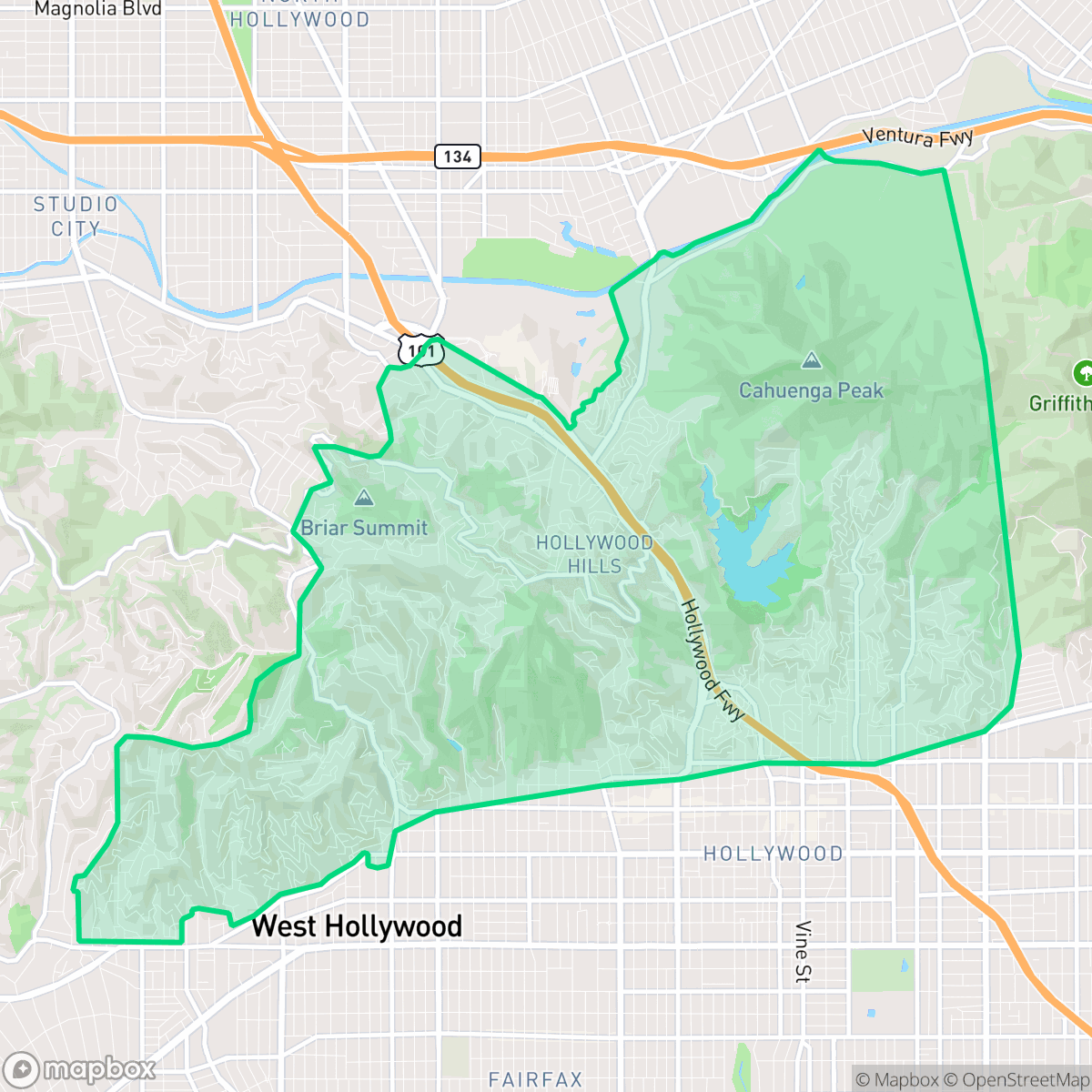
About Hollywood Hills
Developed in 1923 as the "Hollywoodland" residential tract, the Hollywood Hills began around Beachwood Canyon, with the iconic hillside sign originally erected to advertise the development. The neighborhood's architectural legacy spans 1920s Period Revivals—such as Spanish Colonial, Mediterranean, and French Normandy estates—to legendary Mid-Century Modern masterpieces like the Stahl House and John Lautner's Chemosphere. Enclaves like Whitley Heights attracted silent film stars, while Laurel Canyon became the epicenter of the 1960s and 1970s folk-rock counterculture, hosting musicians like Jim Morrison and Carole King. Distinctive local landmarks include the Hollywood Bowl, Frank Lloyd Wright's Samuel Freeman House, and the historic High Tower transit elevator. Today, this secluded, winding neighborhood remains synonymous with creative sanctuary and panoramic Los Angeles vistas.
This neighborhood serves as a quiet retreat from the surrounding Los Angeles bustle, characterized by its winding roads, steep terrain, and expansive views. According to iHuus data, the area maintains high visual appeal through its concentration of private pools, manicured landscaping, and diverse architectural styles. While the northern reaches offer significant privacy and large lots, the southern sections transition into denser grids that provide closer proximity to commercial hubs and essential services. Living here involves specific trade-offs, particularly regarding accessibility and safety. The terrain makes the area largely car-dependent, as narrow, winding streets often lack pedestrian infrastructure. Prospective residents should also be aware of the notably low fire safety rating and the consistent ambient noise from regional road traffic. Despite these challenges, the neighborhood remains a desirable location for those prioritizing privacy, scenic beauty, and proximity to the creative centers of the city.
Neighborhood Scores Across 15 Qualities
Residential spacing varies significantly between dense, shared-wall housing in the lower grid and secluded, spacious estates in the northern hills. According to iHuus data, this area offers slightly more separation between neighbors than the Los Angeles average.
Sidewalks are plentiful within the central commercial corridors and southern grid blocks, but the steep, winding residential streets often lack dedicated paths. While pedestrian infrastructure is reliable in flatter areas, overall walkability is slightly lower than the Los Angeles average due to the challenging terrain in the northern hills.
Hillside estates featuring private pools and manicured landscapes provide a level of visual prestige significantly higher than the Los Angeles average. Residents can expect a landscape dominated by large homes, luxury amenities, and well-maintained properties according to iHuus data.
Tree-lined streets and hilly terrain provide pleasant walking paths, though public park access is limited compared to the Los Angeles average. Most greenery is found within private yards or scattered natural brush rather than large, accessible public parks.
Residential streets and green spaces are balanced with commercial development, making the area slightly less urban than the Los Angeles average. According to iHuus data, the landscape transitions from dense hillside homes to more concentrated urban pockets.
The area offers a blend of energetic commercial pockets and tranquil, remote landscapes, providing a slightly higher level of activity than the city average. While some blocks feature diverse dining and social hubs, many residential sections remain quiet and car-dependent.
Frequent noise from nearby freeways and flight paths impacts the area. According to iHuus data, acoustic levels here are consistent with the Los Angeles average.
Air quality remains consistently high with rare instances of elevated readings. According to iHuus data, the atmosphere in this area is cleaner than the Los Angeles city average.
Industrial activity is virtually nonexistent here, as the area is comprised exclusively of residential and light commercial zones. This lack of warehouses or heavy manufacturing makes the neighborhood significantly cleaner of industrial hazards than the Los Angeles average, according to iHuus data.
Health insurance accessibility in this area is slightly below the Los Angeles city average, according to iHuus data.
Voting patterns and census indicators show a very high concentration of liberal-leaning residents, which is slightly more pronounced than the average across Los Angeles.
Residents live alongside a varied demographic of young professionals, families, and seniors. According to iHuus data, the age distribution is slightly more varied than the average seen across Los Angeles.
Flood risk in this area is higher than the Los Angeles average, though specific vulnerability remains difficult to determine due to incomplete federal studies. According to iHuus data, the lack of a detailed FEMA study means residents should remain cautious during heavy rain events.
Wildfire danger is severe in this area, necessitating maximum protection measures. According to iHuus data, this level of fire hazard is consistent with the city average.
Address-Level Insights for Hollywood Hills


iHuus Neighborhood Intelligence Insights
Get address-level neighborhood insights for Hollywood Hills
- Street-level scores — see how individual blocks compare, not just neighborhood averages
- Micro-zone boundaries — identify quiet pockets, flood boundaries, and walkable clusters before you visit
- 15 dimensions in full — walkability, noise, air quality, school quality, insurance coverage, population age profile, urban/rural index, and more
- Boundary risk alerts — know if your address sits near a block boundary where scores drop, the kind of detail no listing will ever mention
- School insights — individual school ratings and insights, not just district-level data
- Compare before you commit — side-by-side data across neighborhoods, down to block precision
No credit card required
Compare with Any Neighborhood
| Dimension | Hollywood Hills | Adams-Normandie |
|---|---|---|
| 🚶 Walkabilityavg 8.9 | ||
| 🔊 Acoustic Comfortavg 2.91 | ||
| 🤫 Privacy Indexavg 4.14 | ||
| 🎨 Visual Appealavg 6.58 | ||
| 🐕 Dog Friendlinessavg 5.04 | ||
| 🗺️ Urban-Rural Indexavg 5.96 | ||
| ✨ Neighborhood Vibeavg 5.07 | ||
| 🏥 Health Insurance Coverageavg 6.2 | ||
| 🌿 Air Qualityavg 8.12 | ||
| 🏭 Industrial Proximityavg 8.46 | ||
| 🌊 Flood Safetyavg 2.66 | ||
| 🗳️ Ideological Leanavg 9.56 | ||
| 👥 Population Age Profileavg 4.85 | ||
| 🔥 Fire Safetyavg 0.18 | ||
| 🏫 School Quality |
Hollywood Hills Rankings
School Districts Serving Hollywood Hills
School Insights for Hollywood Hills
Below average outcomes; significant attendance and academic challenges.
School Insights
See what's really behind every school rating near Hollywood Hills
- Individual school ratings — each school's own score with outcome context, not just a district average
- Enrollment & class size data — student-to-teacher ratio and how it compares to the state average
- Full demographics breakdown — ethnicity and gender composition for every school in the enrollment zone
- Every school in the district — all schools within the enrollment boundary ranked by rating, not just the closest one
- Grade levels & benchmarks — elementary through high school, with below/above state-average flags
No credit card required