Highland Park, Los Angeles
Updated · 48,161 residents
Highland Park is a highly walkable neighborhood defined by its vibrant commercial corridors and dense residential streets. Residents benefit from excellent access to local dining and services, though the area features closely packed homes and moderate noise levels from road traffic.
Key Highlights
About Highland Park
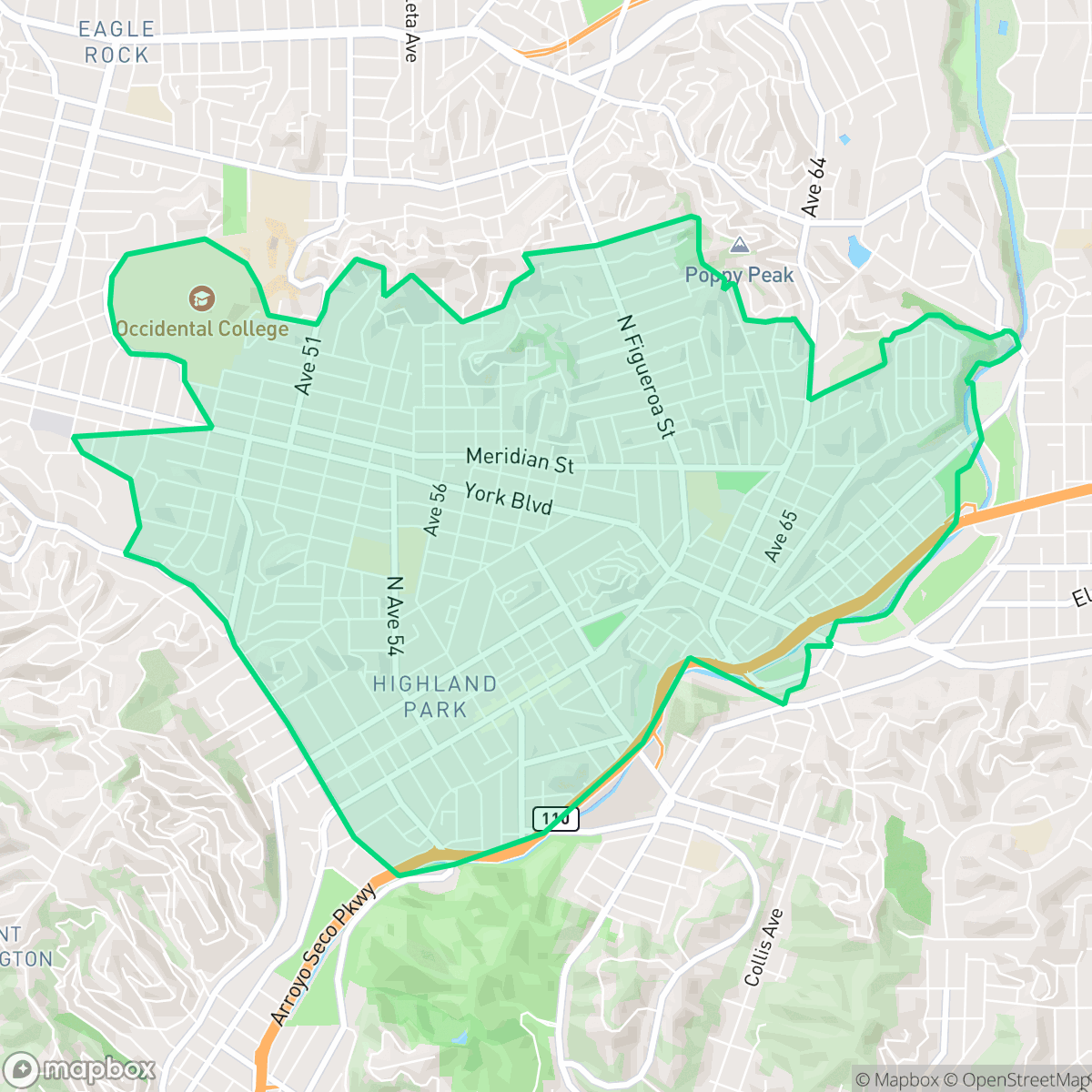
Established in 1886 and annexed by Los Angeles in 1895, Highland Park is one of the city’s oldest and most architecturally diverse neighborhoods. It forms the core of the Highland Park-Garvanza Historic Preservation Overlay Zone, celebrated for its concentration of Victorian Queen Anne mansions—such as the 1887 Smith Estate—and early 20th-century Craftsman bungalows. Historically a hub for the American Arts and Crafts movement, championed by resident Charles Lummis, the neighborhood evolved into a vibrant center for the Chicano arts movement by the 1970s, anchored by institutions like Avenue 50 Studio. Today, Highland Park’s cultural identity is defined by historic commercial corridors along York Boulevard and North Figueroa Street, featuring landmarks like the meticulously restored 1927 Highland Park Bowl.
The neighborhood serves as a dense, low-rise urban hub where a well-connected grid of sidewalks facilitates easy access to a variety of social and culinary destinations. Residents frequently visit established spots along York Boulevard and North Figueroa Street, which contribute to a lively local atmosphere. The area is characterized by its residential and light commercial layout, which remains free of heavy industrial hazards and large-scale manufacturing facilities. Living here involves balancing high walkability with the realities of urban density. Homes are typically situated close together, which limits private yard space and contributes to a moderate sense of privacy. Prospective residents should note that road traffic is the primary source of noise, averaging 61 decibels across the area. While the neighborhood falls within the Los Angeles Unified School District, families often navigate a landscape of diverse magnet programs and neighborhood schools, requiring careful consideration of specific local campus performance.
Neighborhood Scores Across 15 Qualities
Residential spacing varies significantly across the area, ranging from closely packed multi-family units to more secluded hillside estates. This neighborhood offers more personal buffer space between neighbors than the Los Angeles average.
Consistent sidewalks and a well-connected street grid facilitate easy pedestrian movement to local amenities, though high-traffic arterial roads can impact connectivity. This neighborhood offers a walking experience nearly comparable to the Los Angeles average.
Expansive properties with manicured landscaping and private pools are common in certain sections, contributing to a visual appeal slightly above the city average. The area features a mix of large, upscale estates and more dense, standard residential tracts.
Access to large public parks and tree-lined streets provides more opportunities for pet walking than the Los Angeles average. While some denser residential pockets rely primarily on private yards, the neighborhood features significant green corridors and open fields for dogs.
Scattered open land and significant tree coverage provide a more semi-rural atmosphere than the typical Los Angeles landscape. Residents will find a mix of wooded areas and single-family homes that feel less densely developed than the city average.
Local dining and social destinations provide a more active atmosphere than the Los Angeles average. While some pockets remain quiet and suburban, many blocks feature a dense concentration of diverse cafes, eateries, and community landmarks.
Frequent noise from nearby freeway corridors and railroad tracks characterizes the area. According to iHuus data, acoustic comfort levels in this neighborhood remain slightly higher than the Los Angeles average.
Air quality is consistently high with rare instances of elevated readings. According to iHuus data, conditions here are slightly better than the Los Angeles average.
Residential and light commercial uses dominate the area with no visible warehouses, factories, or heavy industrial hazards. This lack of industrial activity is notably lower than the city average, according to iHuus data.
Health insurance accessibility in Highland Park is higher than the average seen across Los Angeles. According to iHuus data, a majority of the local population maintains active coverage.
Voting patterns and census indicators show a predominantly liberal political leaning, slightly more pronounced than the Los Angeles average. According to iHuus data, the community maintains very strong progressive political alignment.
Residents live alongside a balanced demographic of young professionals, families, and older adults. This age distribution is consistent with the broader Los Angeles area, according to iHuus data.
Frequent flooding risks exist due to the area being located within a designated floodplain. According to iHuus data, this level of vulnerability is slightly higher than the Los Angeles average.
Elevated fire hazards are present in this area, representing a significantly higher risk level than the Los Angeles average according to iHuus data.
Address-Level Insights for Highland Park


iHuus Neighborhood Intelligence Insights
Get address-level neighborhood insights for Highland Park
- Street-level scores — see how individual blocks compare, not just neighborhood averages
- Micro-zone boundaries — identify quiet pockets, flood boundaries, and walkable clusters before you visit
- 15 dimensions in full — walkability, noise, air quality, school quality, insurance coverage, population age profile, urban/rural index, and more
- Boundary risk alerts — know if your address sits near a block boundary where scores drop, the kind of detail no listing will ever mention
- School insights — individual school ratings and insights, not just district-level data
- Compare before you commit — side-by-side data across neighborhoods, down to block precision
No credit card required
Compare with Any Neighborhood
| Dimension | Highland Park | Adams-Normandie |
|---|---|---|
| 🚶 Walkabilityavg 8.9 | ||
| 🔊 Acoustic Comfortavg 2.91 | ||
| 🤫 Privacy Indexavg 4.14 | ||
| 🎨 Visual Appealavg 6.58 | ||
| 🐕 Dog Friendlinessavg 5.04 | ||
| 🗺️ Urban-Rural Indexavg 5.96 | ||
| ✨ Neighborhood Vibeavg 5.07 | ||
| 🏥 Health Insurance Coverageavg 6.2 | ||
| 🌿 Air Qualityavg 8.12 | ||
| 🏭 Industrial Proximityavg 8.46 | ||
| 🌊 Flood Safetyavg 2.66 | ||
| 🗳️ Ideological Leanavg 9.56 | ||
| 👥 Population Age Profileavg 4.85 | ||
| 🔥 Fire Safetyavg 0.18 | ||
| 🏫 School Quality |
Highland Park Rankings
School Districts Serving Highland Park
School Insights for Highland Park
Below average outcomes; significant attendance and academic challenges.
School Insights
See what's really behind every school rating near Highland Park
- Individual school ratings — each school's own score with outcome context, not just a district average
- Enrollment & class size data — student-to-teacher ratio and how it compares to the state average
- Full demographics breakdown — ethnicity and gender composition for every school in the enrollment zone
- Every school in the district — all schools within the enrollment boundary ranked by rating, not just the closest one
- Grade levels & benchmarks — elementary through high school, with below/above state-average flags
No credit card required