Harbor Pines, Los Angeles
Updated · 1,890 residents
Harbor Pines is a dense, suburban neighborhood in Los Angeles characterized by its hilly terrain and a consistent grid of sidewalks. While it offers high walkability and strong health insurance coverage, residents should be prepared for significant noise from road traffic and proximity to industrial storage facilities.
Key Highlights
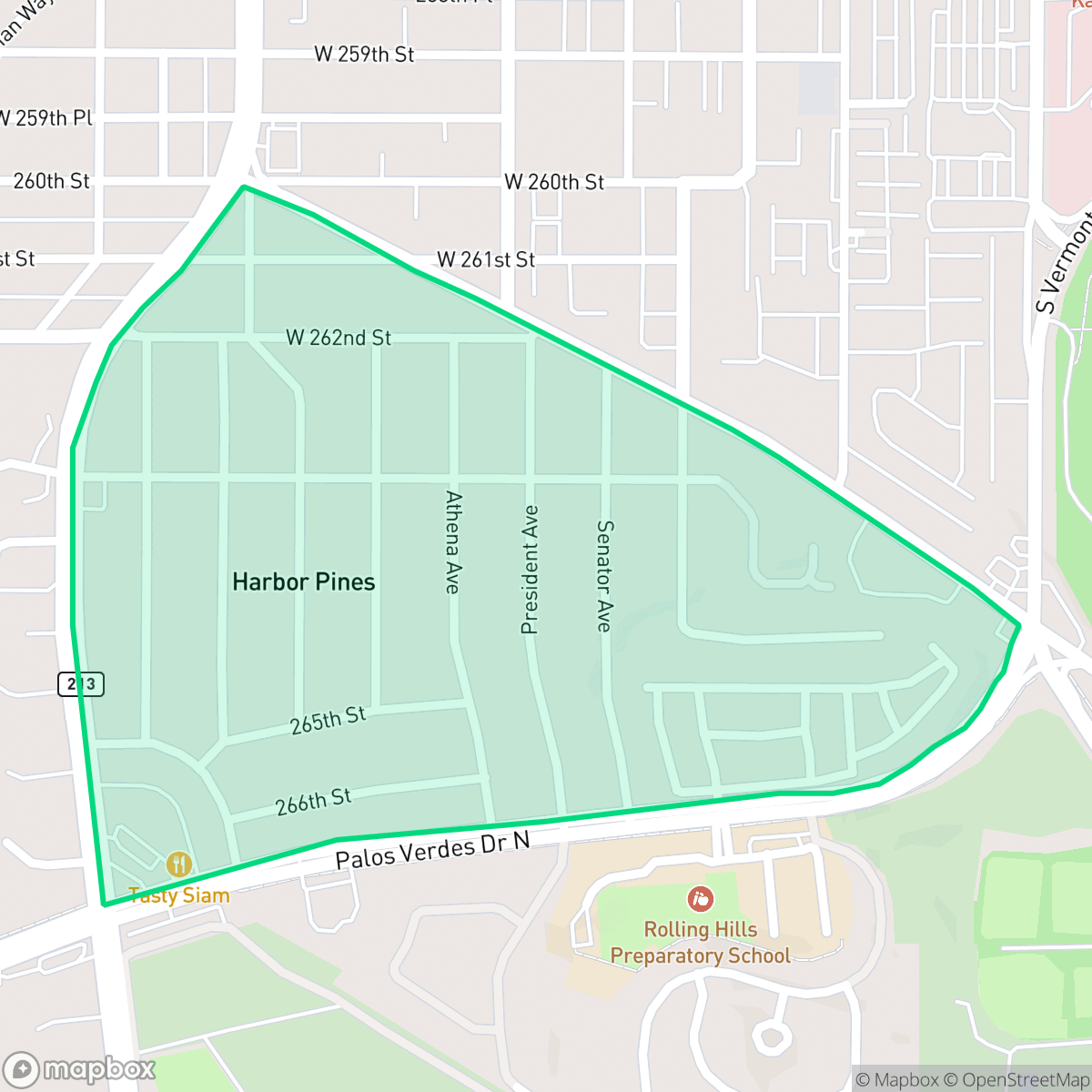
About Harbor Pines
Located in the southern section of Harbor City in Los Angeles, Harbor Pines is a quiet, residential enclave characterized by its hilly terrain, mature pine trees, and a distinctive lack of sidewalks. Originally part of the historic Rancho San Pedro Spanish land grant, the residential community began developing in 1936. Long cherished by residents for its tight-knit, small-town atmosphere, the neighborhood was officially designated as "Harbor Pines" in January 2011 following a successful community naming application led by local advocate Michael F. Cooley and approved by the Los Angeles City Council.
The neighborhood functions as a dense residential enclave with a mix of single-family homes and multi-family units. According to iHuus data, the area benefits from a consistent sidewalk network that supports local pedestrian activity, connecting residents to nearby amenities like local coffee shops and community spaces. Despite its suburban feel, the landscape is marked by the presence of large utility structures and industrial storage tanks in the southern portions, which contrast with the area's established residential character.
Living here involves navigating specific environmental trade-offs, most notably the elevated noise levels from surrounding road traffic. While the neighborhood offers good air quality and high rates of health insurance coverage, the density of the housing stock results in limited privacy for residents. It is best suited for those who prioritize walkability and access to essential services over absolute acoustic tranquility or expansive personal space.
Neighborhood Scores Across 15 Qualities
Residential spacing is consistent with the city average, featuring a mix of closely spaced houses and shared-wall apartment complexes. According to iHuus data, some areas present minimal setbacks between neighbors.
Pedestrian access is facilitated by sidewalks on residential streets and safe crossings at major intersections, though the area is less walkable than the Los Angeles average. Residents can utilize the park's pedestrian paths and navigate many local blocks on foot, according to iHuus data.
Standard tract housing and multi-family units define the local landscape, offering tidy but small yards. This level of visual variety is slightly below the Los Angeles average.
Continuous sidewalks and a large public park with lake access and walking trails make this area significantly more pet friendly than the Los Angeles average. According to iHuus data, the presence of connected green spaces provides ample, safe space for exercise away from traffic.
Open land and scattered homes amid woodland characterize this area, providing a more semi-rural atmosphere than the typical Los Angeles landscape. According to iHuus data, the neighborhood features a higher proportion of undeveloped land compared to the city average.
Local amenities and small dining spots provide pockets of activity within a primarily low-density residential landscape. This level of activity and social variety is consistent with the average found across Los Angeles.
Frequent loud disturbances from nearby airport flight paths and heavy transit infrastructure characterize the area. According to iHuus data, acoustic comfort is significantly lower than the Los Angeles average.
Air quality remains consistently good with rare instances of elevated readings. This level of air cleanliness is roughly in line with the average for Los Angeles.
Industrial and utility structures are notably more prevalent here than in most parts of Los Angeles. Large warehouses and utility tanks are situated near residential areas, particularly toward the northern and southern edges of the neighborhood.
Health insurance access is significantly higher here than the Los Angeles average. According to iHuus data, most residents in Harbor Pines possess comprehensive medical coverage.
Political leanings here are predominantly liberal, though slightly less so than the broader Los Angeles area according to iHuus data.
A balanced mix of young adults, families, and older residents characterizes the local demographic. According to iHuus data, this age distribution is slightly more varied than the average found across Los Angeles.
Significant flood hazards from wave action and coastal surges are present here, making the risk substantially higher than the Los Angeles average. Residents should anticipate elevated or potentially prohibitive flood insurance costs according to iHuus data.
Address-Level Insights for Harbor Pines


iHuus Neighborhood Intelligence Insights
Get address-level neighborhood insights for Harbor Pines
- Street-level scores — see how individual blocks compare, not just neighborhood averages
- Micro-zone boundaries — identify quiet pockets, flood boundaries, and walkable clusters before you visit
- 15 dimensions in full — walkability, noise, air quality, school quality, insurance coverage, population age profile, urban/rural index, and more
- Boundary risk alerts — know if your address sits near a block boundary where scores drop, the kind of detail no listing will ever mention
- School insights — individual school ratings and insights, not just district-level data
- Compare before you commit — side-by-side data across neighborhoods, down to block precision
No credit card required
Compare with Any Neighborhood
| Dimension | Harbor Pines | Adams-Normandie |
|---|---|---|
| 🚶 Walkabilityavg 8.9 | ||
| 🔊 Acoustic Comfortavg 2.91 | ||
| 🤫 Privacy Indexavg 4.14 | ||
| 🎨 Visual Appealavg 6.58 | ||
| 🐕 Dog Friendlinessavg 5.04 | ||
| 🗺️ Urban-Rural Indexavg 5.96 | ||
| ✨ Neighborhood Vibeavg 5.07 | ||
| 🏥 Health Insurance Coverageavg 6.2 | ||
| 🌿 Air Qualityavg 8.12 | ||
| 🏭 Industrial Proximityavg 8.46 | ||
| 🌊 Flood Safetyavg 2.66 | ||
| 🗳️ Ideological Leanavg 9.56 | ||
| 👥 Population Age Profileavg 4.85 | ||
| 🔥 Fire Safetyavg 0.18 | ||
| 🏫 School Quality |
Harbor Pines Rankings
School Districts Serving Harbor Pines
School Insights for Harbor Pines
Below average outcomes; significant attendance and academic challenges.
School Insights
See what's really behind every school rating near Harbor Pines
- Individual school ratings — each school's own score with outcome context, not just a district average
- Enrollment & class size data — student-to-teacher ratio and how it compares to the state average
- Full demographics breakdown — ethnicity and gender composition for every school in the enrollment zone
- Every school in the district — all schools within the enrollment boundary ranked by rating, not just the closest one
- Grade levels & benchmarks — elementary through high school, with below/above state-average flags
No credit card required