Harbor Gateway, Los Angeles
Updated · 36,766 residents
Harbor Gateway is a utilitarian, suburban-industrial corridor defined by its proximity to major transit routes and logistics hubs. While the area offers a consistent sidewalk grid for pedestrians, residents experience significant noise levels from nearby freeways and a landscape dominated by warehouses.
Key Highlights
About Harbor Gateway
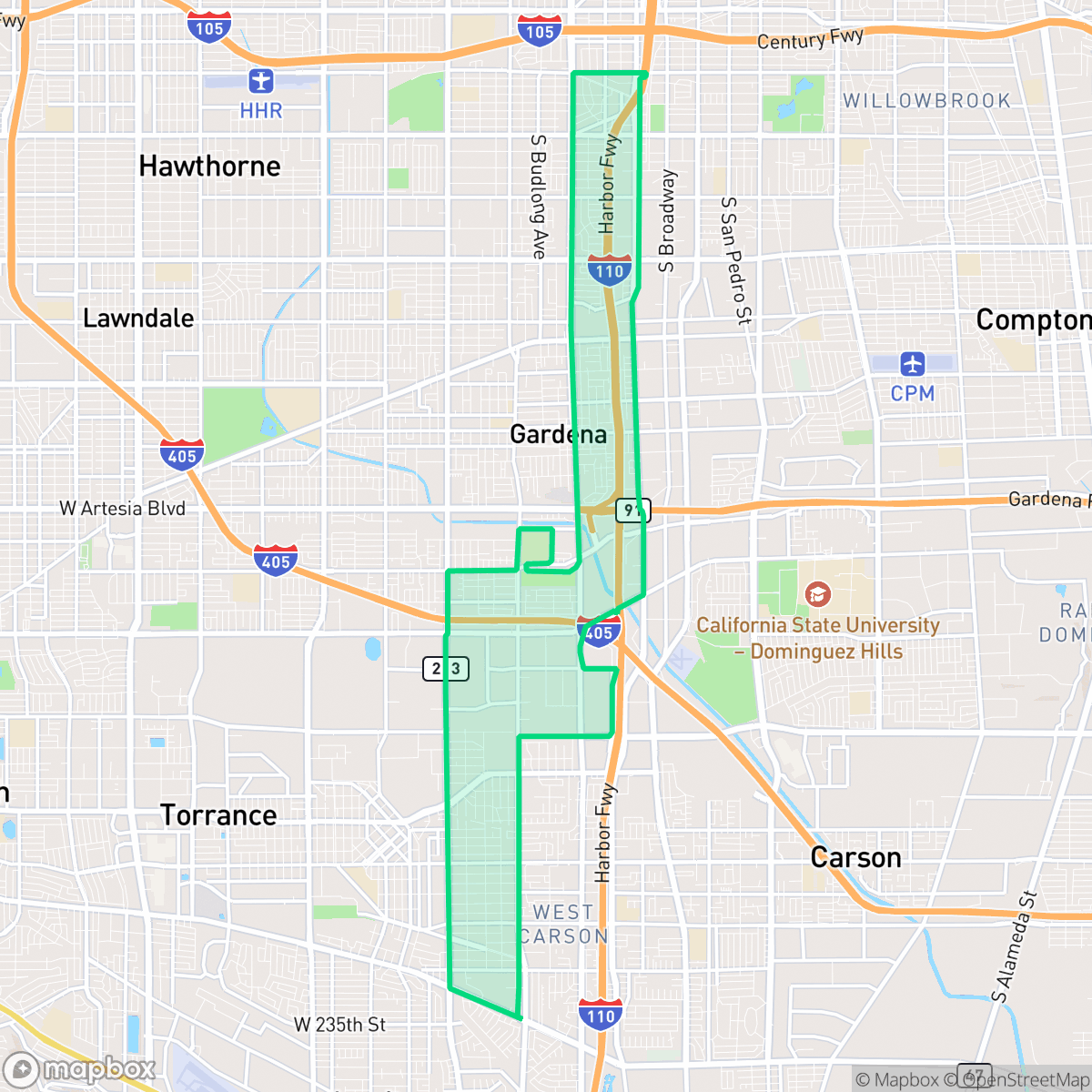
Harbor Gateway, historically known as the 'Shoestring Strip,' was annexed by the City of Los Angeles in 1906. This narrow, 15-mile-long corridor was strategically created to connect the city proper to the Port of Los Angeles in San Pedro and Wilmington, ensuring municipal control over vital harbor facilities. Historically, the area functioned as a critical industrial and transit artery, facilitating the movement of goods and workers to the waterfront. Today, it remains a diverse residential and industrial neighborhood, defined by its unique geography that physically links the South Bay to the rest of Los Angeles. Its identity is deeply tied to this logistical purpose, serving as a gateway for maritime commerce while maintaining a community character shaped by its long-standing role in the city's port-related infrastructure.
Harbor Gateway serves as a functional link between Los Angeles and its southern ports, blending residential tract housing with expansive industrial logistics centers. The environment is characterized by a mix of apartment complexes and single-family homes that often feature limited privacy due to close building proximity. While the area maintains a quiet, suburban atmosphere, the presence of heavy truck traffic and proximity to major transit corridors creates a persistent acoustic backdrop that distinguishes it from more residential-only zones.
Prospective residents should consider the trade-offs of living in a zone with elevated flood risks and moderate air quality compared to other parts of the city. The area is best suited for those who prioritize access to major transit arteries and the high-performing schools within the Torrance Unified School District. While daily errands often require a vehicle, the neighborhood provides a stable, generational mix of residents who value the logistical convenience of this unique corridor.
Neighborhood Scores Across 15 Qualities
Residential structures are often closely packed with minimal side-yard setbacks, leading to less separation between neighbors than is typical for Los Angeles. Many homes and multi-family units feature shared walls or very narrow gaps between buildings, according to iHuus data.
A consistent sidewalk grid and marked crosswalks facilitate pedestrian movement through residential blocks, though the large freeway corridor and high-traffic arterials create significant physical barriers. While the network is well-developed, walking ease is slightly below the Los Angeles average due to these heavy traffic segments.
Standard tract housing and apartment complexes define the area, featuring uniform rooflines and small yards. The visual landscape is more utilitarian than the Los Angeles average due to the proximity of large industrial warehouses and storage facilities.
Public access to large parks and wide grassy verges is sparse, as most greenery is contained within private fenced backyards. According to iHuus data, the availability of open recreational areas for pets is below the city average.
A mix of single-family homes and apartment complexes exists alongside large-scale warehouses and logistics hubs. This landscape features slightly more open land and varied spacing than the typical Los Angeles urban density.
Primarily characterized by industrial warehouses and suburban streets, this area offers a tranquil atmosphere but lacks the social energy found in more active parts of the city. Most daily needs require a vehicle due to the sparse density of shops and services.
Persistent noise from nearby freeway traffic and railroad lines is a significant factor in this area. According to iHuus data, acoustic comfort is lower than the Los Angeles average due to proximity to major transit corridors and flight paths.
Air quality in this area is generally good, though it tends to be lower than the average seen throughout Los Angeles. According to iHuus data, residents may occasionally encounter elevated readings compared to cleaner parts of the city.
Frequent heavy truck traffic and large-scale logistics hubs are common throughout the area, making industrial proximity notably higher than the Los Angeles average. Residents should be aware of nearby warehouses and the presence of an EPA Superfund site with potential environmental impacts on soil and groundwater.
Health insurance accessibility in Harbor Gateway is slightly below the Los Angeles city average. According to iHuus data, a significant portion of the local population lacks coverage.
Voting patterns and census indicators show a predominantly liberal political leaning, which is largely consistent with the broader Los Angeles area. According to iHuus data, the political landscape here closely mirrors the city average.
Residents experience a balanced demographic spread of young adults, families, and older individuals. This age distribution is consistent with the broader Los Angeles area, according to iHuus data.
Properties in this area are situated within a designated floodplain, which may necessitate flood insurance. According to iHuus data, the risk level in Harbor Gateway is slightly higher than the Los Angeles average.
Address-Level Insights for Harbor Gateway


iHuus Neighborhood Intelligence Insights
Get address-level neighborhood insights for Harbor Gateway
- Street-level scores — see how individual blocks compare, not just neighborhood averages
- Micro-zone boundaries — identify quiet pockets, flood boundaries, and walkable clusters before you visit
- 15 dimensions in full — walkability, noise, air quality, school quality, insurance coverage, population age profile, urban/rural index, and more
- Boundary risk alerts — know if your address sits near a block boundary where scores drop, the kind of detail no listing will ever mention
- School insights — individual school ratings and insights, not just district-level data
- Compare before you commit — side-by-side data across neighborhoods, down to block precision
No credit card required
Compare with Any Neighborhood
| Dimension | Harbor Gateway | Adams-Normandie |
|---|---|---|
| 🚶 Walkabilityavg 8.9 | ||
| 🔊 Acoustic Comfortavg 2.91 | ||
| 🤫 Privacy Indexavg 4.14 | ||
| 🎨 Visual Appealavg 6.58 | ||
| 🐕 Dog Friendlinessavg 5.04 | ||
| 🗺️ Urban-Rural Indexavg 5.96 | ||
| ✨ Neighborhood Vibeavg 5.07 | ||
| 🏥 Health Insurance Coverageavg 6.2 | ||
| 🌿 Air Qualityavg 8.12 | ||
| 🏭 Industrial Proximityavg 8.46 | ||
| 🌊 Flood Safetyavg 2.66 | ||
| 🗳️ Ideological Leanavg 9.56 | ||
| 👥 Population Age Profileavg 4.85 | ||
| 🔥 Fire Safetyavg 0.18 | ||
| 🏫 School Quality |
Harbor Gateway Rankings
School Districts Serving Harbor Gateway
School Insights for Harbor Gateway
Below average outcomes; significant attendance and academic challenges.
School Insights
See what's really behind every school rating near Harbor Gateway
- Individual school ratings — each school's own score with outcome context, not just a district average
- Enrollment & class size data — student-to-teacher ratio and how it compares to the state average
- Full demographics breakdown — ethnicity and gender composition for every school in the enrollment zone
- Every school in the district — all schools within the enrollment boundary ranked by rating, not just the closest one
- Grade levels & benchmarks — elementary through high school, with below/above state-average flags
No credit card required