Harbor City, Los Angeles
Updated · 23,793 residents
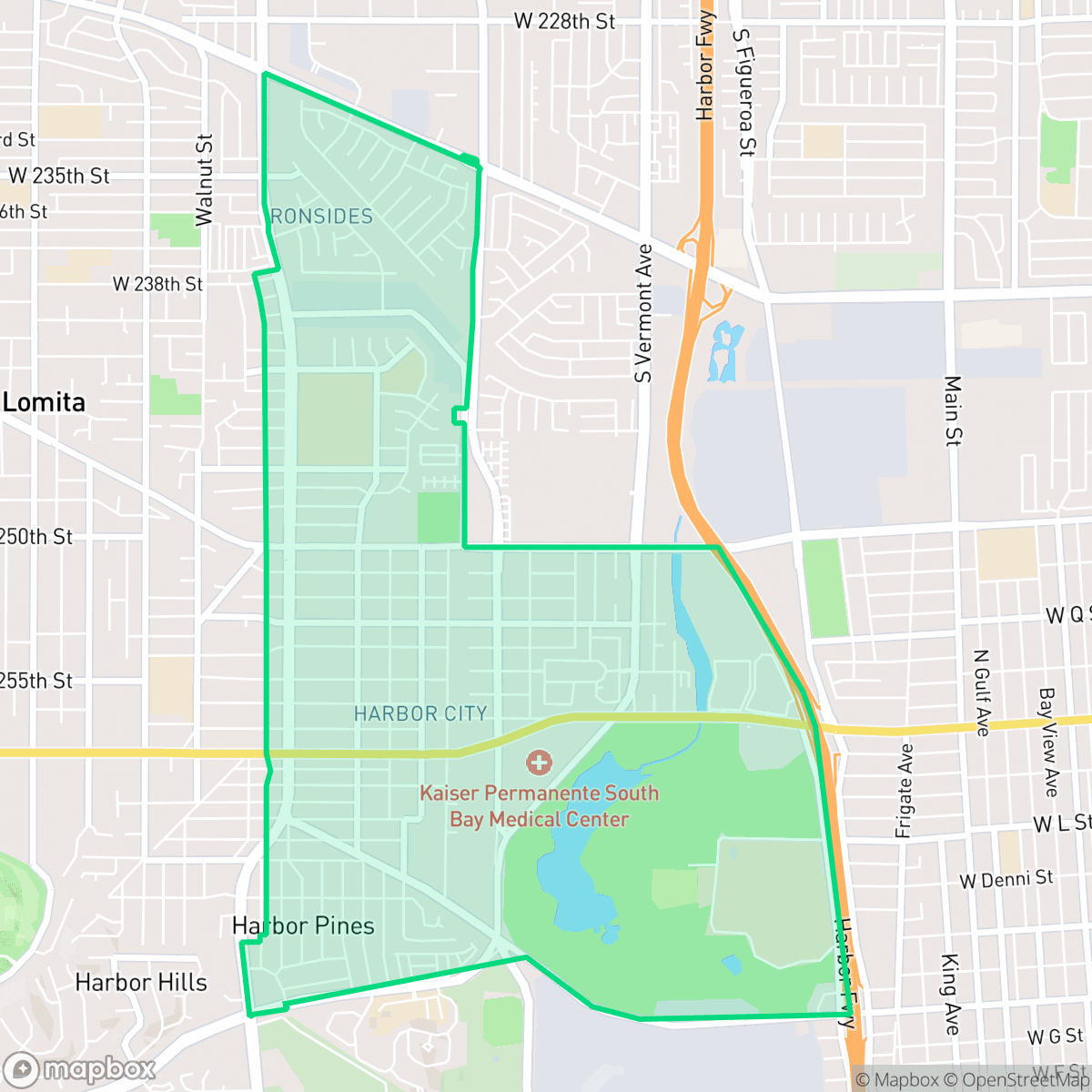
Harbor City is a densely developed neighborhood in Los Angeles characterized by a consistent grid of sidewalks and proximity to the expansive Ken Malloy Harbor Regional Park. While the area offers high walkability and strong health insurance coverage, residents often experience significant noise from road traffic and live in tightly packed housing developments.
Key Highlights
About Harbor City
Originally part of the 1784 Rancho San Pedro Spanish land grant, Harbor City was envisioned by developers in 1914 as a bustling port town. Their ambitious original plan involved dynamiting a nearby hill to flood the local depression with ocean water to create a harbor. While that plan was never realized, the city of Los Angeles annexed the land-locked area in 1909 as a strategic "shoestring" corridor to force the consolidation of the coastal cities of Wilmington and San Pedro. Early community life centered around Belleporte Avenue and the 1916 Italian Renaissance-style Harbor City Elementary School. The neighborhood's defining natural landmark is the 231-acre Ken Malloy Harbor Regional Park, which preserves Machado Lake—historically known as "Sweet Water" to the indigenous Tongva and early Californio settlers.
The neighborhood functions as a dense suburban environment that blends residential tracts with light industrial zones. It is defined by its grid-based street layout, which facilitates high walkability despite the area's relative quiet and sparse commercial activity. Industrial footprints, including warehouses and logistics facilities, are prominent in the northern and eastern sections, contributing to a landscape that balances residential life with active daytime commercial transit.
Prospective residents should note that the area faces challenges with acoustic comfort, as road traffic noise is a persistent factor. Housing density is high, often resulting in limited privacy due to the close proximity of structures and shared-wall complexes. However, the area provides access to significant green space at the local lake and maintains good air quality. It is well-suited for those prioritizing neighborhood connectivity and proximity to regional transit corridors over quiet, low-density living.
Neighborhood Scores Across 15 Qualities
Residential lots are densely packed with minimal separation between structures; this lack of distance between homes is more pronounced here than in most of Los Angeles.
Extensive sidewalk networks and marked crosswalks make most residential blocks easy to navigate on foot. While the area is slightly below the city average for walkability, many streets offer continuous pedestrian paths and safe crossings.
Residential landscapes consist primarily of dense tract housing and mobile home parks with modest yard space. This visual environment is less varied than the Los Angeles average, featuring many flat roofs and shared amenities rather than lush private greenery.
Public parks and greenway trails offer decent opportunities for exercise, though the availability of wide grassy verges for walking is slightly above the Los Angeles average. According to iHuus data, many areas rely more on private backyards than accessible public green space.
Frequent open land and scattered residential clusters create a more semi-rural feel than the typical Los Angeles urban core. According to iHuus data, the landscape features a notable amount of undeveloped space and industrial footprints compared to the city average.
Suburban streets and industrial zones provide a calm atmosphere, but local business density is below the city average. Most essential services and dining options require a vehicle, as walking routes offer limited destinations.
Persistent noise from nearby airport runways and heavy rail infrastructure defines the area. According to iHuus data, acoustic comfort is significantly lower than the Los Angeles average.
Air quality in Harbor City remains consistently good with rare instances of elevated readings. This level of air purity is roughly in line with the Los Angeles average according to iHuus data.
Large-scale warehouses, utility structures, and heavy truck infrastructure are integrated with residential areas, making industrial proximity notably higher than the Los Angeles average. According to iHuus data, while some pockets remain primarily residential, significant portions of the neighborhood feature active commercial zones and industrial facilities near the highway and rail corridors.
Health insurance accessibility is notably higher than the Los Angeles average, according to iHuus data. Most residents in this area have access to medical coverage.
Voting patterns and census indicators show a predominantly liberal political leaning, though this is slightly less pronounced than the average found across Los Angeles.
Residents live alongside a balanced variety of young professionals, families, and seniors. This demographic spread is slightly more even than the average seen across Los Angeles.
Located within a designated floodplain, this area carries a higher risk of flooding than much of Los Angeles. Residents should anticipate that flood insurance will likely be a requirement for property owners according to iHuus data.
Fire hazards in this area are severe and require maximum protection measures. According to iHuus data, this level of risk is consistent with the city average.
Address-Level Insights for Harbor City


iHuus Neighborhood Intelligence Insights
Get address-level neighborhood insights for Harbor City
- Street-level scores — see how individual blocks compare, not just neighborhood averages
- Micro-zone boundaries — identify quiet pockets, flood boundaries, and walkable clusters before you visit
- 15 dimensions in full — walkability, noise, air quality, school quality, insurance coverage, population age profile, urban/rural index, and more
- Boundary risk alerts — know if your address sits near a block boundary where scores drop, the kind of detail no listing will ever mention
- School insights — individual school ratings and insights, not just district-level data
- Compare before you commit — side-by-side data across neighborhoods, down to block precision
No credit card required
Compare with Any Neighborhood
| Dimension | Harbor City | Adams-Normandie |
|---|---|---|
| 🚶 Walkabilityavg 8.9 | ||
| 🔊 Acoustic Comfortavg 2.91 | ||
| 🤫 Privacy Indexavg 4.14 | ||
| 🎨 Visual Appealavg 6.58 | ||
| 🐕 Dog Friendlinessavg 5.04 | ||
| 🗺️ Urban-Rural Indexavg 5.96 | ||
| ✨ Neighborhood Vibeavg 5.07 | ||
| 🏥 Health Insurance Coverageavg 6.2 | ||
| 🌿 Air Qualityavg 8.12 | ||
| 🏭 Industrial Proximityavg 8.46 | ||
| 🌊 Flood Safetyavg 2.66 | ||
| 🗳️ Ideological Leanavg 9.56 | ||
| 👥 Population Age Profileavg 4.85 | ||
| 🔥 Fire Safetyavg 0.18 | ||
| 🏫 School Quality |
Harbor City Rankings
School Districts Serving Harbor City
School Insights for Harbor City
Below average outcomes; significant attendance and academic challenges.
School Insights
See what's really behind every school rating near Harbor City
- Individual school ratings — each school's own score with outcome context, not just a district average
- Enrollment & class size data — student-to-teacher ratio and how it compares to the state average
- Full demographics breakdown — ethnicity and gender composition for every school in the enrollment zone
- Every school in the district — all schools within the enrollment boundary ranked by rating, not just the closest one
- Grade levels & benchmarks — elementary through high school, with below/above state-average flags
No credit card required