Granada Hills, Los Angeles
Updated · 52,340 residents
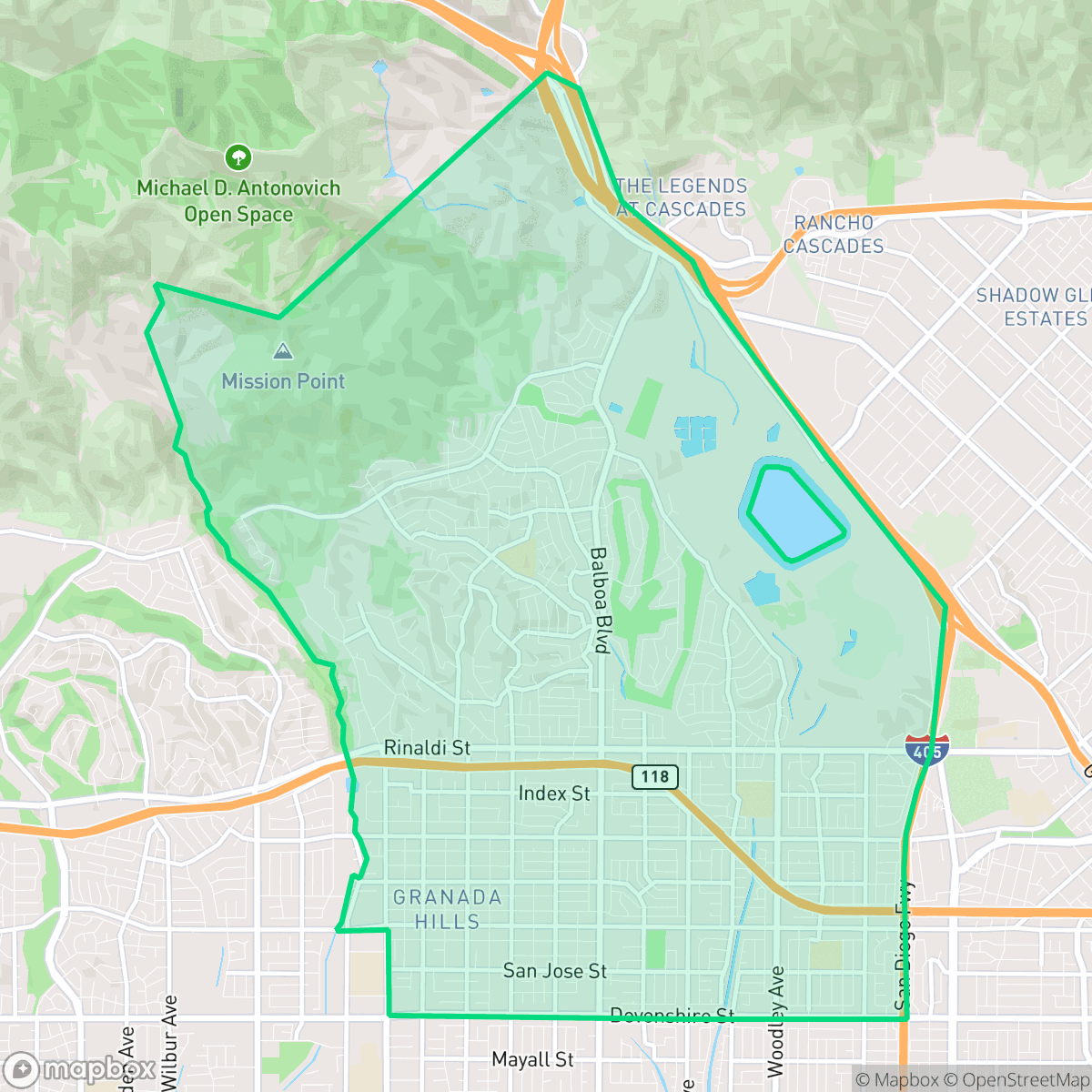
Granada Hills is a scenic Los Angeles community known for its modernist architecture and tree-lined streets in the Santa Susana Mountain foothills. The neighborhood offers a suburban atmosphere with high visual appeal, though residents should expect a car-dependent lifestyle and standard suburban housing density.
Key Highlights
About Granada Hills
Nestled in the foothills of the Santa Susana Mountains, Granada Hills evolved from the agricultural Sunshine Ranch and a 1920s rabbit-breeding colony into a prominent mid-century suburb. Founded in 1927 as "Granada" and renamed in 1942, the neighborhood is architecturally distinguished by Balboa Highlands, a tract of 108 modernist homes built in the 1960s by developer Joseph Eichler. This tract was designated a Historic Preservation Overlay Zone in 2010, celebrating Eichler's affordable, progressive designs. A defining local landmark is White Oak Avenue, lined with 101 towering Deodar Cedar trees planted in 1932. Declared a Los Angeles Historic-Cultural Monument, this scenic stretch famously served as the backdrop for the iconic flying bicycle scene in the 1982 film E.T. the Extra-Terrestrial.
The area is characterized by its well-manicured properties and a high density of private backyard swimming pools, contributing to an affluent suburban aesthetic. While it maintains a consistent grid of residential streets with accessible sidewalks, the neighborhood is primarily oriented toward vehicle travel, as many daily amenities and services require driving. Residents benefit from a range of high-performing local schools, including several charter and magnet programs that serve the community, alongside a quiet environment that balances residential life with proximity to the natural landscape of the northern valley.
Living here involves navigating common suburban trade-offs, such as limited public green space outside of private yards and a high risk of fire due to the proximity to mountainous terrain. The neighborhood is best suited for families and professionals seeking a stable, quiet environment with strong educational options and architectural character. While the area provides a peaceful retreat from the urban core, prospective residents should be prepared for the realities of living in a car-centric suburb where most daily errands are not reachable by foot.
Neighborhood Scores Across 15 Qualities
Standard suburban spacing provides a moderate level of separation between homes, offering more privacy than the typical Los Angeles density. Most residences feature fenced yards and small side buffers, though some areas contain closely packed houses with limited distance between structures.
Extensive sidewalk networks and clear crosswalks exist on most residential streets and major arterials, making the area nearly as walkable as the Los Angeles average. While the local grid is well-connected for pedestrians, the nearby freeway acts as a significant barrier to movement.
Large, well-maintained homes with private backyard pools and expansive driveways define the area. This high density of manicured landscaping and premium amenities is notably higher than the Los Angeles average.
Large public parks and athletic fields provide reliable access to open greenery for pet owners. According to iHuus data, these accessible spaces make the area more dog friendly than the city average.
Frequent open land and rugged canyon terrain provide a more open, semi-rural atmosphere than most of Los Angeles. Residents will find a mix of dense suburban grids and vast, undeveloped hillsides according to iHuus data.
Suburban streets and industrial pockets offer a serene, low-density environment, but most daily needs and dining options require a vehicle. This area has a lower level of commercial activity and social density than the Los Angeles average.
Frequent disturbances from nearby freeway traffic and flight paths characterize the area. According to iHuus data, acoustic comfort in this neighborhood is consistent with the Los Angeles average.
Air quality remains mostly clean with rare instances of elevated readings, performing very closely to the Los Angeles average according to iHuus data.
Industrial presence is minimal, with the area consisting mostly of residential and light commercial uses. According to iHuus data, the neighborhood lacks the heavy warehouses and manufacturing facilities found more frequently in other parts of the city.
Health insurance accessibility is significantly higher than the Los Angeles average, according to iHuus data. Most residents have access to medical coverage through employer-sponsored or private plans.
Political leanings in this area are primarily liberal, though the concentration is slightly lower than the city average. Residents will find a moderate presence of opposing viewpoints within the community.
Residents live alongside a balanced mix of young adults, families, and seniors. This demographic spread is slightly more varied than the average seen across Los Angeles, according to iHuus data.
Property located within the 100-year floodplain may require flood insurance due to elevated risks. According to iHuus data, this vulnerability is slightly higher than the average for Los Angeles.
High fire hazards exist throughout the area, which is consistent with the extreme fire risk levels found across Los Angeles. Residents should be prepared for significant wildfire threats according to iHuus data.
Address-Level Insights for Granada Hills


iHuus Neighborhood Intelligence Insights
Get address-level neighborhood insights for Granada Hills
- Street-level scores — see how individual blocks compare, not just neighborhood averages
- Micro-zone boundaries — identify quiet pockets, flood boundaries, and walkable clusters before you visit
- 15 dimensions in full — walkability, noise, air quality, school quality, insurance coverage, population age profile, urban/rural index, and more
- Boundary risk alerts — know if your address sits near a block boundary where scores drop, the kind of detail no listing will ever mention
- School insights — individual school ratings and insights, not just district-level data
- Compare before you commit — side-by-side data across neighborhoods, down to block precision
No credit card required
Compare with Any Neighborhood
| Dimension | Granada Hills | Adams-Normandie |
|---|---|---|
| 🚶 Walkabilityavg 8.9 | ||
| 🔊 Acoustic Comfortavg 2.91 | ||
| 🤫 Privacy Indexavg 4.14 | ||
| 🎨 Visual Appealavg 6.58 | ||
| 🐕 Dog Friendlinessavg 5.04 | ||
| 🗺️ Urban-Rural Indexavg 5.96 | ||
| ✨ Neighborhood Vibeavg 5.07 | ||
| 🏥 Health Insurance Coverageavg 6.2 | ||
| 🌿 Air Qualityavg 8.12 | ||
| 🏭 Industrial Proximityavg 8.46 | ||
| 🌊 Flood Safetyavg 2.66 | ||
| 🗳️ Ideological Leanavg 9.56 | ||
| 👥 Population Age Profileavg 4.85 | ||
| 🔥 Fire Safetyavg 0.18 | ||
| 🏫 School Quality |
Granada Hills Rankings
School Districts Serving Granada Hills
School Insights for Granada Hills
Below average outcomes; significant attendance and academic challenges.
School Insights
See what's really behind every school rating near Granada Hills
- Individual school ratings — each school's own score with outcome context, not just a district average
- Enrollment & class size data — student-to-teacher ratio and how it compares to the state average
- Full demographics breakdown — ethnicity and gender composition for every school in the enrollment zone
- Every school in the district — all schools within the enrollment boundary ranked by rating, not just the closest one
- Grade levels & benchmarks — elementary through high school, with below/above state-average flags
No credit card required