Granada Hills South Neighborhood Council District, Los Angeles
Updated · 34,457 residents
Granada Hills South is a historically rich San Fernando Valley community defined by its mid-century modern architecture and iconic tree-lined streets. Residents benefit from a highly walkable urban grid and access to top-rated schools, though the area experiences notable road traffic noise and dense suburban housing with limited private yard space.
Key Highlights
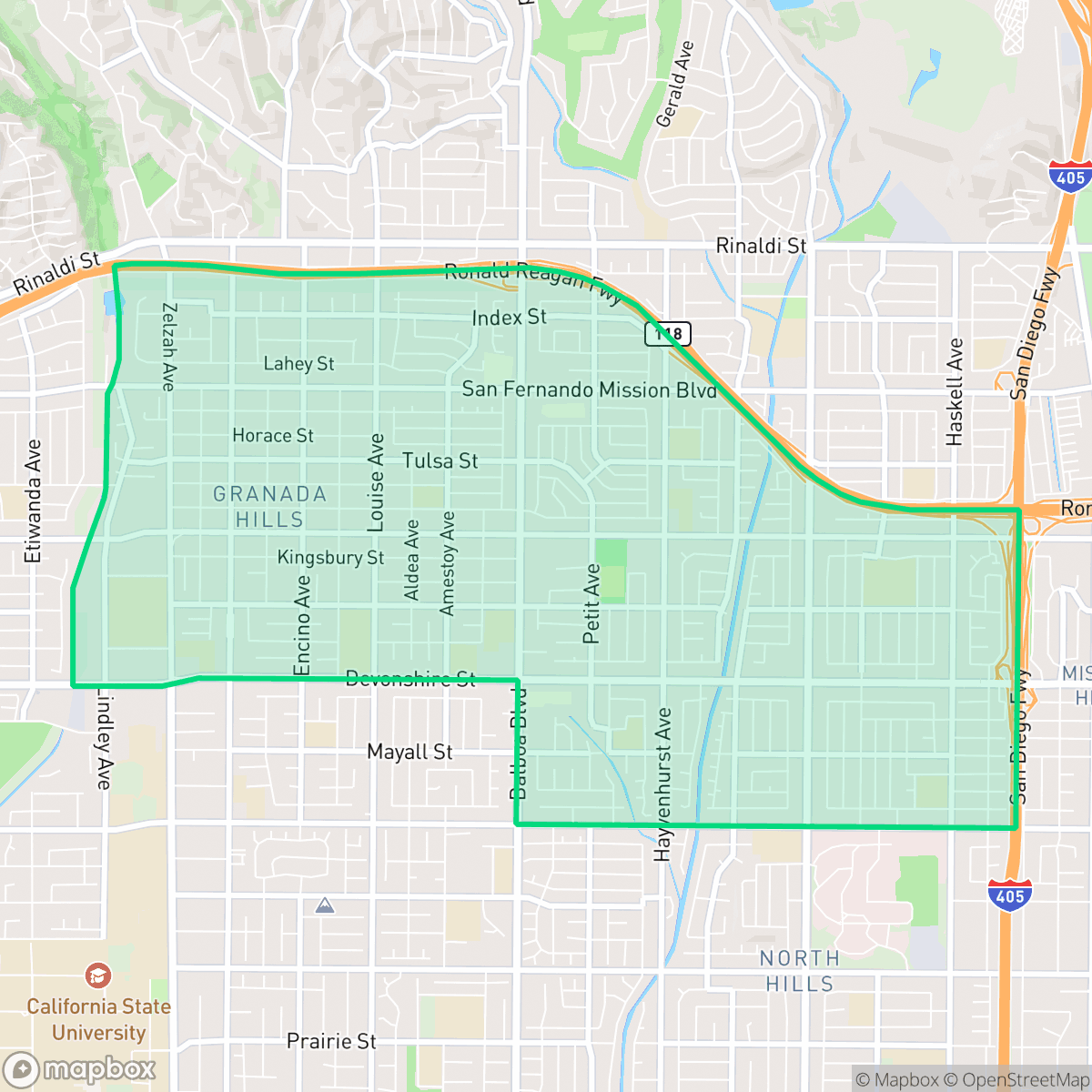
About Granada Hills South Neighborhood Council District
Established in 2002, the Granada Hills South Neighborhood Council District encompasses a historically rich portion of the San Fernando Valley. Originally part of the agricultural Sunshine Ranch, the area was founded as "Granada" in 1926. It is celebrated for its mid-century modern architectural heritage, notably the Marlborough Palms Residential Historic District, which features postwar Contemporary Ranch-style homes designed by the prominent firm Palmer & Krisel. A signature local landmark is the double row of 101 towering Deodar Cedar trees along White Oak Avenue, planted in 1932 and designated a Los Angeles Historic-Cultural Monument; these trees famously served as the backdrop for the iconic flying bicycle scene in the 1982 film E.T. the Extra-Terrestrial. Additionally, the historic "Old Granada Hills" business district along Chatsworth Street maintains a classic, small-town Main Street character.
The area maintains a classic suburban aesthetic characterized by well-manicured properties and a high density of private backyard pools. The neighborhood layout follows a consistent grid system, providing residents with reliable pedestrian access throughout the community. Educational opportunities are a primary draw, with several campuses, including Mayall Street Elementary and the Vintage Math/Science/Technology Magnet, consistently achieving high performance ratings. Prospective residents should note that the neighborhood experiences significant road traffic noise, which impacts the overall acoustic environment. While the area is largely free from industrial hazards, the dense housing configuration results in closely spaced homes and reduced visual privacy between properties. This community is best suited for families seeking a stable, school-focused environment who are comfortable with a standard suburban lifestyle and the associated traffic-related noise levels.
Neighborhood Scores Across 15 Qualities
Residential spacing provides a moderate level of seclusion with consistent yard buffers between homes. This degree of privacy is higher than the average found throughout Los Angeles.
Continuous sidewalks and well-defined crosswalks exist on both sides of most residential and arterial streets, offering better pedestrian accessibility than the Los Angeles average. While the local freeway acts as a significant barrier, the internal street network is highly navigable for those traveling on foot.
Manicured landscapes and a high density of private backyard pools create a visual environment that is notably more upscale than the Los Angeles average. According to iHuus data, the area is characterized by large, well-maintained homes and expansive driveways.
Sidewalks with grass verges and nearby public sports fields offer reliable walking routes for pets. According to iHuus data, the availability of public green space for dog walking is consistent with the city average.
Open land and scattered homes provide a more semi-rural atmosphere than most of Los Angeles. Residents can expect a mix of woodland and field areas interspersed with suburban housing, according to iHuus data.
Suburban blocks offer a balance of green space and diverse dining options, though the area remains largely car-dependent with a level of activity similar to the city average. Most daily needs and social hubs are accessible via driving, as few businesses are clustered within easy walking distance.
Frequent noise from nearby freeway traffic and railroad proximity impacts the area. This level of acoustic disturbance is notably higher than the Los Angeles average, according to iHuus data.
Air quality remains consistently high with rare instances of elevated readings. This level of air cleanliness is roughly comparable to the average found throughout Los Angeles.
Industrial activity and large warehouses are virtually nonexistent here, providing a cleaner environment than the Los Angeles average. Land use is limited to residential, institutional, and light commercial zones with no detectable heavy industrial hazards.
Health insurance access is widespread among residents, sitting well above the Los Angeles city average. According to iHuus data, most members of the community are covered by a health plan.
Political leanings in this area are largely liberal, though the neighborhood shows a slightly less progressive tilt than the city average according to iHuus data.
Residents live alongside a balanced variety of young adults, families, and seniors. According to iHuus data, this demographic distribution is slightly more varied than the typical Los Angeles profile.
Properties are situated within a known floodplain, which may necessitate additional flood insurance coverage. This level of risk is slightly higher than the average for Los Angeles.
Address-Level Insights for Granada Hills South Neighborhood Council District


iHuus Neighborhood Intelligence Insights
Get address-level neighborhood insights for Granada Hills South Neighborhood Council District
- Street-level scores — see how individual blocks compare, not just neighborhood averages
- Micro-zone boundaries — identify quiet pockets, flood boundaries, and walkable clusters before you visit
- 15 dimensions in full — walkability, noise, air quality, school quality, insurance coverage, population age profile, urban/rural index, and more
- Boundary risk alerts — know if your address sits near a block boundary where scores drop, the kind of detail no listing will ever mention
- School insights — individual school ratings and insights, not just district-level data
- Compare before you commit — side-by-side data across neighborhoods, down to block precision
No credit card required
Compare with Any Neighborhood
| Dimension | Granada Hills South Neighborhood Council District | Adams-Normandie |
|---|---|---|
| 🚶 Walkabilityavg 8.9 | ||
| 🔊 Acoustic Comfortavg 2.91 | ||
| 🤫 Privacy Indexavg 4.14 | ||
| 🎨 Visual Appealavg 6.58 | ||
| 🐕 Dog Friendlinessavg 5.04 | ||
| 🗺️ Urban-Rural Indexavg 5.96 | ||
| ✨ Neighborhood Vibeavg 5.07 | ||
| 🏥 Health Insurance Coverageavg 6.2 | ||
| 🌿 Air Qualityavg 8.12 | ||
| 🏭 Industrial Proximityavg 8.46 | ||
| 🌊 Flood Safetyavg 2.66 | ||
| 🗳️ Ideological Leanavg 9.56 | ||
| 👥 Population Age Profileavg 4.85 | ||
| 🔥 Fire Safetyavg 0.18 | ||
| 🏫 School Quality |
Granada Hills South Neighborhood Council District Rankings
School Districts Serving Granada Hills South Neighborhood Council District
School Insights for Granada Hills South Neighborhood Council District
Below average outcomes; significant attendance and academic challenges.
School Insights
See what's really behind every school rating near Granada Hills South Neighborhood Council District
- Individual school ratings — each school's own score with outcome context, not just a district average
- Enrollment & class size data — student-to-teacher ratio and how it compares to the state average
- Full demographics breakdown — ethnicity and gender composition for every school in the enrollment zone
- Every school in the district — all schools within the enrollment boundary ranked by rating, not just the closest one
- Grade levels & benchmarks — elementary through high school, with below/above state-average flags
No credit card required