Granada Hills North Neighborhood Council District, Los Angeles
Updated · 26,001 residents
Granada Hills North is defined by its mid-century modern residential tracts and expansive access to the Santa Susana Mountain foothills. While the area offers a quiet, affluent suburban environment with high visual appeal, residents rely primarily on personal vehicles for daily errands due to limited local commercial density.
Key Highlights
About Granada Hills North Neighborhood Council District
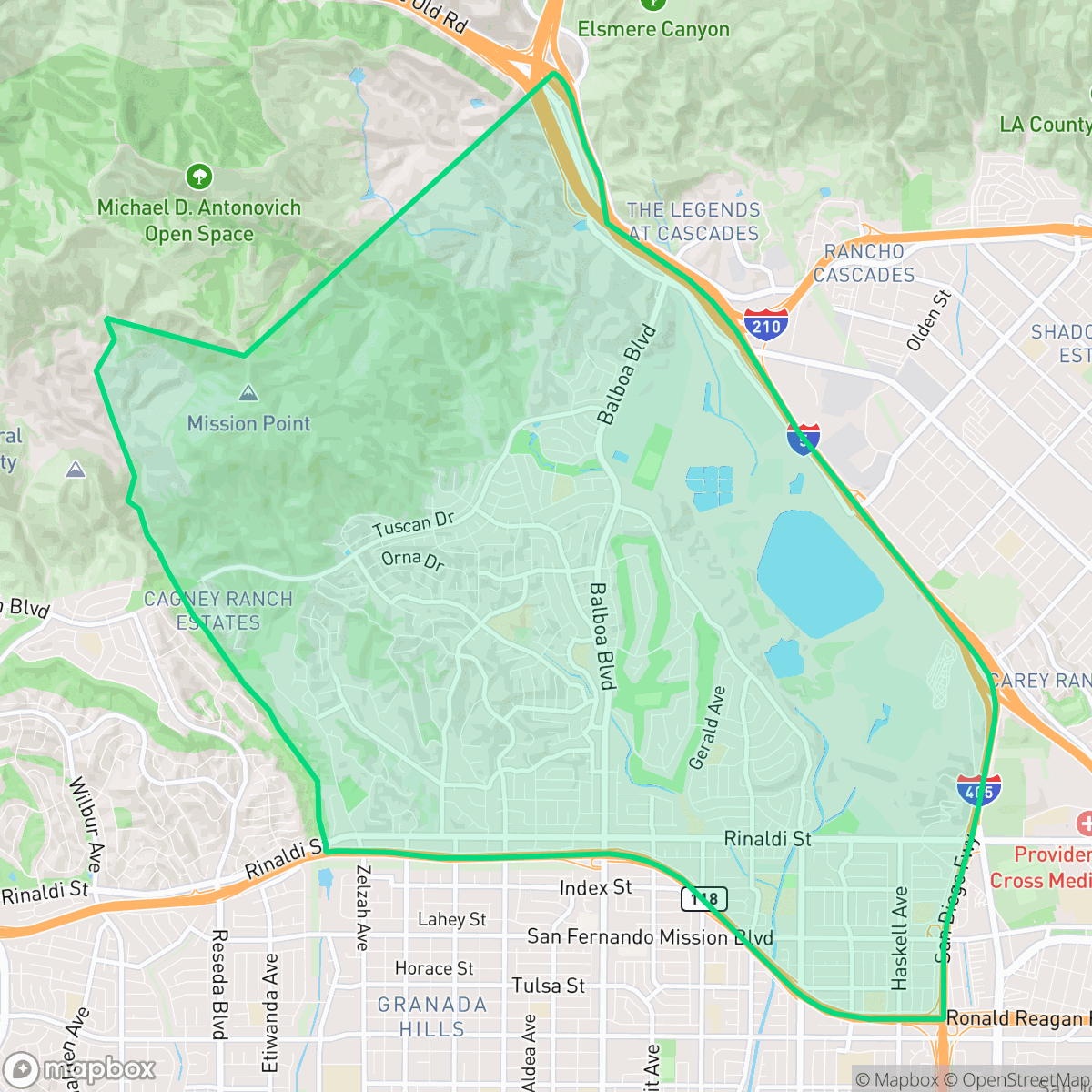
Formed in 2002, the Granada Hills North Neighborhood Council District spans the northernmost foothills of the Santa Susana Mountains down to State Route 118. Historically part of the early 20th-century Sunshine Ranch agricultural tract, this scenic area transitioned from citrus orchards and dairy farms into a premier mid-century residential hub. The district is celebrated for its architectural heritage, notably the Balboa Highlands and Knollwood Grove tracts. Developed in the 1960s by iconic modernist Joseph Eichler, these tracts are famous for their "California Cool" mid-century modern designs. The neighborhood is also home to major local landmarks, including the historic Knollwood Country Club and the 672-acre O'Melveny Park, the second-largest public park in the City of Los Angeles.
The neighborhood maintains a distinct suburban character marked by well-manicured properties, many of which feature private swimming pools and generous driveways. Residents benefit from significant proximity to natural landmarks like O'Melveny Park, which provides extensive outdoor recreational space. The area blends residential living with utility infrastructure, resulting in a landscape that balances quiet, low-density housing with industrial and water management facilities.
Prospective residents should note that the area is largely car-dependent, as local services and businesses are sparse compared to more central parts of Los Angeles. While the grid layout allows for pedestrian movement, the proximity to major highways contributes to consistent road noise. Additionally, those considering the area should be aware of the environmental context, including the elevated risk of wildfires common to these northern foothill communities.
Neighborhood Scores Across 15 Qualities
Residential spacing provides a greater sense of seclusion than most of Los Angeles. While some houses feature closely packed side yards, many properties maintain a comfortable buffer between neighbors.
Residential streets feature consistent sidewalks and safe crossings, though the nearby freeway acts as a major barrier to pedestrian movement. This level of connectivity is slightly lower than the Los Angeles average according to iHuus data.
Manicured properties and a high density of private backyard pools create a visual environment that is notably more polished than the Los Angeles average. According to iHuus data, the area is characterized by large homes and spacious, multi-car driveways typical of an affluent suburban setting.
Public park access and sidewalk verges are somewhat limited; however, the area offers better opportunities for pet owners than the city average due to some accessible green spaces in the northwest. Most greenery is contained within private backyards rather than accessible public verges.
Open hillsides and large utility zones provide a more rural feel than most of Los Angeles. Residents will find a mix of suburban housing and vast, undeveloped terrain according to iHuus data.
Limited commercial density and a prevalence of industrial and residential zones make most daily errands dependent on a vehicle. The area feels significantly more subdued than the Los Angeles average, offering a serene environment with very few walkable social hubs or local businesses.
Frequent noise from nearby freeways and flight paths impacts the area, resulting in acoustic comfort that is slightly below the Los Angeles average. According to iHuus data, residents may experience regular auditory disturbances from heavy transit corridors.
Air quality remains consistently high with rare instances of elevated readings, performing nearly in line with the Los Angeles average according to iHuus data.
Primarily residential in character, this area lacks heavy manufacturing or large-scale warehouses. While some utility infrastructure and water treatment facilities are present, the industrial footprint is slightly lower than the Los Angeles average.
Health insurance accessibility is significantly higher than the Los Angeles average, providing residents with greater access to medical services. According to iHuus data, the majority of the population maintains active coverage.
Political leanings in this area are largely liberal, though the neighborhood trend is less progressive than the broader Los Angeles average according to iHuus data.
Residents live alongside a balanced mix of young adults, families, and seniors. This demographic distribution is slightly more varied than the Los Angeles average, according to iHuus data.
Significant flood risk exists here because parts of the area fall within the 100-year floodplain. According to iHuus data, this vulnerability is slightly higher than the average found across Los Angeles.
Wildfire hazards are exceptionally high in this area, representing a significantly greater danger than most of Los Angeles. Residents should prioritize maximum fire protection measures and emergency preparedness.
Address-Level Insights for Granada Hills North Neighborhood Council District


iHuus Neighborhood Intelligence Insights
Get address-level neighborhood insights for Granada Hills North Neighborhood Council District
- Street-level scores — see how individual blocks compare, not just neighborhood averages
- Micro-zone boundaries — identify quiet pockets, flood boundaries, and walkable clusters before you visit
- 15 dimensions in full — walkability, noise, air quality, school quality, insurance coverage, population age profile, urban/rural index, and more
- Boundary risk alerts — know if your address sits near a block boundary where scores drop, the kind of detail no listing will ever mention
- School insights — individual school ratings and insights, not just district-level data
- Compare before you commit — side-by-side data across neighborhoods, down to block precision
No credit card required
Compare with Any Neighborhood
| Dimension | Granada Hills North Neighborhood Council District | Adams-Normandie |
|---|---|---|
| 🚶 Walkabilityavg 8.9 | ||
| 🔊 Acoustic Comfortavg 2.91 | ||
| 🤫 Privacy Indexavg 4.14 | ||
| 🎨 Visual Appealavg 6.58 | ||
| 🐕 Dog Friendlinessavg 5.04 | ||
| 🗺️ Urban-Rural Indexavg 5.96 | ||
| ✨ Neighborhood Vibeavg 5.07 | ||
| 🏥 Health Insurance Coverageavg 6.2 | ||
| 🌿 Air Qualityavg 8.12 | ||
| 🏭 Industrial Proximityavg 8.46 | ||
| 🌊 Flood Safetyavg 2.66 | ||
| 🗳️ Ideological Leanavg 9.56 | ||
| 👥 Population Age Profileavg 4.85 | ||
| 🔥 Fire Safetyavg 0.18 | ||
| 🏫 School Quality |
Granada Hills North Neighborhood Council District Rankings
School Districts Serving Granada Hills North Neighborhood Council District
School Insights for Granada Hills North Neighborhood Council District
Below average outcomes; significant attendance and academic challenges.
School Insights
See what's really behind every school rating near Granada Hills North Neighborhood Council District
- Individual school ratings — each school's own score with outcome context, not just a district average
- Enrollment & class size data — student-to-teacher ratio and how it compares to the state average
- Full demographics breakdown — ethnicity and gender composition for every school in the enrollment zone
- Every school in the district — all schools within the enrollment boundary ranked by rating, not just the closest one
- Grade levels & benchmarks — elementary through high school, with below/above state-average flags
No credit card required