Glassell Park, Los Angeles
Updated · 24,893 residents
Glassell Park is a Northeast Los Angeles community defined by its hillside terrain and proximity to major transit corridors. While it offers a quiet, suburban atmosphere with diverse local dining, residents should expect notable noise from nearby freeway traffic and high-density residential layouts in certain sectors.
Key Highlights
About Glassell Park
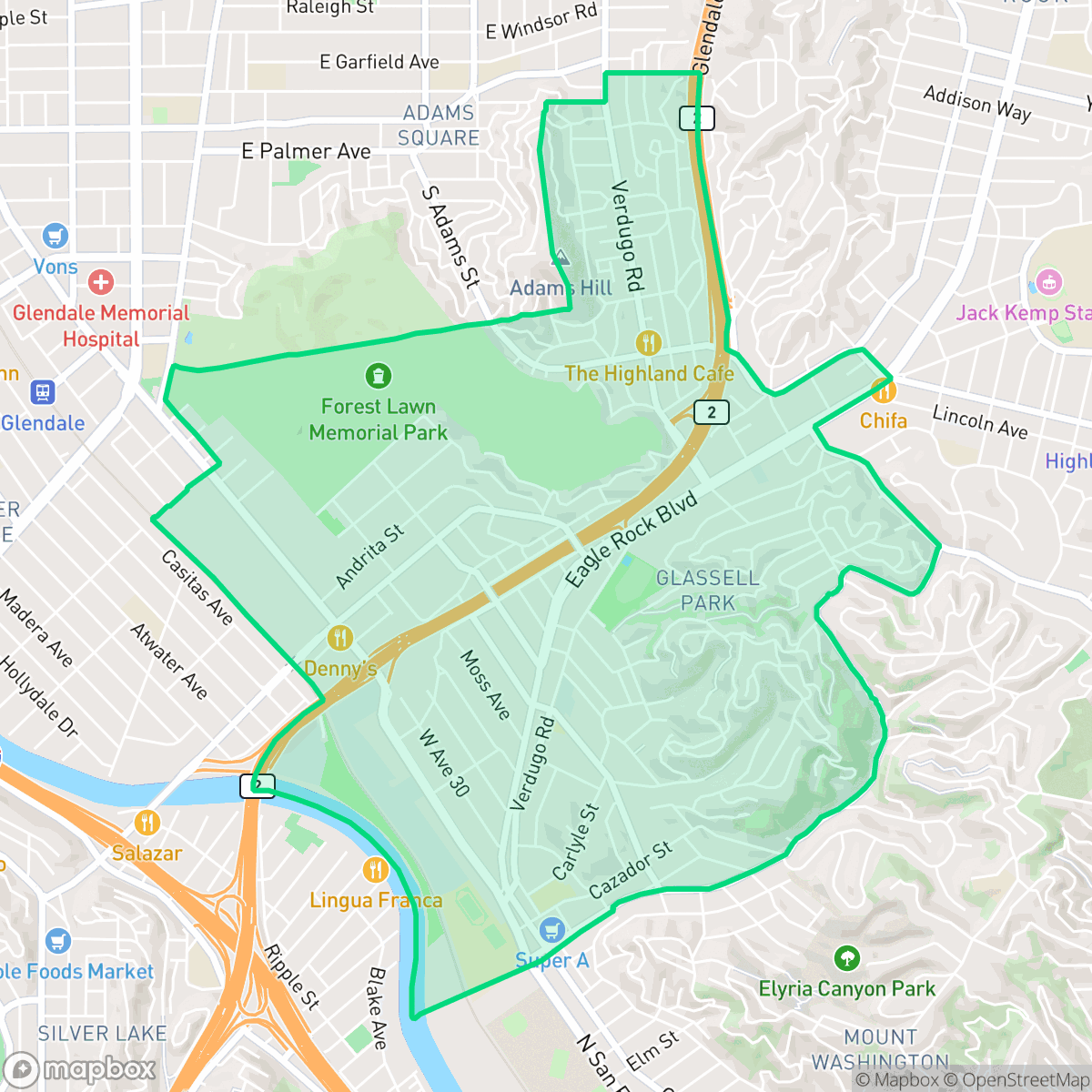
Originally part of the 1784 Spanish land grant Rancho San Rafael, the Northeast Los Angeles neighborhood of Glassell Park was acquired by prominent attorney Andrew Glassell following the 1871 Great Partition lawsuit. Glassell built a Victorian estate on the land in 1889, and many local streets—such as Toland Way and Drew Street—were named after his family members. Subdivisions began in 1907, and the area was annexed by Los Angeles between 1912 and 1916. Early local fixtures included the popular Los Angeles Pigeon Farm tourist attraction (destroyed by a 1914 flood) and Southern Pacific's massive Taylor Yard rail yard, established in 1923. During the Great Depression, the Glassell family sold 62 acres of their land, allowing the neighboring Forest Lawn Memorial Park to expand into the community. Today, the neighborhood is known for its historic Craftsman and hillside homes.
The area balances a dense suburban landscape with steep, natural hillsides that provide scenic views and canyon trails. It features a mix of single-family homes and multi-unit structures, with pockets of light industrial activity and commercial corridors. Residents have access to local social spots like Little Barn Coffee House and various dining options, though the neighborhood remains largely car-oriented with limited walkable business districts. According to iHuus data, the community maintains a consistent sidewalk grid in many residential areas, though the hilly topography and major highways create barriers to pedestrian movement.
Livability in the neighborhood is marked by trade-offs between its central location and environmental factors. While the area benefits from high health insurance coverage and a strong academic foundation provided by nearby Glendale Unified schools, it faces challenges regarding acoustic comfort due to significant road traffic noise. The community is best suited for those seeking a quiet residential environment who are comfortable navigating a car-dependent landscape and hilly topography.
Neighborhood Scores Across 15 Qualities
Residential spacing varies from tightly packed apartment blocks to hillside homes with more generous buffers. This level of separation is higher than the city average, though some areas feature minimal setbacks between structures.
Consistent sidewalk networks and low-traffic residential streets facilitate safe pedestrian movement throughout most blocks. However, the nearby major highway acts as a significant barrier to connectivity, making the area slightly less walkable than the Los Angeles average.
Manicured landscapes and large estates with private pools are present in certain pockets, contributing to an aesthetic that is slightly above the Los Angeles average. This visual quality contrasts with more standard high-density housing and industrial areas found in other parts of the neighborhood.
Abundant canyon-side green space and proximity to large parks provide excellent exercise areas for pets. This access to natural trails and wide residential parkways makes the area more dog-friendly than the Los Angeles average, according to iHuus data.
Residential pockets blend dense suburban housing with steep, unbuilt natural hillsides and canyons. This layout provides more open, rugged terrain than the typical Los Angeles urban landscape.
Residential life here is characterized by a calm, low-density atmosphere with pockets of light industrial use. According to iHuus data, the level of activity and social density is lower than the Los Angeles average.
Proximity to major freeways and rail lines results in acoustic levels that are slightly higher than the Los Angeles average. Residents should expect intermittent disturbances from nearby transportation corridors according to iHuus data.
Air quality remains consistently good with rare instances of elevated readings. This level of air cleanliness is consistent with the average found throughout Los Angeles.
Residential and light commercial uses dominate the landscape, with very little heavy industrial activity present. While some large warehouses and logistics centers are visible near the freeway corridors, the area remains largely free of industrial hazards compared to the city average.
Health insurance enrollment among residents is notably higher than the Los Angeles average, according to iHuus data.
Voting patterns and census indicators show a predominantly liberal political leaning that is slightly more pronounced than the Los Angeles average.
Residents live within a diverse age demographic that features a balanced spread of young adults, families, and older inhabitants. According to iHuus data, this age distribution is slightly more varied than the average found across Los Angeles.
Flood risk in this area is higher than the Los Angeles average, though official FEMA studies for the neighborhood remain incomplete. Residents should exercise caution as the precise level of susceptibility is currently undetermined.
Fire risk in this area is exceptionally high, significantly exceeding the average for Los Angeles. Residents should be prepared for extreme fire hazards and prioritize maximum protection measures, according to iHuus data.
Address-Level Insights for Glassell Park


iHuus Neighborhood Intelligence Insights
Get address-level neighborhood insights for Glassell Park
- Street-level scores — see how individual blocks compare, not just neighborhood averages
- Micro-zone boundaries — identify quiet pockets, flood boundaries, and walkable clusters before you visit
- 15 dimensions in full — walkability, noise, air quality, school quality, insurance coverage, population age profile, urban/rural index, and more
- Boundary risk alerts — know if your address sits near a block boundary where scores drop, the kind of detail no listing will ever mention
- School insights — individual school ratings and insights, not just district-level data
- Compare before you commit — side-by-side data across neighborhoods, down to block precision
No credit card required
Compare with Any Neighborhood
| Dimension | Glassell Park | Adams-Normandie |
|---|---|---|
| 🚶 Walkabilityavg 8.9 | ||
| 🔊 Acoustic Comfortavg 2.91 | ||
| 🤫 Privacy Indexavg 4.14 | ||
| 🎨 Visual Appealavg 6.58 | ||
| 🐕 Dog Friendlinessavg 5.04 | ||
| 🗺️ Urban-Rural Indexavg 5.96 | ||
| ✨ Neighborhood Vibeavg 5.07 | ||
| 🏥 Health Insurance Coverageavg 6.2 | ||
| 🌿 Air Qualityavg 8.12 | ||
| 🏭 Industrial Proximityavg 8.46 | ||
| 🌊 Flood Safetyavg 2.66 | ||
| 🗳️ Ideological Leanavg 9.56 | ||
| 👥 Population Age Profileavg 4.85 | ||
| 🔥 Fire Safetyavg 0.18 | ||
| 🏫 School Quality |
Glassell Park Rankings
School Districts Serving Glassell Park
School Insights for Glassell Park
Below average outcomes; significant attendance and academic challenges.
School Insights
See what's really behind every school rating near Glassell Park
- Individual school ratings — each school's own score with outcome context, not just a district average
- Enrollment & class size data — student-to-teacher ratio and how it compares to the state average
- Full demographics breakdown — ethnicity and gender composition for every school in the enrollment zone
- Every school in the district — all schools within the enrollment boundary ranked by rating, not just the closest one
- Grade levels & benchmarks — elementary through high school, with below/above state-average flags
No credit card required