Encino, Los Angeles
Updated · 49,280 residents
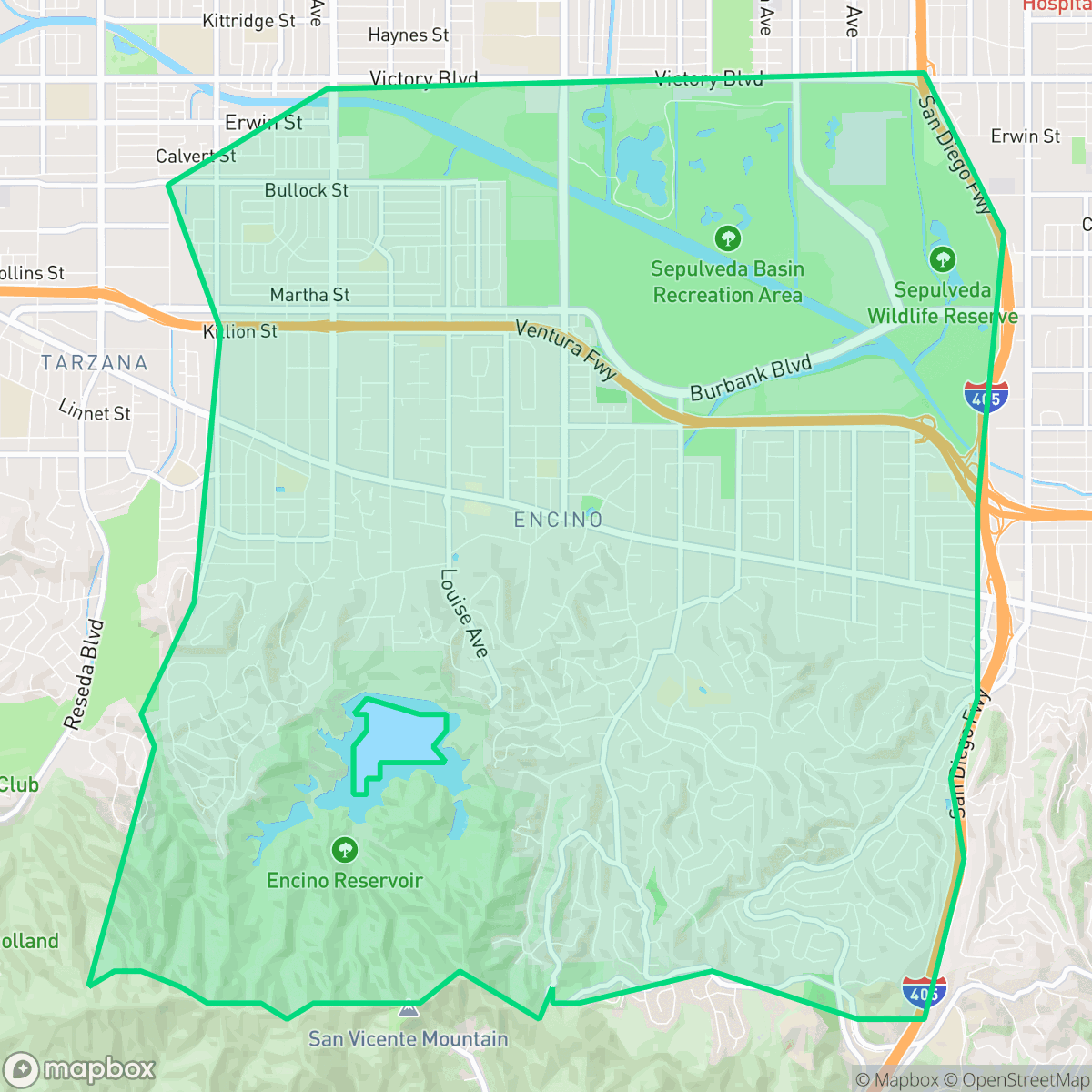
Encino is an upscale residential neighborhood in the San Fernando Valley defined by its large estates and established mid-century suburban layout. The area offers high visual appeal and a comprehensive sidewalk network, though residents often rely on cars for daily errands and should expect moderate noise levels from local road traffic.
Key Highlights
About Encino
Located in the southwestern San Fernando Valley, Encino takes its name from the Spanish word for oak, inspired by its historic oak trees and the original 1845 Mexican land grant, Rancho Los Encinos. The area's rich history is preserved at Los Encinos State Historic Park, which sits on the former site of the Tongva village of Siutcanga. The park features the nine-room de la Ossa Adobe, built in 1849 as a roadhouse along El Camino Real (now Ventura Boulevard), and the 1872 French provincial-style limestone Garnier Building. In the mid-20th century, Encino transitioned from agricultural land and movie backlots—such as the RKO Pictures "Encino Ranch"—into a premier mid-century suburb. This era is highlighted by the Encino Village tract, designed by architect Martin Stern Jr. in 1954, which established the neighborhood's enduring upscale, residential character.
The neighborhood maintains a distinct character through its blend of expansive, high-end estates and diverse multi-family housing options. Residents benefit from a high level of health insurance coverage and access to several top-rated public and charter schools, including the Academy for Enriched Sciences and Hesby Oaks Leadership Charter. While the area lacks a dense urban core, it provides a steady rhythm of residential life with proximity to various dining and service hubs along major thoroughfares. The visual appeal is consistently high, characterized by manicured lawns and private swimming pools, contributing to a polished suburban environment.
Living in this part of the San Fernando Valley involves specific trade-offs, particularly regarding fire safety and acoustic comfort. While the grid layout supports pedestrian activity, the neighborhood remains largely car-dependent for most daily needs. It is best suited for families and professionals who prioritize access to quality education and a quiet, established community over a high-energy urban lifestyle. Prospective residents should also be aware that while the area is largely free of industrial hazards, the regional noise profile is influenced by its proximity to major highways.
Neighborhood Scores Across 15 Qualities
Residential spacing provides a moderate level of seclusion with some buffer between neighbors. According to iHuus data, this level of privacy is higher than the average found across Los Angeles.
Sidewalk networks are well-defined along residential streets and include clear crossings at major intersections. While many areas are highly navigable, large highway interchanges and high-traffic arterials can create barriers for pedestrians, making the area slightly less walkable than the city average.
Manicured lawns, large custom estates, and frequent private swimming pools create a highly polished landscape that is noticeably more visually appealing than the Los Angeles average. According to iHuus data, the presence of expansive lots and well-maintained properties defines the neighborhood's premium streetscape.
Access to large public parks and golf course trails varies by sector, though some areas offer better walking opportunities than the city average. According to iHuus data, many residential streets feature narrow sidewalk verges and rely heavily on private backyards for greenery.
Open land and pockets of woodland provide a more spacious, less urban atmosphere than much of Los Angeles. This higher degree of open space creates a landscape characterized by scattered homes and significant greenbelts, according to iHuus data.
Residential life here follows a steady, subdued rhythm characterized by low-density housing and significant open space. The area lacks a high concentration of commercial activity and is slightly less lively than the Los Angeles average.
Frequent noise from nearby freeway corridors and transit routes is common here. This level of acoustic disturbance is roughly consistent with the average found across Los Angeles.
Air quality in this area is consistently good with rare instances of elevated readings. This level of cleanliness is largely in line with the average found across Los Angeles.
Industrial presence is minimal throughout the area, as most streets consist of residential and light commercial uses with no heavy warehouses or hazardous sites. According to iHuus data, this lack of industrial activity is slightly better than the city average.
Health insurance accessibility is notably higher than the Los Angeles average, according to iHuus data. Most residents have access to employer-sponsored or private medical plans.
Voting patterns and census indicators show a predominantly liberal leaning, though this is slightly less pronounced than the average for Los Angeles.
Residents live among a balanced distribution of young professionals, families, and older adults, representing a slightly more varied age spread than the Los Angeles average.
Flood risk in this area is higher than the Los Angeles average, though a detailed study from FEMA has not yet been completed for this specific location. Residents should note that according to iHuus data, the area carries a moderate level of uncertainty regarding flood safety.
Extreme fire hazards are prevalent in this area, matching the high risk levels found across the rest of Los Angeles. According to iHuus data, residents must prioritize maximum protection measures due to the severe threat of wildfire.
Address-Level Insights for Encino


iHuus Neighborhood Intelligence Insights
Get address-level neighborhood insights for Encino
- Street-level scores — see how individual blocks compare, not just neighborhood averages
- Micro-zone boundaries — identify quiet pockets, flood boundaries, and walkable clusters before you visit
- 15 dimensions in full — walkability, noise, air quality, school quality, insurance coverage, population age profile, urban/rural index, and more
- Boundary risk alerts — know if your address sits near a block boundary where scores drop, the kind of detail no listing will ever mention
- School insights — individual school ratings and insights, not just district-level data
- Compare before you commit — side-by-side data across neighborhoods, down to block precision
No credit card required
Compare with Any Neighborhood
| Dimension | Encino | Adams-Normandie |
|---|---|---|
| 🚶 Walkabilityavg 8.9 | ||
| 🔊 Acoustic Comfortavg 2.91 | ||
| 🤫 Privacy Indexavg 4.14 | ||
| 🎨 Visual Appealavg 6.58 | ||
| 🐕 Dog Friendlinessavg 5.04 | ||
| 🗺️ Urban-Rural Indexavg 5.96 | ||
| ✨ Neighborhood Vibeavg 5.07 | ||
| 🏥 Health Insurance Coverageavg 6.2 | ||
| 🌿 Air Qualityavg 8.12 | ||
| 🏭 Industrial Proximityavg 8.46 | ||
| 🌊 Flood Safetyavg 2.66 | ||
| 🗳️ Ideological Leanavg 9.56 | ||
| 👥 Population Age Profileavg 4.85 | ||
| 🔥 Fire Safetyavg 0.18 | ||
| 🏫 School Quality |
Encino Rankings
School Districts Serving Encino
School Insights for Encino
Below average outcomes; significant attendance and academic challenges.
School Insights
See what's really behind every school rating near Encino
- Individual school ratings — each school's own score with outcome context, not just a district average
- Enrollment & class size data — student-to-teacher ratio and how it compares to the state average
- Full demographics breakdown — ethnicity and gender composition for every school in the enrollment zone
- Every school in the district — all schools within the enrollment boundary ranked by rating, not just the closest one
- Grade levels & benchmarks — elementary through high school, with below/above state-average flags
No credit card required