Elysian Park, Los Angeles
Updated · 3,563 residents
Elysian Park is a tranquil, semi-rural enclave defined by its expansive green space and quiet, low-density residential streets. While it offers excellent conditions for dog owners and a peaceful atmosphere, the area experiences significant noise from nearby highway traffic and limited walkability for daily errands.
Key Highlights
About Elysian Park
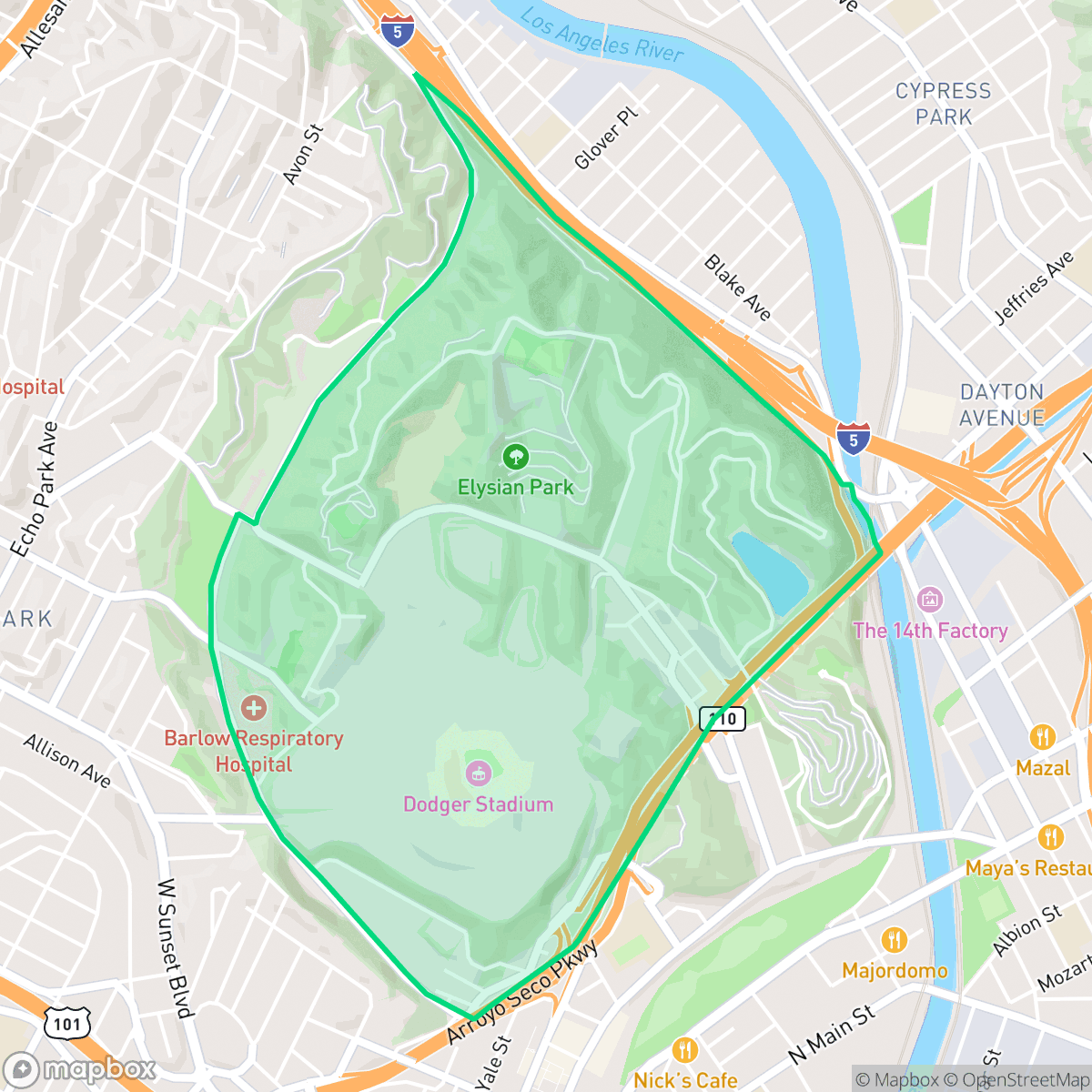
Elysian Park is a central Los Angeles neighborhood centered around the city’s oldest municipal park, established in 1886. Originally known as the Rock Quarry Hills, the rugged, undeveloped terrain is the only remaining natural parcel of the 1781 Spanish land grant for the Pueblo of Los Angeles. The neighborhood is deeply defined by its historic districts and landmarks, including the Solano Canyon residential enclave, the 1902 Barlow Respiratory Hospital, and the 1893 Chavez Ravine Arboretum. It is also indelibly linked to the controversial mid-20th-century displacement of Chavez Ravine’s vibrant Mexican-American communities—Palo Verde, La Loma, and Bishop—which were demolished to make way for Dodger Stadium. Other notable local landmarks include the 1895 Avenue of the Palms and the historic 1925 Cathedral High School.
The area functions as a quiet residential retreat that feels disconnected from the typical urban density of Los Angeles. It features a high urban-rural index, characterized by vast open spaces and minimal commercial development. Residents benefit from high air quality and a strong sense of community, though the neighborhood remains largely residential with few nightlife or entertainment options. The environment is notably serene, providing a stark contrast to the bustling city center located just a short distance away.
Living here requires navigating specific trade-offs, particularly regarding acoustic comfort, as road traffic noise remains a persistent factor. The area is best suited for those who prioritize proximity to nature and pet-friendly environments over urban convenience. Prospective residents should note that while the neighborhood offers a peaceful lifestyle, it lacks the high walkability and service density found in neighboring districts, making personal transportation essential for most daily tasks. According to iHuus data, the neighborhood provides a unique, lower-density living experience that is increasingly rare within the city.
Neighborhood Scores Across 15 Qualities
Residential structures are situated in close proximity with minimal separation between buildings. According to iHuus data, this density is slightly higher than the average for Los Angeles.
Pedestrian navigation is supported by a consistent street grid with clear crosswalks, though large highway interchanges and parking lots create fragmented paths. This level of walkability is lower than the Los Angeles average.
Dense, uniform housing footprints and small yards characterize the area. This visual profile is slightly below the Los Angeles average according to iHuus data.
Extensive public parklands and connected green spaces offer much more accessible walking area for pets than the typical Los Angeles neighborhood. According to iHuus data, these large open areas and wide paths provide a safe environment away from heavy traffic.
Open landscapes and wooded areas provide a more semi-rural feel than the typical Los Angeles urban core. According to iHuus data, the area features frequent open land and scattered homes nestled among greenery.
Low business density and scattered development create a tranquil, subdued atmosphere that is notably less active than the Los Angeles average. Residents will find a peaceful environment, though many daily errands and social visits require a car due to the limited number of walkable commercial hubs.
Persistent noise from nearby heavy rail and flight paths makes this area significantly louder than most Los Angeles neighborhoods. According to iHuus data, acoustic comfort is extremely low due to constant proximity to major transit infrastructure.
Air quality remains consistently high with infrequent periods of poor ventilation. This level of cleanliness is notably better than the average found throughout Los Angeles.
Industrial presence is minimal, although proximity to major highway interchanges and railway tracks can introduce elevated noise and air pollution. Most of the area remains residential with only light commercial activity along main corridors, making it slightly more industrial-adjacent than the Los Angeles average.
Health insurance enrollment among residents is notably higher than the Los Angeles city average, according to iHuus data.
Voting patterns and census indicators reflect a deeply liberal political landscape that is even more pronounced than the Los Angeles city average, according to iHuus data.
Residents live alongside a balanced mix of young adults, families, and seniors. This demographic spread is slightly more varied than the average seen across Los Angeles.
Flood risk levels remain undetermined due to a lack of detailed federal studies for this area. According to iHuus data, the potential for flooding is notably higher than the average found across Los Angeles.
High fire risk characterizes this area due to dense vegetation, which represents a significantly higher danger level than the Los Angeles average according to iHuus data.
Address-Level Insights for Elysian Park


iHuus Neighborhood Intelligence Insights
Get address-level neighborhood insights for Elysian Park
- Street-level scores — see how individual blocks compare, not just neighborhood averages
- Micro-zone boundaries — identify quiet pockets, flood boundaries, and walkable clusters before you visit
- 15 dimensions in full — walkability, noise, air quality, school quality, insurance coverage, population age profile, urban/rural index, and more
- Boundary risk alerts — know if your address sits near a block boundary where scores drop, the kind of detail no listing will ever mention
- School insights — individual school ratings and insights, not just district-level data
- Compare before you commit — side-by-side data across neighborhoods, down to block precision
No credit card required
Compare with Any Neighborhood
| Dimension | Elysian Park | Adams-Normandie |
|---|---|---|
| 🚶 Walkabilityavg 8.9 | ||
| 🔊 Acoustic Comfortavg 2.91 | ||
| 🤫 Privacy Indexavg 4.14 | ||
| 🎨 Visual Appealavg 6.58 | ||
| 🐕 Dog Friendlinessavg 5.04 | ||
| 🗺️ Urban-Rural Indexavg 5.96 | ||
| ✨ Neighborhood Vibeavg 5.07 | ||
| 🏥 Health Insurance Coverageavg 6.2 | ||
| 🌿 Air Qualityavg 8.12 | ||
| 🏭 Industrial Proximityavg 8.46 | ||
| 🌊 Flood Safetyavg 2.66 | ||
| 🗳️ Ideological Leanavg 9.56 | ||
| 👥 Population Age Profileavg 4.85 | ||
| 🔥 Fire Safetyavg 0.18 | ||
| 🏫 School Quality |
Elysian Park Rankings
School Districts Serving Elysian Park
School Insights for Elysian Park
Below average outcomes; significant attendance and academic challenges.
School Insights
See what's really behind every school rating near Elysian Park
- Individual school ratings — each school's own score with outcome context, not just a district average
- Enrollment & class size data — student-to-teacher ratio and how it compares to the state average
- Full demographics breakdown — ethnicity and gender composition for every school in the enrollment zone
- Every school in the district — all schools within the enrollment boundary ranked by rating, not just the closest one
- Grade levels & benchmarks — elementary through high school, with below/above state-average flags
No credit card required