El Sereno, Los Angeles
Updated · 42,095 residents
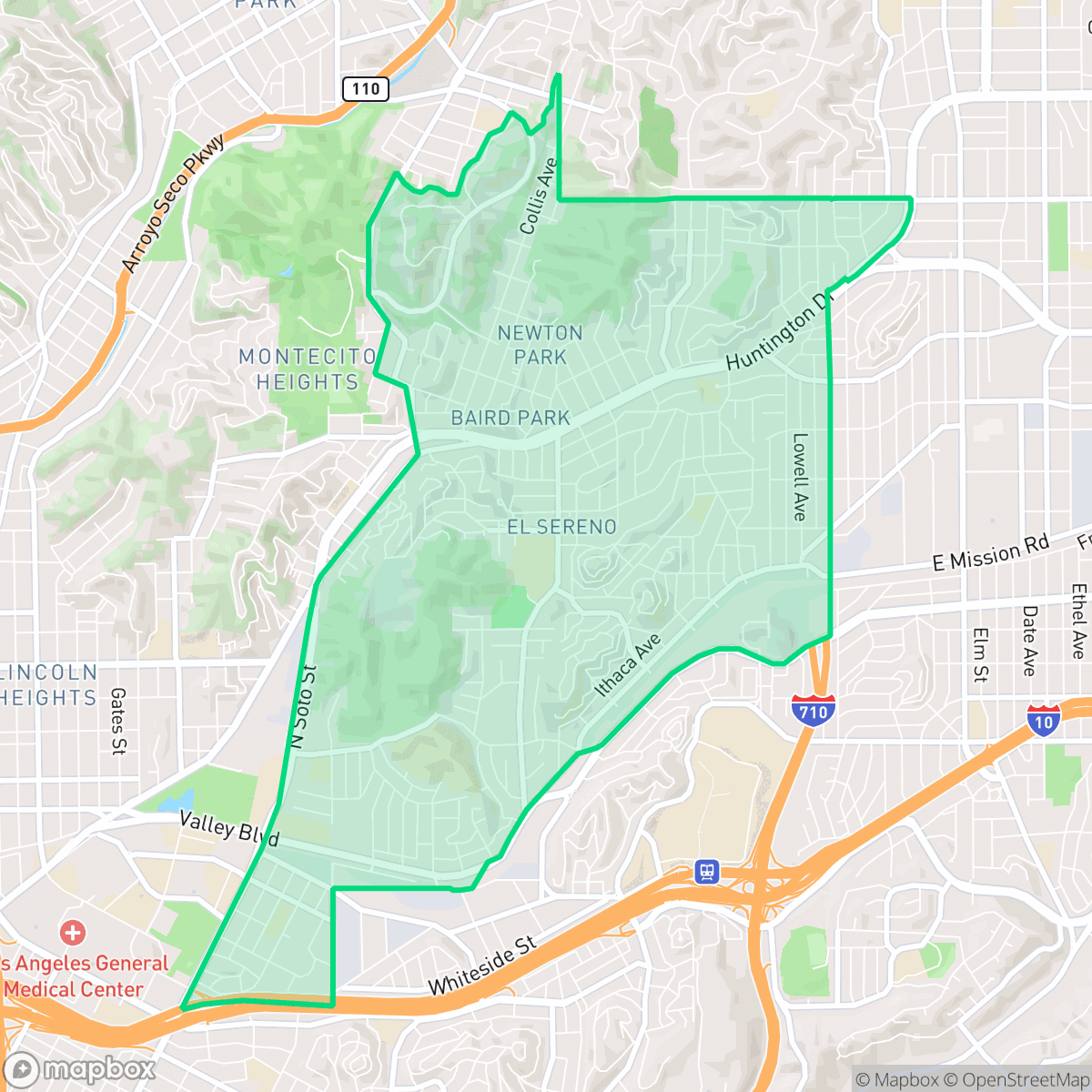
El Sereno is a quiet, hilly neighborhood in East Los Angeles known for its dense suburban character and proximity to expansive green spaces like Ascot Hills Park. While the area offers a peaceful residential atmosphere, residents primarily rely on vehicles for daily errands due to limited local commercial density.
Key Highlights
About El Sereno
Originally home to the Tongva village of Otsungna along the Arroyo Rosa de Castilla, the land that became El Sereno was later part of the Mexican land grant Rancho Rosa Castilla. In 1905, the community of Bairdstown was established here along the Pacific Electric Railway. Following its 1915 annexation by Los Angeles, the area was renamed El Sereno (“the serene one”) in 1917. The neighborhood grew rapidly during the 1920s with Period Revival-style homes and hosted the popular but deadly Ascot Motor Speedway from 1924 to 1936. Although restrictive covenants initially barred Mexican-American families from purchasing property, the landmark 1948 Supreme Court decision Shelley v. Kraemer lifted these barriers, transforming El Sereno into a culturally rich, predominantly Latino neighborhood.
The neighborhood is defined by its hilly topography and a dense residential fabric that blends mid-century single-family homes with pockets of multi-family units. It maintains a quiet, suburban feel, characterized by narrow streets and significant natural vistas provided by the surrounding canyons. According to iHuus data, the area benefits from relatively good air quality and a strong sense of community, making it a distinct residential enclave within the broader Los Angeles landscape.
Prospective residents should note that the area is largely car-dependent, as local business options are sparse and most daily services require a short drive. While the neighborhood offers a reprieve from the intense noise levels found in other parts of the city, the close proximity of homes results in limited private outdoor space. It is particularly well-suited for those seeking a quieter residential environment who prioritize access to hillside parks and outdoor recreation over immediate walkability to urban amenities.
Neighborhood Scores Across 15 Qualities
Residential spacing is varied, offering more separation between neighbors than the Los Angeles average. While some dense apartment clusters and close-set houses exist, hillside lots provide additional buffers.
Pedestrian navigation is generally easy due to a consistent sidewalk network on residential streets and main thoroughfares. However, walkability is slightly lower than the city average because steep canyon topography and high-traffic freeway interchanges create notable physical barriers.
Uniform tract housing and modest lot sizes define the area, which presents slightly less visual variety than the Los Angeles average. Most properties feature simple rooflines and small yards, though occasional larger homes with manicured landscaping can be found.
Abundant green slopes, canyon spaces, and large central parks provide more opportunities for dog walking than the typical Los Angeles neighborhood. Residents can take advantage of varied terrain and wide grass parkways, according to iHuus data.
Residential streets and green spaces exist in roughly equal measure, mirroring the typical urban-rural balance found throughout Los Angeles. The area features a transition of single-family homes, multi-unit apartments, and hilly terrain.
Low activity levels and a lack of concentrated commercial hubs make this area significantly less lively than the Los Angeles average. Most daily needs and dining options require a vehicle, as the landscape is characterized by a quiet, suburban, and industrial atmosphere with limited walkable amenities.
Frequent noise from nearby freeways and transit corridors is common here. According to iHuus data, acoustic levels are slightly higher than the Los Angeles average.
Air quality remains consistently high with only rare instances of elevated readings, staying largely in line with the Los Angeles average according to iHuus data.
Primarily residential and light commercial in nature, this area lacks the heavy warehouses and large-scale logistics hubs found more frequently across Los Angeles. Residents can expect a landscape dominated by homes and greenery rather than significant industrial activity or truck-related noise.
Health insurance access among El Sereno residents is slightly above the Los Angeles city average, according to iHuus data.
Voting patterns and census indicators show a very high concentration of liberal-leaning residents, which is slightly more pronounced than the average seen across Los Angeles.
Residents live alongside a balanced mix of young professionals, families, and seniors. This demographic distribution aligns closely with the average found across Los Angeles.
Flood risk is higher than the Los Angeles average due to proximity to designated floodplains. Residents may find that flood insurance is typically required for properties in this area according to iHuus data.
Extreme fire hazards exist throughout the area, representing a risk level that is notably higher than the Los Angeles average according to iHuus data.
Address-Level Insights for El Sereno


iHuus Neighborhood Intelligence Insights
Get address-level neighborhood insights for El Sereno
- Street-level scores — see how individual blocks compare, not just neighborhood averages
- Micro-zone boundaries — identify quiet pockets, flood boundaries, and walkable clusters before you visit
- 15 dimensions in full — walkability, noise, air quality, school quality, insurance coverage, population age profile, urban/rural index, and more
- Boundary risk alerts — know if your address sits near a block boundary where scores drop, the kind of detail no listing will ever mention
- School insights — individual school ratings and insights, not just district-level data
- Compare before you commit — side-by-side data across neighborhoods, down to block precision
No credit card required
Compare with Any Neighborhood
| Dimension | El Sereno | Adams-Normandie |
|---|---|---|
| 🚶 Walkabilityavg 8.9 | ||
| 🔊 Acoustic Comfortavg 2.91 | ||
| 🤫 Privacy Indexavg 4.14 | ||
| 🎨 Visual Appealavg 6.58 | ||
| 🐕 Dog Friendlinessavg 5.04 | ||
| 🗺️ Urban-Rural Indexavg 5.96 | ||
| ✨ Neighborhood Vibeavg 5.07 | ||
| 🏥 Health Insurance Coverageavg 6.2 | ||
| 🌿 Air Qualityavg 8.12 | ||
| 🏭 Industrial Proximityavg 8.46 | ||
| 🌊 Flood Safetyavg 2.66 | ||
| 🗳️ Ideological Leanavg 9.56 | ||
| 👥 Population Age Profileavg 4.85 | ||
| 🔥 Fire Safetyavg 0.18 | ||
| 🏫 School Quality |
El Sereno Rankings
School Districts Serving El Sereno
School Insights for El Sereno
Below average outcomes; significant attendance and academic challenges.
School Insights
See what's really behind every school rating near El Sereno
- Individual school ratings — each school's own score with outcome context, not just a district average
- Enrollment & class size data — student-to-teacher ratio and how it compares to the state average
- Full demographics breakdown — ethnicity and gender composition for every school in the enrollment zone
- Every school in the district — all schools within the enrollment boundary ranked by rating, not just the closest one
- Grade levels & benchmarks — elementary through high school, with below/above state-average flags
No credit card required