Echo Park, Los Angeles
Updated · 23,727 residents
Echo Park is a dense, culturally vibrant neighborhood defined by its iconic lake and a strong artistic identity. While it offers high walkability and excellent air quality, residents should be prepared for significant road noise and limited residential privacy due to the close proximity of housing.
Key Highlights
About Echo Park
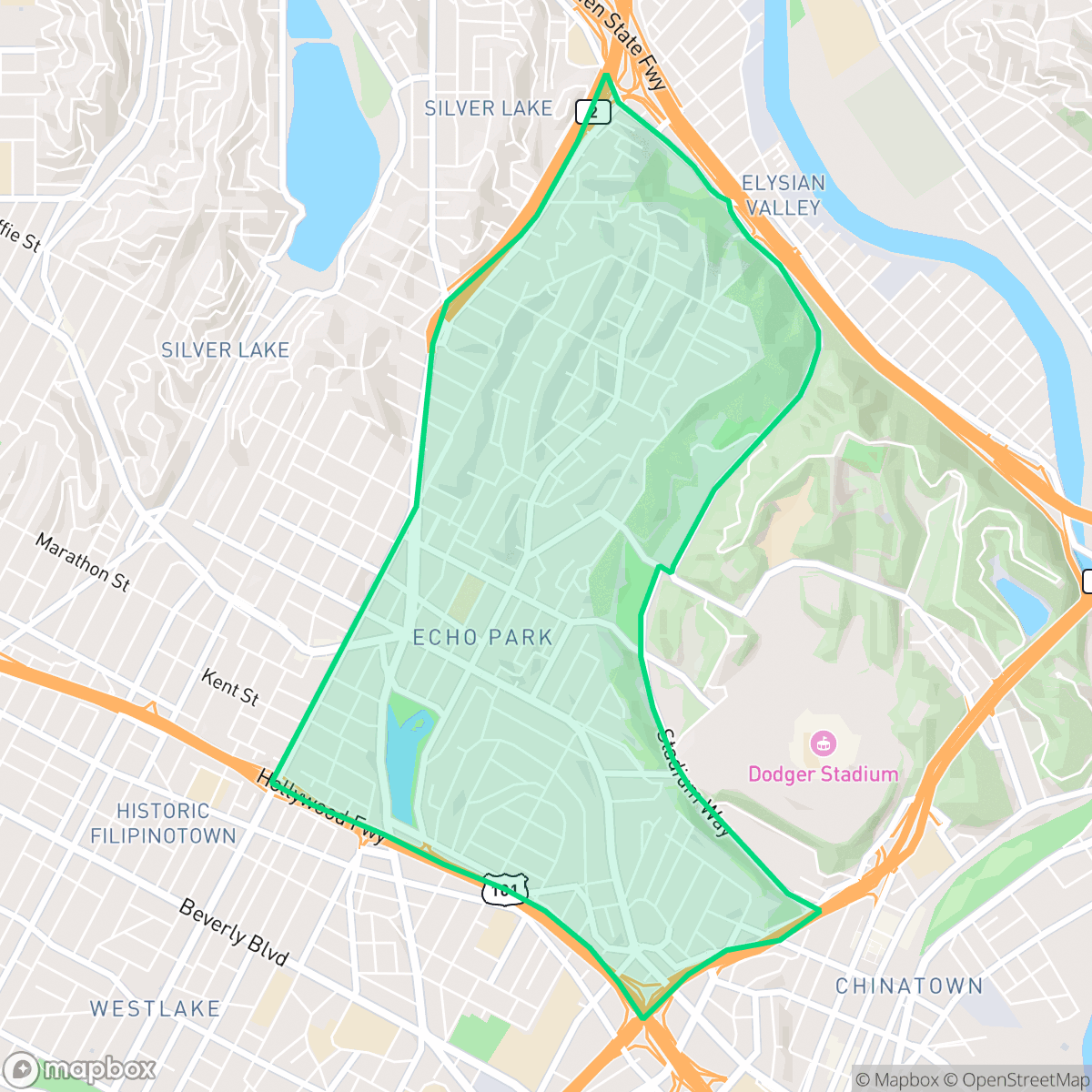
Established in the late 19th century northwest of Downtown Los Angeles, Echo Park developed around a drinking water reservoir built in 1868, which was landscaped and opened as Echo Park Lake in 1895. The neighborhood features Angelino Heights, the city’s first Historic Preservation Overlay Zone, celebrated for its high concentration of Victorian Queen Anne-style homes along Carroll Avenue. Long before Hollywood's rise, the area's Edendale district served as the cradle of West Coast filmmaking, hosting early silent film hubs like Mack Sennett’s Keystone Studios. Historically shaped by streetcar expansion and diverse Armenian, Mexican, and Filipino immigrant communities, Echo Park evolved into a prominent bohemian enclave. Today, it is recognized for its artistic culture, the historic Jensen’s Recreation Center, and iconic local music venues like The Echo.
The area is characterized by a dense, low-rise urban fabric that blends historic charm with a progressive, artistic culture. Residents benefit from consistent street grids and a central public park at the neighborhood lake, which serves as a primary hub for recreation and pet owners. The local dining and social scene is diverse, featuring popular spots like Guisados and Eightfold Coffee, while the architecture ranges from modest, tightly packed urban homes to the Victorian-era residences found in the historic Angelino Heights district.
Living in this community involves certain trade-offs, particularly regarding acoustic comfort and privacy. Due to the proximity of major freeway interchanges, road traffic noise is high, and the high-density layout means homes are often situated very close together. However, the neighborhood maintains high marks for air quality and access to reputable educational institutions, such as the Logan Academy of Global Ecology. It is best suited for those who prioritize cultural access and walkability over quiet, secluded living spaces.
Neighborhood Scores Across 15 Qualities
Closely packed housing and multi-unit buildings with minimal setbacks create a lack of individual private space. According to iHuus data, this level of density is slightly higher than the Los Angeles average.
Pedestrian transit is generally supported by a consistent sidewalk grid and marked crossings, though large highway interchanges and high-traffic corridors occasionally interrupt the network. While much of the area is accessible on foot, walking ease is slightly below the city average due to these fragmented zones.
Standard high-density housing and apartment blocks characterize the area, featuring modest yards and uniform roof structures. This landscape is slightly less visually varied than the Los Angeles average according to iHuus data.
Echo Park Lake and nearby sports fields provide significant green space for pet owners, making the area more dog friendly than the Los Angeles average. While many residential blocks feature narrow sidewalks and limited yards, the central public park offers substantial walking paths.
Residential streets and green spaces are balanced with significant infrastructure and paved surfaces. This environment is slightly less urbanized than the Los Angeles average, offering a blend of dense low-rise housing and accessible public parks according to iHuus data.
A mix of quiet residential streets and active commercial blocks creates a balanced atmosphere that is slightly more subdued than the Los Angeles average. Residents will find a steady presence of local dining and cafes, though access to amenities varies depending on proximity to the neighborhood's denser hubs.
Constant noise from heavy rail or nearby flight paths significantly impacts the area, making acoustic comfort much lower than the average for Los Angeles. Residents should expect persistent sound disturbances according to iHuus data.
Air quality remains consistently high with minimal health concerns, performing significantly better than the Los Angeles average according to iHuus data.
Industrial activity is nearly nonexistent here, offering a landscape primarily composed of residential and light commercial spaces. This lack of heavy industry and large warehouses makes the area significantly cleaner of industrial hazards than the Los Angeles average.
Health insurance coverage levels among residents are slightly above the Los Angeles average, according to iHuus data. This indicates a relatively high rate of insured individuals living in the area.
Voting patterns and census indicators reflect a highly liberal political leaning that is even more pronounced than the Los Angeles average, according to iHuus data.
A balanced mix of young professionals, families, and older residents characterizes the area, aligning with the broader Los Angeles demographic profile according to iHuus data.
Flood risk levels are higher than the Los Angeles average, though specific risk levels remain undetermined due to a lack of detailed FEMA studies for this area.
Extreme fire hazards characterize this area, representing a risk level that is higher than the Los Angeles average according to iHuus data.
Address-Level Insights for Echo Park


iHuus Neighborhood Intelligence Insights
Get address-level neighborhood insights for Echo Park
- Street-level scores — see how individual blocks compare, not just neighborhood averages
- Micro-zone boundaries — identify quiet pockets, flood boundaries, and walkable clusters before you visit
- 15 dimensions in full — walkability, noise, air quality, school quality, insurance coverage, population age profile, urban/rural index, and more
- Boundary risk alerts — know if your address sits near a block boundary where scores drop, the kind of detail no listing will ever mention
- School insights — individual school ratings and insights, not just district-level data
- Compare before you commit — side-by-side data across neighborhoods, down to block precision
No credit card required
Compare with Any Neighborhood
| Dimension | Echo Park | Adams-Normandie |
|---|---|---|
| 🚶 Walkabilityavg 8.9 | ||
| 🔊 Acoustic Comfortavg 2.91 | ||
| 🤫 Privacy Indexavg 4.14 | ||
| 🎨 Visual Appealavg 6.58 | ||
| 🐕 Dog Friendlinessavg 5.04 | ||
| 🗺️ Urban-Rural Indexavg 5.96 | ||
| ✨ Neighborhood Vibeavg 5.07 | ||
| 🏥 Health Insurance Coverageavg 6.2 | ||
| 🌿 Air Qualityavg 8.12 | ||
| 🏭 Industrial Proximityavg 8.46 | ||
| 🌊 Flood Safetyavg 2.66 | ||
| 🗳️ Ideological Leanavg 9.56 | ||
| 👥 Population Age Profileavg 4.85 | ||
| 🔥 Fire Safetyavg 0.18 | ||
| 🏫 School Quality |
Echo Park Rankings
School Districts Serving Echo Park
School Insights for Echo Park
Below average outcomes; significant attendance and academic challenges.
School Insights
See what's really behind every school rating near Echo Park
- Individual school ratings — each school's own score with outcome context, not just a district average
- Enrollment & class size data — student-to-teacher ratio and how it compares to the state average
- Full demographics breakdown — ethnicity and gender composition for every school in the enrollment zone
- Every school in the district — all schools within the enrollment boundary ranked by rating, not just the closest one
- Grade levels & benchmarks — elementary through high school, with below/above state-average flags
No credit card required