Eagle Rock, Los Angeles
Updated · 31,116 residents
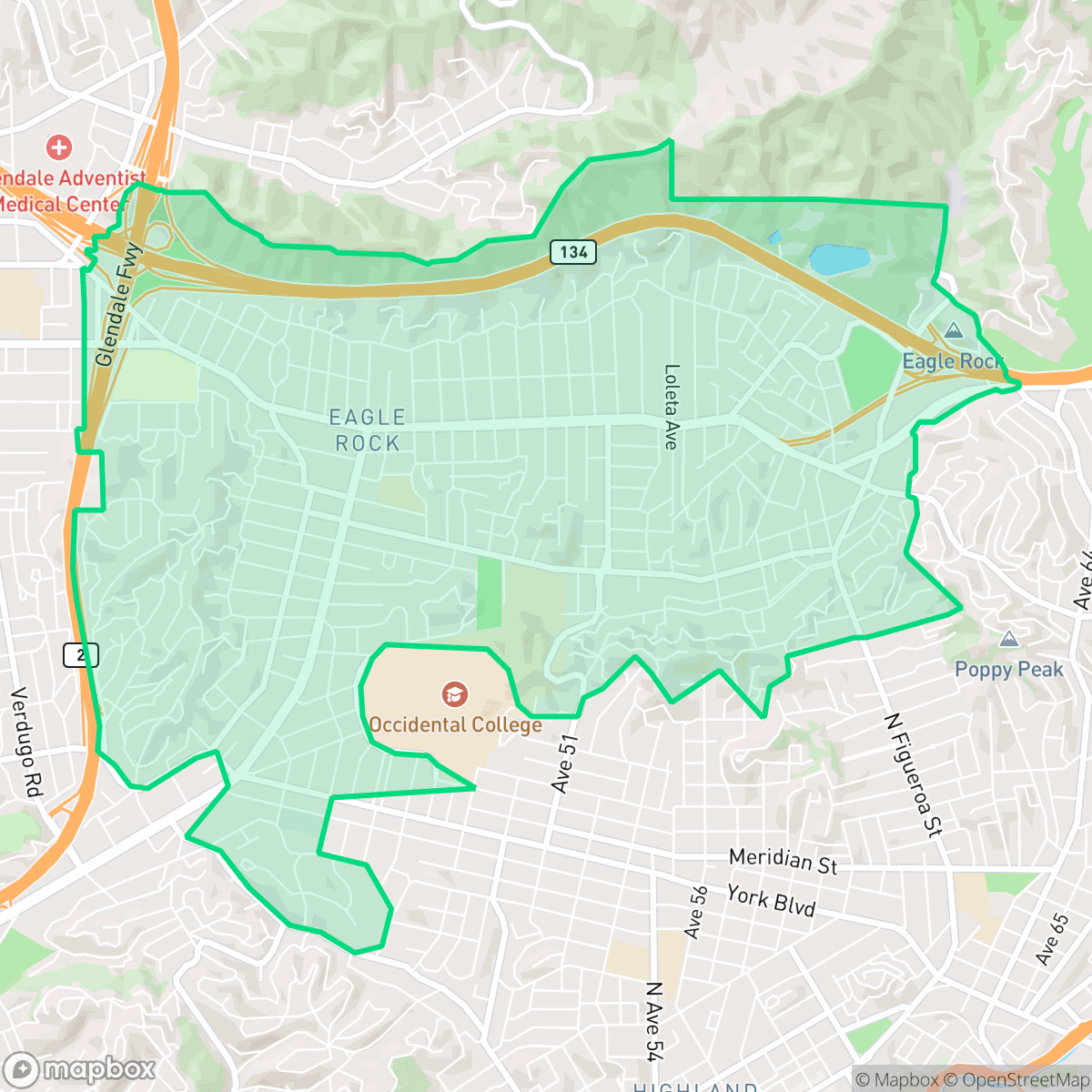
Eagle Rock is defined by its historic Craftsman bungalows, the Mediterranean-style Occidental College campus, and a dense, suburban atmosphere nestled in the hills of Northeast Los Angeles. The neighborhood offers a strong academic environment and excellent air quality, though residents should anticipate moderate noise levels from nearby highway traffic.
Key Highlights
About Eagle Rock
Named after a massive sandstone boulder whose shadow resembles an eagle in flight, Eagle Rock originated as a Tongva lookout before becoming part of Rancho San Rafael. It developed as a farming community in the 1880s, incorporated as an independent city in 1911, and was annexed by Los Angeles in 1923 to secure its water supply. The neighborhood’s architectural character is defined by Victorian farmhouses, Craftsman bungalows, and the Mediterranean Revival-style Occidental College campus, designed by architect Myron Hunt in 1914. The arrival of Henry Huntington’s Los Angeles Railway trolley line along Eagle Rock and Colorado Boulevards spurred rapid suburbanization. Remarkably, Eagle Rock is one of the few annexed areas to retain its original pre-annexation City Hall (built in 1922) and Carnegie Library.
The neighborhood functions as a distinct residential enclave in Northeast Los Angeles, characterized by a blend of historic housing stock and a vibrant, locally-focused commercial corridor along Colorado Boulevard. The area maintains a dense, suburban atmosphere where tree-lined streets and hilly terrain provide a sense of seclusion despite its proximity to major urban arteries. With highly-rated local schools and the presence of Occidental College, the community attracts families and professionals seeking a stable environment that balances suburban comfort with urban accessibility.
Prospective residents should note that while the area boasts excellent air quality and a strong sense of community, it is primarily a car-dependent environment with moderate noise levels stemming from surrounding freeway traffic. The housing density is typical for the region, offering a balance of privacy and close-knit residential blocks. While public green space is somewhat limited in certain pockets, the neighborhood's overall visual appeal, characterized by well-manicured properties and hillside vistas, makes it a desirable location for those prioritizing a quiet, well-established residential lifestyle within the city.
Neighborhood Scores Across 15 Qualities
Residential spacing varies from dense housing with shared walls to spacious hillside estates that provide more buffer. According to iHuus data, this level of privacy is notably higher than the average for Los Angeles.
A continuous network of sidewalks and marked crosswalks facilitates easy movement through residential and commercial zones. While the nearby freeway acts as a significant barrier to north-south transit, the neighborhood offers slightly lower walkability than the Los Angeles average due to the winding, hilly terrain in some sections.
Large residential lots with well-manicured landscaping and frequent private pools create a highly attractive streetscape. According to iHuus data, the presence of expansive homes and premium amenities makes the visual environment more upscale than the Los Angeles average.
Access to canyon-side trails and large parks provides more greenery for pets than the typical Los Angeles neighborhood. Wide residential parkways and nearby hillside paths offer consistent walking options according to iHuus data.
Suburban landscapes transition into hilly, wooded terrain with significant tree canopy and open natural spaces. This provides a more open environment than the typical Los Angeles urban core according to iHuus data.
A varied mix of quiet residential blocks and lively social hubs provides a higher level of activity than the city average. While diverse dining and local cafes are accessible, much of the neighborhood remains car-dependent and characterized by low-density greenery.
Frequent noise from nearby freeways and railroad tracks persists throughout the area. This level of acoustic disturbance is slightly higher than the average for Los Angeles.
Air quality remains consistently clear with only infrequent periods of elevated readings. According to iHuus data, these conditions are slightly better than the average found across Los Angeles.
Residential and light commercial uses dominate the landscape, with a notable absence of heavy industrial hazards or large warehouses. According to iHuus data, this area is significantly clearer of industrial facilities than the Los Angeles average.
Health insurance enrollment among residents is notably higher than the Los Angeles city average, according to iHuus data.
Voting patterns and census indicators show a predominantly liberal political landscape that is slightly more pronounced than the Los Angeles average, according to iHuus data.
A balanced variety of young adults, families, and older residents defines the local demographic. This distribution is slightly more varied than the average seen across Los Angeles, according to iHuus data.
Flood risk levels in Eagle Rock are higher than the Los Angeles average, though official FEMA studies for this specific area remain incomplete. Residents should remain aware of potential drainage concerns during heavy rain events.
Extreme fire hazards are present in this area, representing a significantly higher risk than the average Los Angeles neighborhood. Residents should maintain maximum protection measures and stay informed on local fire safety protocols according to iHuus data.
Address-Level Insights for Eagle Rock


iHuus Neighborhood Intelligence Insights
Get address-level neighborhood insights for Eagle Rock
- Street-level scores — see how individual blocks compare, not just neighborhood averages
- Micro-zone boundaries — identify quiet pockets, flood boundaries, and walkable clusters before you visit
- 15 dimensions in full — walkability, noise, air quality, school quality, insurance coverage, population age profile, urban/rural index, and more
- Boundary risk alerts — know if your address sits near a block boundary where scores drop, the kind of detail no listing will ever mention
- School insights — individual school ratings and insights, not just district-level data
- Compare before you commit — side-by-side data across neighborhoods, down to block precision
No credit card required
Compare with Any Neighborhood
| Dimension | Eagle Rock | Adams-Normandie |
|---|---|---|
| 🚶 Walkabilityavg 8.9 | ||
| 🔊 Acoustic Comfortavg 2.91 | ||
| 🤫 Privacy Indexavg 4.14 | ||
| 🎨 Visual Appealavg 6.58 | ||
| 🐕 Dog Friendlinessavg 5.04 | ||
| 🗺️ Urban-Rural Indexavg 5.96 | ||
| ✨ Neighborhood Vibeavg 5.07 | ||
| 🏥 Health Insurance Coverageavg 6.2 | ||
| 🌿 Air Qualityavg 8.12 | ||
| 🏭 Industrial Proximityavg 8.46 | ||
| 🌊 Flood Safetyavg 2.66 | ||
| 🗳️ Ideological Leanavg 9.56 | ||
| 👥 Population Age Profileavg 4.85 | ||
| 🔥 Fire Safetyavg 0.18 | ||
| 🏫 School Quality |
Eagle Rock Rankings
School Districts Serving Eagle Rock
School Insights for Eagle Rock
Below average outcomes; significant attendance and academic challenges.
School Insights
See what's really behind every school rating near Eagle Rock
- Individual school ratings — each school's own score with outcome context, not just a district average
- Enrollment & class size data — student-to-teacher ratio and how it compares to the state average
- Full demographics breakdown — ethnicity and gender composition for every school in the enrollment zone
- Every school in the district — all schools within the enrollment boundary ranked by rating, not just the closest one
- Grade levels & benchmarks — elementary through high school, with below/above state-average flags
No credit card required