Downtown, Los Angeles
Updated · 40,985 residents
Downtown Los Angeles is a high-energy urban hub defined by its dense grid of skyscrapers and vibrant cultural scene. While it offers exceptional walkability and high air quality, residents should anticipate a noisy environment with minimal private space and limited access to green areas.
Key Highlights
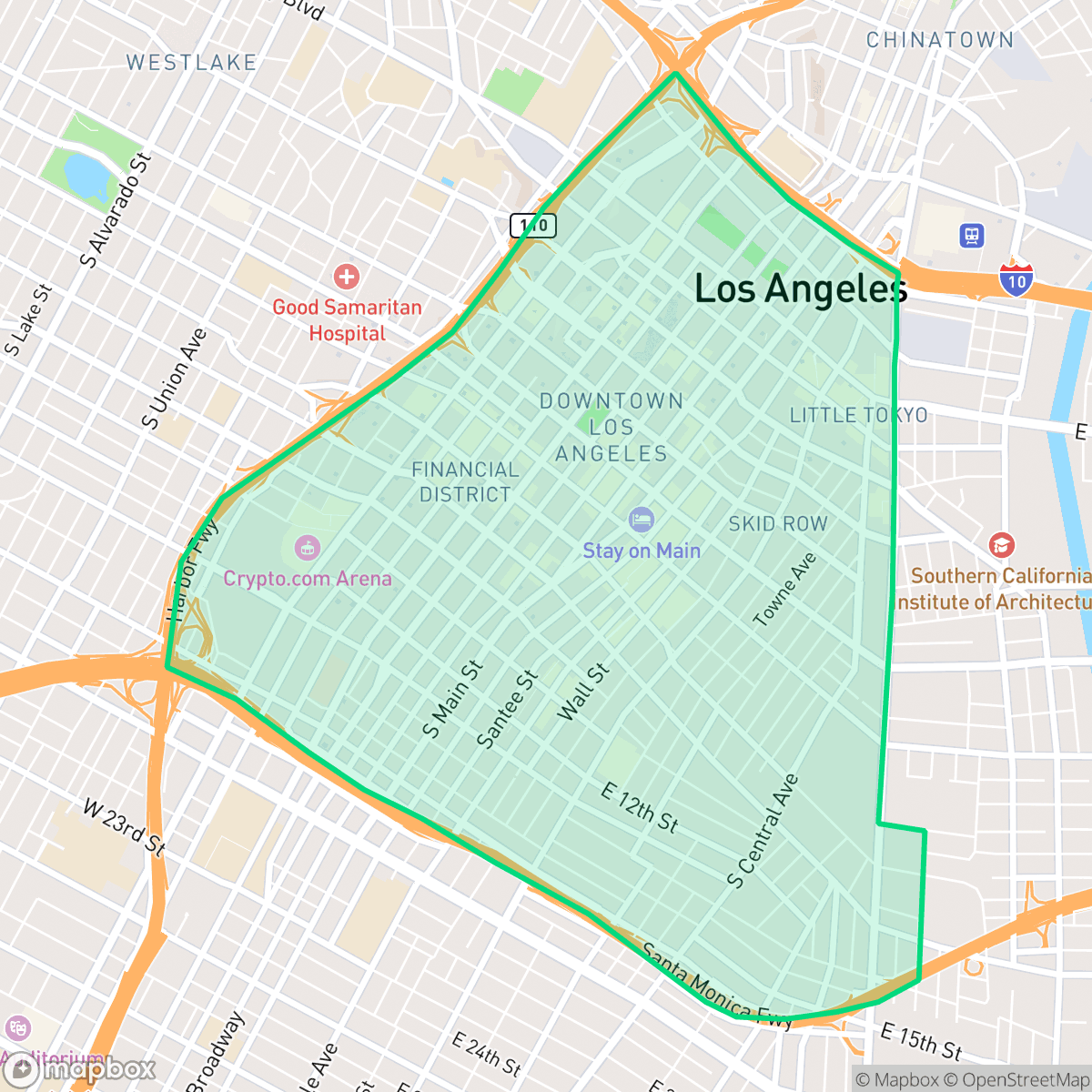
About Downtown
Downtown Los Angeles, established in 1781 as the original site of the city, evolved from a Spanish pueblo into a bustling commercial hub by the early 20th century. The neighborhood is renowned for its dense concentration of historic architecture, featuring prominent Beaux-Arts, Art Deco, and Streamline Moderne structures like the Bradbury Building and the Eastern Columbia Building. The area underwent significant transformation during the mid-20th century, notably the extensive urban renewal project on Bunker Hill that replaced Victorian-era residences with modern skyscrapers. Key landmarks, including the historic Broadway Theater District, Grand Central Market, and the 1939 Union Station, define its cultural character. Today, Downtown remains a vital center for civic life, blending its rich industrial and commercial past with ongoing revitalization efforts that preserve its unique urban fabric.
As the city's primary center for civic and commercial life, the area offers a high-energy environment filled with diverse dining, art galleries, and social hubs. The neighborhood is characterized by a dense network of wide sidewalks and frequent crosswalks, making it one of the most walkable parts of the region. This urban core features a mix of corporate towers and residential blocks that foster a lively, progressive atmosphere, attracting a wide range of residents from young professionals to long-term city dwellers.
Living in this dense urban environment involves specific trade-offs. The lack of private outdoor space and limited park access makes it less ideal for pet owners, while the proximity to major freeways and rail lines creates a constant, audible background of city noise. According to iHuus data, the area also faces challenges regarding flood risk and local healthcare access. Despite these factors, the neighborhood remains a compelling choice for those who prioritize immediate access to city amenities and a lifestyle that minimizes reliance on a vehicle.
Neighborhood Scores Across 15 Qualities
High building density and shared walls result in minimal separation between structures. According to iHuus data, this lack of individual private space is significantly lower than the Los Angeles average.
A dense network of wide sidewalks and frequent crosswalks makes most errands easy to complete on foot. This level of pedestrian infrastructure is slightly above the Los Angeles average, though large freeway interchanges occasionally interrupt the continuity of the grid.
High-density architecture, including corporate skyscrapers and large apartment blocks, defines the skyline. This urban landscape lacks private estates or expansive greenery and sits below the city average for visual appeal.
Extremely dense concrete and asphalt surfaces dominate the landscape, offering very few grass verges or accessible parks for pets. This lack of greenery makes the area significantly less dog friendly than the Los Angeles average.
Extensive grey infrastructure, high-rise buildings, and massive freeway interchanges dominate the landscape with very little vegetation. This area represents a much more concentrated urban environment than the Los Angeles average.
Dense high-rise developments and a wide variety of dining, galleries, and social hubs create an atmosphere significantly more vibrant than the city average. While the area offers extensive amenities and diverse local destinations, the heavy presence of industrial corridors and highways can make some blocks less walkable.
Constant auditory disturbances from nearby freeways and rail lines characterize this area. According to iHuus data, acoustic comfort is notably lower than the city average.
Air quality remains consistently high with minimal health concerns for residents. According to iHuus data, the air quality in this area is significantly cleaner than the Los Angeles average.
Limited heavy industry and hazardous warehouses characterize this area, though some logistics-related noise and truck activity exist near the periphery. This level of industrial proximity is slightly lower than the city average due to the presence of certain distribution centers and warehouse hubs.
Health insurance access is significantly lower here than the city average, according to iHuus data. Residents may face challenges accessing employer-sponsored or private medical plans within the immediate area.
Voting patterns and census indicators reflect a highly progressive political landscape that is slightly more liberal than the Los Angeles average.
Residents live alongside a balanced variety of young professionals, families, and seniors. This demographic spread is slightly more varied than the average found across Los Angeles.
Flood risk in this area is significantly higher than the Los Angeles average. Residents should anticipate much higher insurance premiums and potential challenges related to coastal hazards.
Address-Level Insights for Downtown


iHuus Neighborhood Intelligence Insights
Get address-level neighborhood insights for Downtown
- Street-level scores — see how individual blocks compare, not just neighborhood averages
- Micro-zone boundaries — identify quiet pockets, flood boundaries, and walkable clusters before you visit
- 15 dimensions in full — walkability, noise, air quality, school quality, insurance coverage, population age profile, urban/rural index, and more
- Boundary risk alerts — know if your address sits near a block boundary where scores drop, the kind of detail no listing will ever mention
- School insights — individual school ratings and insights, not just district-level data
- Compare before you commit — side-by-side data across neighborhoods, down to block precision
No credit card required
Compare with Any Neighborhood
| Dimension | Downtown | Adams-Normandie |
|---|---|---|
| 🚶 Walkabilityavg 8.9 | ||
| 🔊 Acoustic Comfortavg 2.91 | ||
| 🤫 Privacy Indexavg 4.14 | ||
| 🎨 Visual Appealavg 6.58 | ||
| 🐕 Dog Friendlinessavg 5.04 | ||
| 🗺️ Urban-Rural Indexavg 5.96 | ||
| ✨ Neighborhood Vibeavg 5.07 | ||
| 🏥 Health Insurance Coverageavg 6.2 | ||
| 🌿 Air Qualityavg 8.12 | ||
| 🏭 Industrial Proximityavg 8.46 | ||
| 🌊 Flood Safetyavg 2.66 | ||
| 🗳️ Ideological Leanavg 9.56 | ||
| 👥 Population Age Profileavg 4.85 | ||
| 🔥 Fire Safetyavg 0.18 | ||
| 🏫 School Quality |
Downtown Rankings
School Districts Serving Downtown
School Insights for Downtown
Below average outcomes; significant attendance and academic challenges.
School Insights
See what's really behind every school rating near Downtown
- Individual school ratings — each school's own score with outcome context, not just a district average
- Enrollment & class size data — student-to-teacher ratio and how it compares to the state average
- Full demographics breakdown — ethnicity and gender composition for every school in the enrollment zone
- Every school in the district — all schools within the enrollment boundary ranked by rating, not just the closest one
- Grade levels & benchmarks — elementary through high school, with below/above state-average flags
No credit card required