Del Rey, Los Angeles
Updated · 29,799 residents
Del Rey is a dense Westside Los Angeles neighborhood characterized by its grid-based street layout and proximity to major transit arteries. Residents benefit from high health insurance coverage and access to several top-rated public schools, though the area experiences notable road traffic noise and limited residential privacy due to closely spaced housing.
Key Highlights
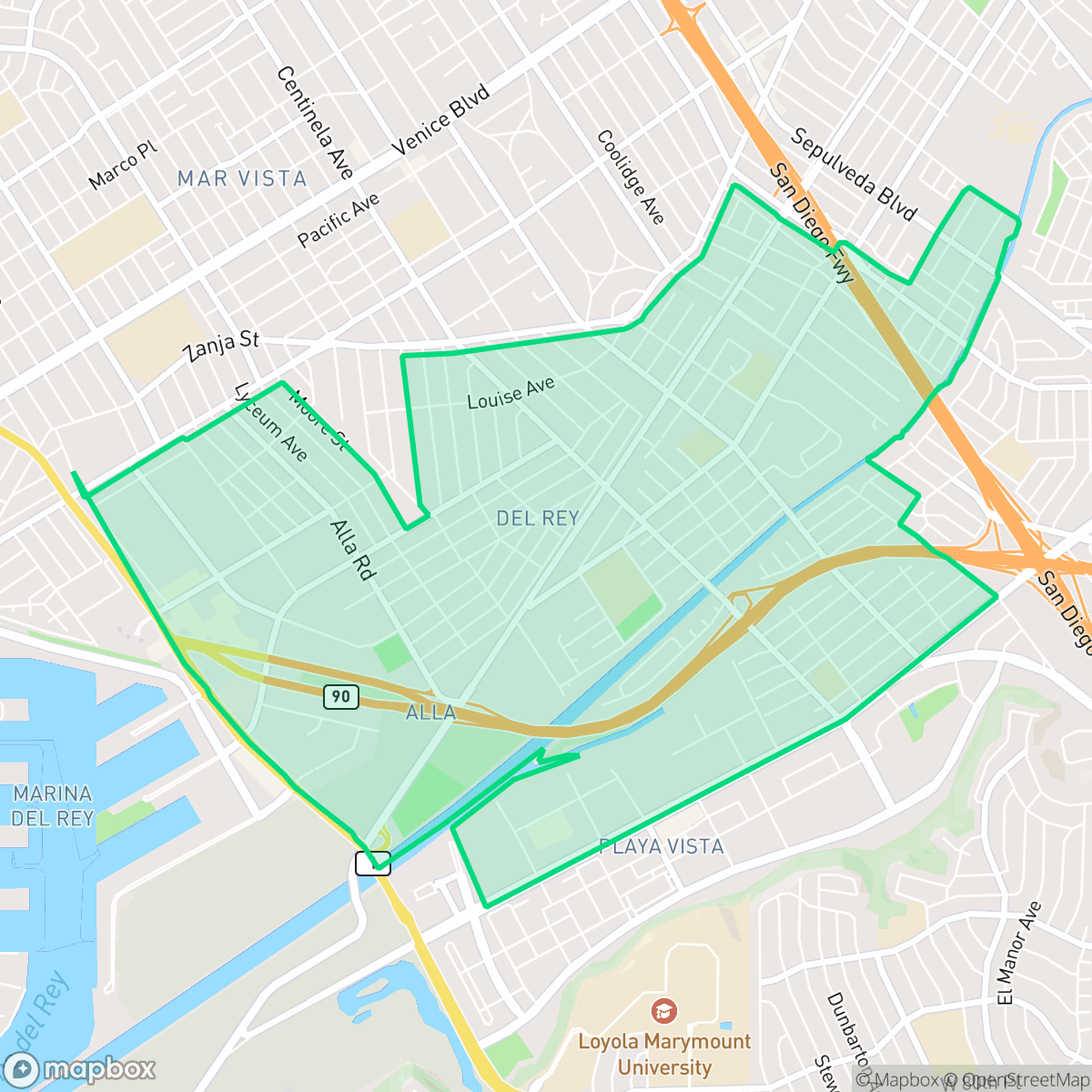
About Del Rey
Del Rey, a Westside Los Angeles neighborhood, developed in 1902 following the establishment of the Redondo Beach via Playa del Rey streetcar line. Historically an agricultural hub, it was defined by dairy farms and market gardens famous for summer celery crops. In the 1930s, Del Rey’s diverse makeup of Mexican-American and Japanese-American residents led to low Federal Housing Administration ratings due to a lack of enforced racial segregation; during World War II, many Japanese-American residents were forcibly interned. The neighborhood transformed rapidly in the 1940s with the arrival of Hughes Aircraft and the paving of Ballona Creek, sparking a post-war housing boom of single-story homes. Today, the former streetcar line is preserved as the Culver Boulevard Median Bike Path, and the neighborhood remains celebrated as one of the Westside's most ethnically diverse communities.
The area functions as a dense suburban-urban hybrid, blending single-family tracts with multi-family apartment complexes. Its street network is highly walkable, featuring consistent sidewalks that connect residential blocks to local dining and wellness services. While the neighborhood lacks large public parks, the presence of green spaces near local schools and the Culver Boulevard Median Bike Path offer necessary outdoor access for residents. The community maintains a steady rhythm of life, supported by a diverse array of small businesses and proximity to major employment hubs in the surrounding Westside.
Prospective residents should note that the neighborhood is subject to significant road traffic noise, which is a primary factor in its acoustic environment. The housing stock is tightly packed, resulting in limited yard space and reduced privacy between neighboring structures. Despite these trade-offs, the area remains a stable choice for those seeking high health insurance coverage and access to high-performing educational institutions like Short Avenue Elementary and ICEF Vista Academy. It is well-suited for individuals who prioritize a central location and walkability over quietude or expansive private outdoor space.
Neighborhood Scores Across 15 Qualities
Residential spacing is roughly in line with the city average, featuring a mix of multi-family buildings and single-family homes with varying distances between structures. Some areas contain closely packed housing and shared walls, which may reduce the sense of separation between neighbors.
Continuous sidewalks and frequent crosswalks make most errands easy to complete on foot. According to iHuus data, the sidewalk network is more complete and accessible than the average for Los Angeles.
A mix of medium-density apartments and modest tract housing defines the area, offering a landscape of uniform rooftops and small yards. The visual variety is slightly below the Los Angeles average, as many residential blocks feature tightly packed bungalows and shared community amenities rather than expansive private greenery.
Access to walking space is generally adequate due to a central public park and consistent sidewalk verges, making it slightly more dog friendly than the Los Angeles average. While some residential pockets feature narrower street verges and rely more on private yards, many areas offer accessible green trails and parkway strips for pets.
A blend of multi-story apartment complexes and single-family homes creates a landscape that is slightly more open than the Los Angeles average. According to iHuus data, the area features a notable presence of larger commercial footprints alongside dense residential pockets.
A steady, subdued atmosphere prevails throughout the area, characterized by a mix of suburban greenery and light industrial pockets. While several dining and wellness spots are accessible via walkable paths, the overall level of activity is slightly below the Los Angeles average.
Frequent disturbances from nearby freeway traffic and flight paths contribute to significant acoustic noise. This level of ambient sound is notably higher than the Los Angeles average, according to iHuus data.
Air quality is generally high with rare instances of elevated readings. This level of cleanliness is roughly in line with the Los Angeles average, according to iHuus data.
Most of the area remains primarily residential and light commercial with very few heavy industrial hazards. Some larger warehouses and storage yards are located near the edges of the neighborhood, though the overall level of industrial activity is slightly below the Los Angeles average.
Health insurance accessibility is notably higher than the Los Angeles average, according to iHuus data. Most residents in this area possess active health coverage.
Voting patterns and census indicators show a predominantly liberal leaning, which is slightly more pronounced than the Los Angeles city average.
Residents live alongside a balanced mix of young professionals, families, and older adults. This age distribution is slightly more varied than the average seen across Los Angeles.
Flood risk in this area is higher than the Los Angeles average, though a lack of detailed FEMA studies means the precise level of exposure remains undetermined. According to iHuus data, residents should maintain awareness of local drainage patterns during heavy rain events.
Address-Level Insights for Del Rey


iHuus Neighborhood Intelligence Insights
Get address-level neighborhood insights for Del Rey
- Street-level scores — see how individual blocks compare, not just neighborhood averages
- Micro-zone boundaries — identify quiet pockets, flood boundaries, and walkable clusters before you visit
- 15 dimensions in full — walkability, noise, air quality, school quality, insurance coverage, population age profile, urban/rural index, and more
- Boundary risk alerts — know if your address sits near a block boundary where scores drop, the kind of detail no listing will ever mention
- School insights — individual school ratings and insights, not just district-level data
- Compare before you commit — side-by-side data across neighborhoods, down to block precision
No credit card required
Compare with Any Neighborhood
| Dimension | Del Rey | Adams-Normandie |
|---|---|---|
| 🚶 Walkabilityavg 8.9 | ||
| 🔊 Acoustic Comfortavg 2.91 | ||
| 🤫 Privacy Indexavg 4.14 | ||
| 🎨 Visual Appealavg 6.58 | ||
| 🐕 Dog Friendlinessavg 5.04 | ||
| 🗺️ Urban-Rural Indexavg 5.96 | ||
| ✨ Neighborhood Vibeavg 5.07 | ||
| 🏥 Health Insurance Coverageavg 6.2 | ||
| 🌿 Air Qualityavg 8.12 | ||
| 🏭 Industrial Proximityavg 8.46 | ||
| 🌊 Flood Safetyavg 2.66 | ||
| 🗳️ Ideological Leanavg 9.56 | ||
| 👥 Population Age Profileavg 4.85 | ||
| 🔥 Fire Safetyavg 0.18 | ||
| 🏫 School Quality |
Del Rey Rankings
School Districts Serving Del Rey
School Insights for Del Rey
Below average outcomes; significant attendance and academic challenges.
School Insights
See what's really behind every school rating near Del Rey
- Individual school ratings — each school's own score with outcome context, not just a district average
- Enrollment & class size data — student-to-teacher ratio and how it compares to the state average
- Full demographics breakdown — ethnicity and gender composition for every school in the enrollment zone
- Every school in the district — all schools within the enrollment boundary ranked by rating, not just the closest one
- Grade levels & benchmarks — elementary through high school, with below/above state-average flags
No credit card required