Cypress Park, Los Angeles
Updated · 9,837 residents
Cypress Park is a dense, historically significant neighborhood defined by its Craftsman-style homes and proximity to the Los Angeles River. While the area offers a highly walkable grid and convenient access to local parks, residents should be prepared for significant road noise and tightly packed housing conditions.
Key Highlights
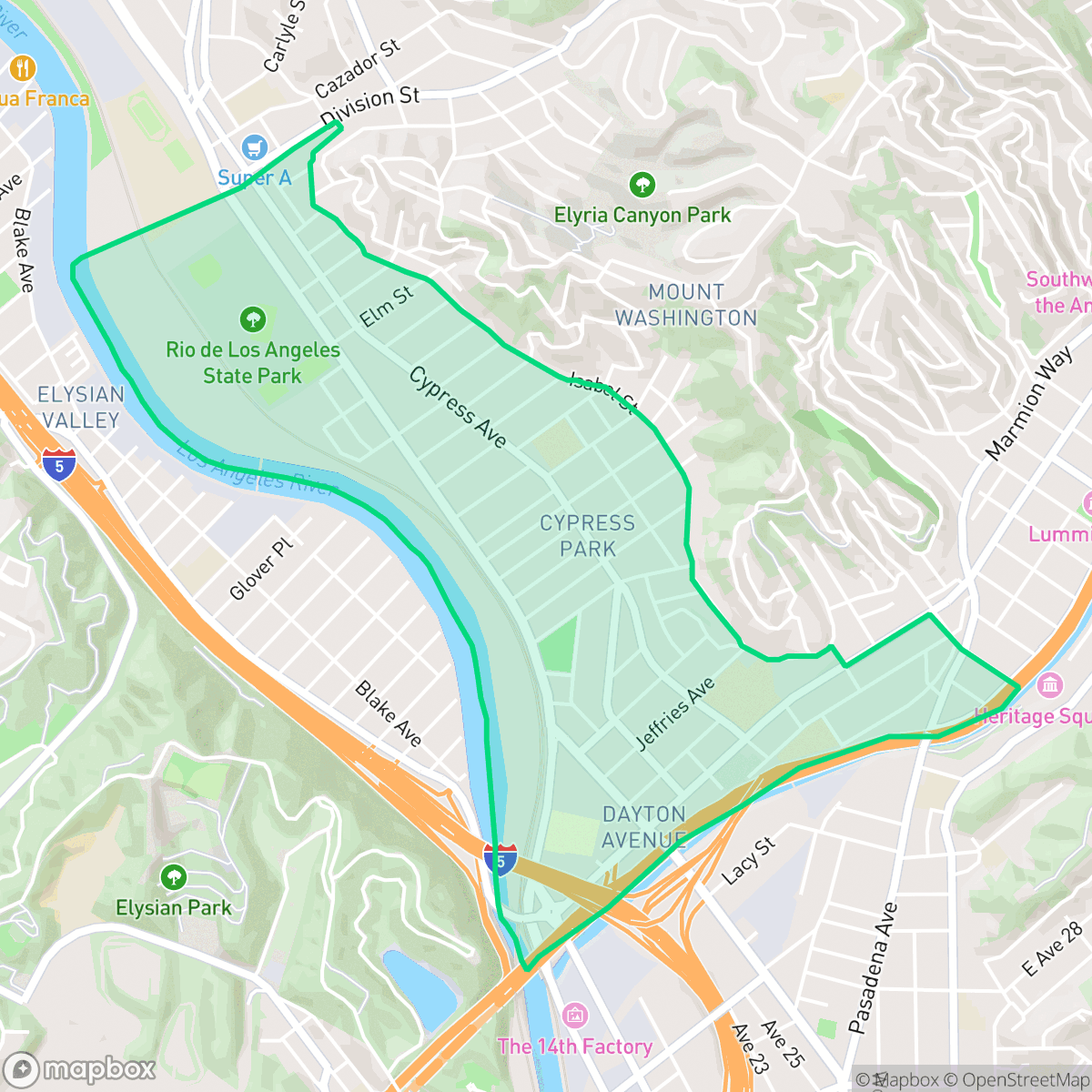
About Cypress Park
Nestled at the confluence of the Los Angeles River and the Arroyo Seco, Cypress Park was originally part of Rancho San Rafael. Following the death of landowner Jessie D. Hunter, the area was subdivided in 1882, establishing it as the first of the Arroyo Seco streetcar communities. Early development was heavily shaped by the prominent Jeffries family, who settled in the 1880s and inspired the Jeffries-Cypress Residential Historic District, renowned for its intact 1900s Craftsman-style homes. Historically a working-class neighborhood, Cypress Park is home to several Los Angeles Historic-Cultural Monuments. These include the 1906 Huron Substation, which powered the city's Yellow Car railway system, and the 1926 New England Colonial Revival-style Richard Henry Dana library branch. Today, the former Taylor Yard railway facility has been reclaimed as the Rio de Los Angeles State Park.
The neighborhood functions as a quiet, low-density urban enclave that balances residential life with light industrial activity. According to iHuus data, the area features a consistent grid of streets and sidewalks that support pedestrian movement, though the proximity to major transit corridors and warehouses results in notable acoustic challenges. Residents benefit from the nearby Rio de Los Angeles State Park, which provides essential green space, though the overall visual landscape remains dominated by standard tract housing with limited private yard space. For prospective residents, the area offers a distinct, politically progressive community atmosphere that is well-suited for those who prioritize neighborhood connectivity over absolute quiet. While the local school district faces systemic challenges, the neighborhood remains a practical choice for individuals who value proximity to central Los Angeles landmarks and a well-connected street network. The primary trade-off for this accessibility includes a high level of ambient traffic noise and limited privacy due to the close proximity of neighboring homes.
Neighborhood Scores Across 15 Qualities
Residential spacing is somewhat dense with houses frequently situated near shared property lines; however, some distance between neighbors is maintained in the hillside areas. This level of privacy is slightly higher than the average for Los Angeles.
A consistent sidewalk network and clear crosswalks define much of the residential grid, though major freeway corridors and industrial zones can interrupt pedestrian continuity. While the area is highly navigable, walkability is slightly below the Los Angeles average due to these large-scale infrastructure barriers.
Uniform tract housing and industrial warehouses define the landscape, resulting in a visual profile that is slightly below the Los Angeles average. Residential lots are typically small with simple roof geometries and very few private pools visible.
Accessible green spaces and nearby hillside parkland provide more opportunities for pet exercise than the city average. While some industrial zones lack grass verges, several areas feature large public parks and natural terrain suitable for dog walking.
Open land and scattered greenery provide a slightly more open feel than the typical Los Angeles urban landscape. According to iHuus data, the area features a mix of residential pockets interspersed with significant park space and undeveloped lots.
Low levels of social activity and limited pedestrian-friendly amenities make this area feel more functional than vibrant. Most daily needs require a vehicle, as the landscape is primarily composed of quiet, industrial, and suburban pockets that lack a dense concentration of walkable businesses.
Constant auditory disturbances from nearby heavy rail or airport flight paths make this area significantly noisier than most of Los Angeles. According to iHuus data, acoustic comfort is notably lower than the city average.
Air quality in this area remains consistently clean with rare instances of elevated readings. This level of air purity is on par with the rest of Los Angeles.
Large warehouses and transit corridors along the southern section introduce more industrial activity than is typical for Los Angeles. While much of the area remains residential, proximity to major rail lines and highways can result in increased noise and heavy vehicle traffic.
Health insurance accessibility is below the Los Angeles average, according to iHuus data. Residents may find fewer options for employer-sponsored coverage within the immediate area.
Voting patterns and census indicators show a highly liberal political leaning that is slightly more pronounced than the Los Angeles average.
A balanced mix of young adults, families, and older residents characterizes the local demographic. According to iHuus data, this distribution is largely consistent with the broader Los Angeles area.
Significant flood risk exists due to the area's location within a 100-year floodplain, which is comparable to the broader Los Angeles area. Residents should be aware that flood insurance is typically required for properties in this zone according to iHuus data.
Fire hazards in this area are significantly higher than the Los Angeles average, necessitating extreme precautions and maximum protection measures. According to iHuus data, the neighborhood faces a critical level of wildfire vulnerability.
Address-Level Insights for Cypress Park


iHuus Neighborhood Intelligence Insights
Get address-level neighborhood insights for Cypress Park
- Street-level scores — see how individual blocks compare, not just neighborhood averages
- Micro-zone boundaries — identify quiet pockets, flood boundaries, and walkable clusters before you visit
- 15 dimensions in full — walkability, noise, air quality, school quality, insurance coverage, population age profile, urban/rural index, and more
- Boundary risk alerts — know if your address sits near a block boundary where scores drop, the kind of detail no listing will ever mention
- School insights — individual school ratings and insights, not just district-level data
- Compare before you commit — side-by-side data across neighborhoods, down to block precision
No credit card required
Compare with Any Neighborhood
| Dimension | Cypress Park | Adams-Normandie |
|---|---|---|
| 🚶 Walkabilityavg 8.9 | ||
| 🔊 Acoustic Comfortavg 2.91 | ||
| 🤫 Privacy Indexavg 4.14 | ||
| 🎨 Visual Appealavg 6.58 | ||
| 🐕 Dog Friendlinessavg 5.04 | ||
| 🗺️ Urban-Rural Indexavg 5.96 | ||
| ✨ Neighborhood Vibeavg 5.07 | ||
| 🏥 Health Insurance Coverageavg 6.2 | ||
| 🌿 Air Qualityavg 8.12 | ||
| 🏭 Industrial Proximityavg 8.46 | ||
| 🌊 Flood Safetyavg 2.66 | ||
| 🗳️ Ideological Leanavg 9.56 | ||
| 👥 Population Age Profileavg 4.85 | ||
| 🔥 Fire Safetyavg 0.18 | ||
| 🏫 School Quality |
Cypress Park Rankings
School Districts Serving Cypress Park
School Insights for Cypress Park
Below average outcomes; significant attendance and academic challenges.
School Insights
See what's really behind every school rating near Cypress Park
- Individual school ratings — each school's own score with outcome context, not just a district average
- Enrollment & class size data — student-to-teacher ratio and how it compares to the state average
- Full demographics breakdown — ethnicity and gender composition for every school in the enrollment zone
- Every school in the district — all schools within the enrollment boundary ranked by rating, not just the closest one
- Grade levels & benchmarks — elementary through high school, with below/above state-average flags
No credit card required